
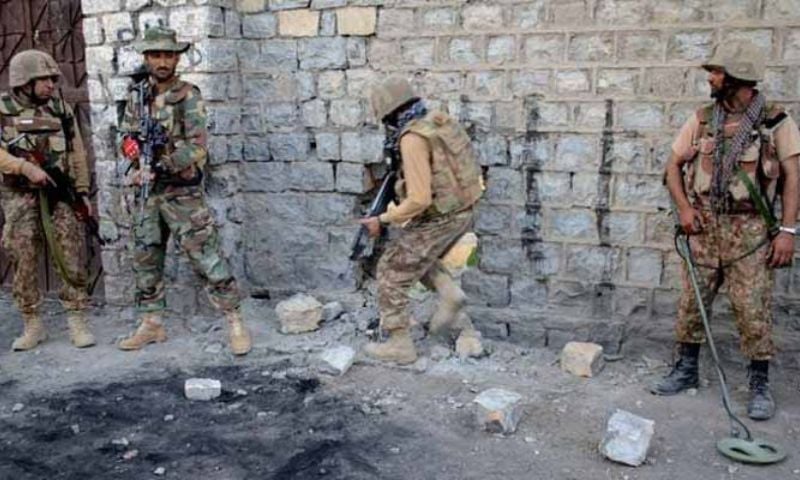
ISLAMABAD: Pakistan’s security forces have killed 32 Indian-backed terrorists during counter terrorism operations in Khyber Pakhtunkhwa and Balochistan provinces over the last 24 hours, the military’s media wing said in a statement on Wednesday.
In continuation of security forces operations against the terrorists’ nexus of Indian sponsored Fitna al Khwarij and Fitna al Hindustan, comprehensive joint operations are being carried out in different parts of the two provinces to weed out terrorists and their facilitators, the Inter-Services Public Relations (ISPR) said.
The state uses the term Fitna-al-Khawarij for the banned Tehreek-i-Taliban Pakistan (TTP) and has designated Balochistan-based terrorist groups as Fitna-al-Hindustan to highlight India’s role in terrorism across Pakistan.
In continuation of security forces operations against the terrorists nexus of Indian sponsored Fitna al Khwarij and Fitna al Hindustan, comprehensive joint operations are being carried in different parts of Khyber Pukhtunkhwa & Balochistan to weed out terrorists and their…
— DG ISPR (@OfficialDGISPR) July 29, 2026
“In the last 24 hours, security forces have successfully eliminated thirty-two terrorists of these Indian proxies,” ISPR said.
Multiple “intelligence-based area sanitisation and targeted operations” were conducted in KP’s Khyber on July 28 and 29, during which 24 terrorists belonging to Fitna-al-Khawarij were killed, it said.
Meanwhile, eight terrorists belonging to Fitna-al-Hindustan were killed after an “intense engagement” in Balochistan’s Nushki during multiple intelligence-based operations, ISPR added.
“Weapons, ammunition and improvised explosive devices used by terrorists were also recovered and destroyed during the operations,” it said.
Sanitisation operations underway to eliminate any other terrorist
“Sanitisation operations are being conducted to eliminate any other India-sponsored terrorist found in the area. Relentless counter-terrorism campaign under the vision ‘Azm-i-Istehkam’ (as approved by Federal Apex Committee on National Action Plan) by security forces and law enforcement agencies of Pakistan will continue at full pace to wipe out the menace of foreign-sponsored and supported terrorism from the country,” the ISPR statement read.
Earlier this month, security forces and law enforcement personnel jointly launched Operation Shaban in Balochistan in retaliation for a deadly attack on a police post at the Mangi Dam pumping station in Ziarat on July 6. During that assault, armed attackers kidnapped and killed 27 police officers.
Later, security forces also launched Operation Al-Azm in the province after a shooting on a Karachi-bound coach coming from Quetta claimed three lives and injured five others last week.

President, PM laud security forces
President Asif Ali Zardari and Prime Minister Shehbaz Sharif have commended the security forces and law enforcement agencies for conducting successful intelligence-based operations in Khyber Pakhtunkhwa and Balochistan.
In separate statements, the two leaders praised the professionalism of the security forces, saying they had eliminated 32 terrorists of Fitna-ul-Khawarij and Fitna-ul-Hindustan.
President Zardari said Pakistan would thwart the designs of terrorist groups backed by India and reaffirmed the country’s commitment to safeguarding its peace, stability and sovereignty through national unity and the capabilities of its security forces.
Prime Minister Shehbaz Sharif said the campaign against terrorism would continue until the threat is eliminated, adding that the nation stands firmly behind the armed forces in their efforts to defend the country.
Pakistan witnesses surge in terror activities
Pakistan witnessed a surge in terror activities, particularly in its Khyber Pakhtunkhwa and Balochistan provinces, since 2021, when the Afghan Taliban came into power.
A monthly security assessment published in early June by the Pakistan Institute for Conflict and Security Studies (PICSS) reported that Pakistan’s security situation deteriorated sharply in May after showing improvement over the previous two months. The decline was attributed mainly to a surge in terrorist violence in Khyber Pakhtunkhwa and Balochistan.
According to the report, Balochistan was the worst-affected province, recording 71 terrorist attacks in May, up from 34 in April—a 109 per cent increase.