Key Points
• China remained the largest buyer of Pakistani seafood products
• Russia opened its market to Pakistani seafood exporters for the first time
• Authorities plan a major seafood processing and export zone in Karachi
• Industry leaders see potential for exports to approach $600 million next year
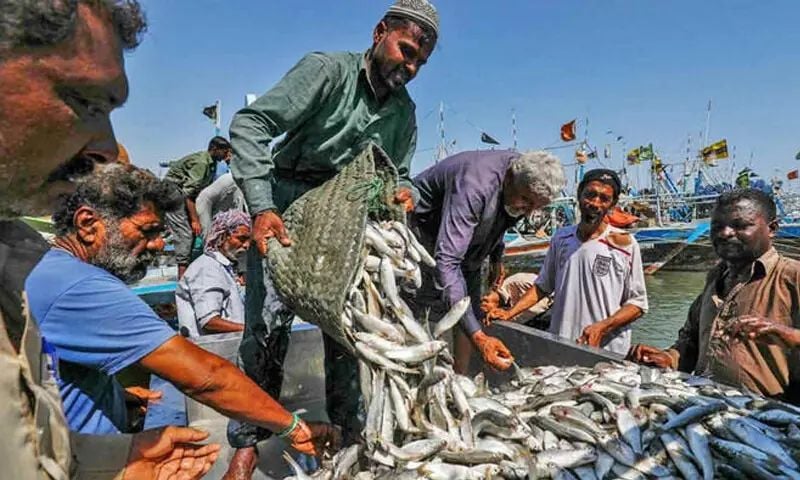
ISLAMABAD: Pakistan’s exports of fish and fisheries products have crossed the historic $500 million mark for the first time, marking a breakthrough for the country’s maritime economy and export diversification.
Federal Minister for Maritime Affairs Muhammad Junaid Anwar Chaudhry said the milestone was achieved 46 days before the close of the current fiscal year. He attributed the performance to reforms in the fisheries sector, expansion into new international markets and improvements in export facilitation and quality compliance.
Asim Abrar, Chief Executive Officer of Seagreen Enterprises and Chairman of the Korangi Fisheries Harbour Authority under the Ministry of Maritime Affairs, described the achievement as the “highest-ever seafood export figure achieved within 11 months of any fiscal year.”
The milestone reflected coordinated efforts by the Ministry of Maritime Affairs, the Marine Fisheries Department, the Korangi Fisheries Harbour Authority, seafood exporters and other regulatory institutions working to strengthen Pakistan’s global seafood footprint, he said.
According to Abrar, improved coordination between government agencies and the private sector had significantly boosted seafood exports and enhanced Pakistan’s standing in international markets.
“With one month remaining in the fiscal year, we remain hopeful that Pakistan will achieve the $600 million export mark,” Abrar said.
He added that the achievement was expected to attract new investors and market participants into the seafood industry. It would contribute to foreign exchange earnings, employment generation and broader economic growth.
Abrar termed the development a proud moment for Pakistan’s seafood and maritime sectors and praised the combined efforts of exporters, ministries and regulatory authorities in reaching the historic threshold.
Pakistan seeks to expand its export base beyond traditional textile shipments and strengthen foreign exchange earnings in the face of persistent trade and balance-of-payments pressures.
According to official figures cited by the ministry, seafood exports during the first half of fiscal year 2025-26 reached 122,629 metric tonnes valued at $253.24 million, compared with $208.25 million during the same period a year earlier.
It reflected growth of more than 21 per cent in value terms.
Frozen fish remained Pakistan’s leading seafood export category, generating more than $53 million in earnings, followed by shrimps and prawns and frozen cuttlefish products.
China continued to dominate as Pakistan’s largest seafood destination, accounting for nearly 59 per cent of exports. Thailand, the United Arab Emirates, Malaysia, Japan, the European Union and the United States are also emerging as important markets for processed seafood products.
Officials said Pakistan’s recent access to the Russian seafood market could significantly alter the sector’s long-term export trajectory.
Sixteen Pakistani companies have reportedly received authorisation to export seafood products to Russia for the first time, opening access to a market officials estimate at around $3 billion annually.
The government projects that annual seafood exports could eventually climb toward $800 million if Pakistan succeeds in expanding value-added processing capacity and deepening access to Central Asian and Eurasian markets.
As part of that strategy, authorities have announced plans for a 100-acre seafood processing and export zone at the Korangi Fisheries Harbour in Karachi.
The proposed facility is expected to include processing units, cold-storage infrastructure, blast-freezing systems, and export-grade packaging facilities, in compliance with international sanitary and phytosanitary standards.
Pakistan’s seafood sector has historically struggled with underinvestment, low value addition and inconsistent quality controls despite the country’s long Arabian Sea coastline and significant marine resources.
Industry experts say the latest export growth reflects both stronger external demand and gradual modernisation of fisheries infrastructure.
However, they caution that sustainability concerns, declining shrimp stocks and inadequate cold-chain logistics remain long-term structural challenges.
Over the past two decades, Pakistan’s export mix has shifted increasingly toward cuttlefish, squid and octopus products as shrimp landings declined due to overfishing and environmental pressures.
Fisheries experts and international agencies have repeatedly called for stronger marine resource management and investment in aquaculture to sustain export growth.
Pakistan’s overall exports have shown gradual improvement in recent years, led by information technology services, rice, food products and selective manufacturing segments.
Still, the country continues to face recurring trade deficits driven by high energy and industrial import requirements.
Expanding maritime exports, logistics infrastructure and value-added seafood processing form part of a broader “blue economy” strategy. Pakistan intends to unlock the economic potential of ports, fisheries and coastal development, according to the officials.