Key Points
- Government plans national authority to streamline industrial compliance
- Textile sector urged to shift from volume to value-added exports
- Industry seeks lower energy, tax and regulatory costs
ISLAMABAD: Pakistan is preparing to establish a national compliance authority to help industries meet international sustainability and production standards, Adviser to the Prime Minister for Industries and Production Haroon Akhtar Khan said.
At the same time, the textile sector has called for urgent measures to restore its competitiveness in global markets.
“We are going to set up a national compliance authority very soon,” Haroon Akhtar said while addressing newly elected members of the All Pakistan Textile Processing Mills Association (APTPMA), a representative body for textile processing mills.
The proposed authority is intended to address growing compliance and sustainability requirements imposed by international buyers and streamline regulatory procedures for Pakistani manufacturers.
Haroon Akhtar said Pakistan’s textile industry needed to strengthen compliance, sustainability, quality and production standards to remain internationally competitive. He also acknowledged taxation, documentation, energy costs, access to finance and policy uncertainty as major challenges facing formal businesses.
READ ALSO: Pakistan Textile Exports Rise 8.07 per cent in July
The government’s longer-term objective, he said, was to document the entire economic chain from manufacturers to retailers without placing additional burdens on businesses already operating within the formal economy.
Pakistan seeks lower costs, higher value
Haroon Akhtar said the government was working to create an enabling environment for private-sector investment by rationalising tariffs, simplifying regulations, improving trade facilitation and strengthening the investment climate.
Planned reforms include risk-based inspections, a Bill of Rights for inspected businesses, the proposed national compliance authority and sector-specific measures to address cost disadvantages.
He urged textile manufacturers to move aggressively towards value addition and develop internationally recognised Pakistani brands rather than remaining primarily suppliers to foreign brands.
“If we want greater exports, we must move very aggressively towards value addition,” he said.
“It’s been 79 years. It’s about time that we create our own brands,” he said, citing Khadi as an example of a Pakistani textile brand with international recognition.
“The challenge is to extract far greater value from it,” he said, urging manufacturers to compete not only on price but also on innovation, design, quality, technology, reliability and sustainability.
He said industries facing around a 10 per cent cost disadvantage could require targeted measures, depending on their characteristics and energy consumption.
Haroon Akhtar acknowledged that Pakistan was currently uncompetitive on several major cost indicators.
“We are not competitive in our energy prices. We are not competitive in our taxation,” he said.
Pakistan textile industry warns of export losses
APTPMA Patron-in-Chief Zubair Moti Wala urged the government to restore zero-rating for exporters, rationalise energy tariffs and reduce the cost of doing business.
He warned that continued cost pressures could force more textile processing units to close and weaken Pakistan’s textile exports.
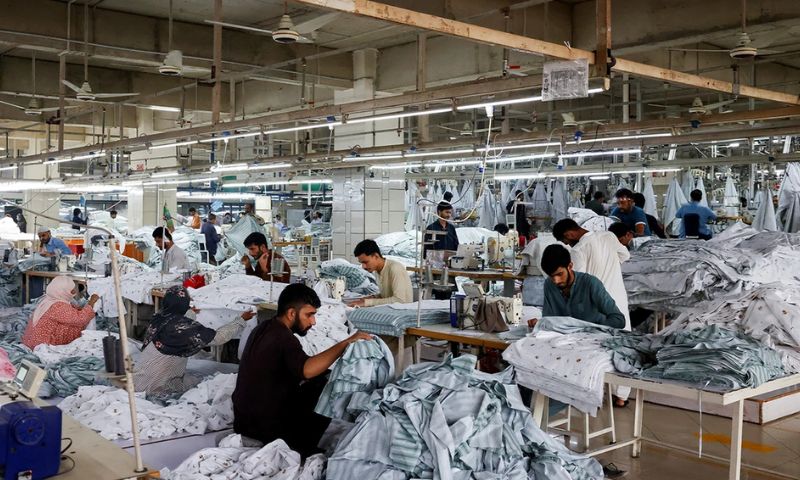
Independent processing units, he said, were a critical part of the textile value chain because grey cloth cannot be sold as a finished “Made in Pakistan” textile product without processes such as dyeing and printing.
He said commercial exporters, which account for a major share of Pakistan’s textile exports, rely heavily on independent processing units.
“How can we compete under these circumstances?” he asked.
Citing Bangladesh, whose textile exports reached about $54 billion by June 2025, Moti Wala said Pakistani exporters were losing international orders because of higher production costs.
He described sales tax as the industry’s biggest problem and argued that restoring zero-rating could reduce refund backlogs and fraudulent invoicing.
He also criticised the involvement of about 29 government agencies in inspections, saying regulatory pressure had contributed to the closure of processing units.
“Without these measures, the textile sector will become history,” he said, offering to present detailed cost data before parliament.
The government says its proposed compliance reforms are intended to reduce regulatory friction while helping manufacturers meet these international requirements.
For the industry, however, the immediate challenge remains narrowing the cost gap with regional competitors while maintaining the investment needed to upgrade production and move towards higher-value exports.