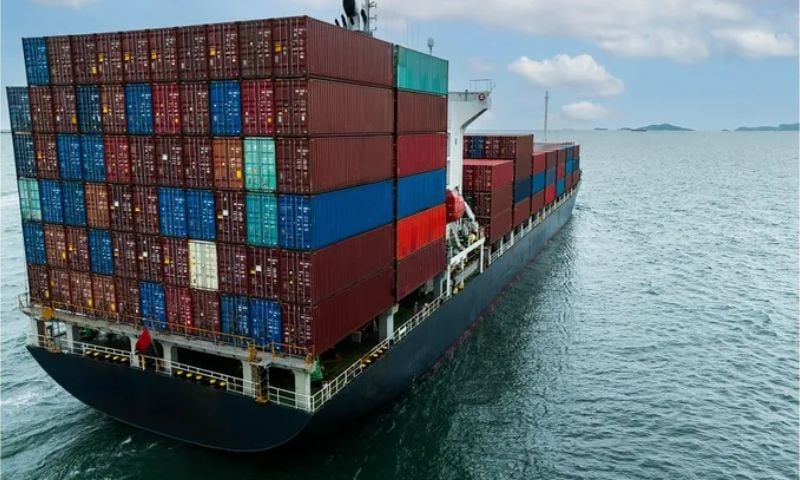
ISLAMABAD: Pakistan’s government has directed its shipping carrier to acquire up to five container ships to strengthen trade links with Gulf markets amid prolonged maritime disruptions caused by the Iran war, a company spokesperson said.
The move comes as the conflict, which began in late February, has severely disrupted shipping through the Strait of Hormuz and pushed up freight costs. The disruption has affected Pakistani exporters dependent on Gulf markets, despite signs of a broader recovery in exports to the region.
“In line with its fleet development strategy, the Pakistan National Shipping Corporation is currently considering the acquisition and chartering of three to five feeder vessels to enhance its regional service capacity,” Ayesha Leena, a spokesperson for the national shipping carrier, PNSC, told Arab News.
Each ship will have a container capacity of between 1,100 and 2,000 twenty-foot equivalent units (TEUs), the standard measure used for shipping-container capacity.
“PNSC is expected to announce its expanded regional feeder services in the near future,” Leena said, without providing a specific timeline.
PNSC currently operates five bulk carriers and eight tankers on three regional routes: the Pakistan Gulf Service, Pakistan Red Sea Service and Pakistan South Asia Service, which links Karachi with Colombo and Chittagong.
The development comes as data from the Federation of Pakistan Chambers of Commerce and Industry (FPCCI) show a volatile trend in Pakistan’s exports to the six Gulf Cooperation Council (GCC) countries since the outbreak of the Iran war.
“Exports had risen 25.2 percent year-on-year in February, before contracting 2.9 percent in March, 10.6 percent in April and 16.7 percent in May,” Mian Zahid Hussain, chairman of the Policy Advisory Board at the FPCCI, said. “They rebounded 13.9 percent in June and grew another 4.7 percent year-on-year in July.”
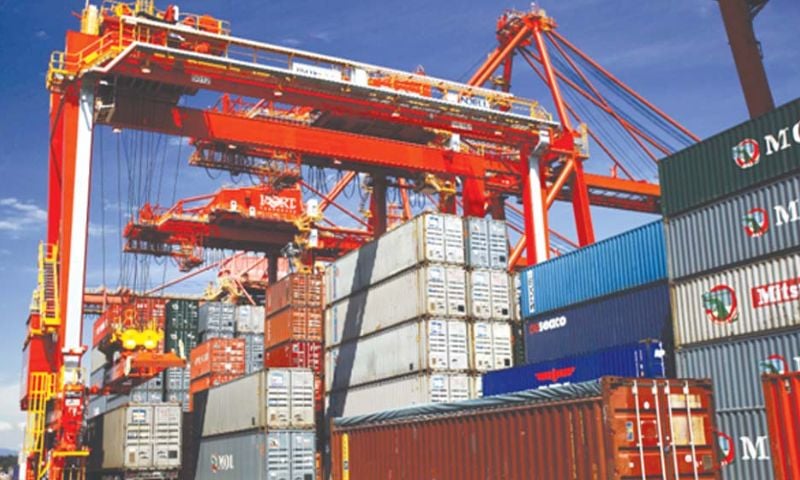
Pakistan’s exports to GCC countries reach $1.94 billion
Pakistan’s exports to the six Gulf Cooperation Council (GCC) countries totalled $1.94 billion between January and July 2026, up 2.1 per cent from $1.904 billion in the same period last year. An FPCCI official described the performance as “resilient but concentrated”, noting that the United Arab Emirates accounted for nearly two-thirds of the total.
The monthly export trend has coincided with major shifts in the regional conflict and efforts to restore maritime traffic. The Iran war began on February 28, followed by a temporary ceasefire in April and months of negotiations. An interim agreement was reached in June but began to unravel in July as disputes over the Strait of Hormuz resurfaced.
The waterway, which carried around a fifth of global oil and liquefied natural gas supplies before the war, remains severely disrupted following the collapse of the June agreement.
A Commerce Ministry official told Arab News on condition of anonymity that the uncertainty had affected purchasing decisions across Middle Eastern markets.
“From a business perspective, buyers hold back their orders during unstable conditions because demand for all items is not uniform,” the official said. “Imports and exports of essential items such as food and medicines continue, while purchases of clothing and luxury goods can be deferred.”
The official said high ocean freight rates had left exporters with limited alternatives. Air freight costs an average of $2 to $2.50 per kilogram, compared with $1,800 to $2,000 for a standard sea container carrying around 10 metric tons.
Perishable goods exporters have been particularly affected by the disruption.
Waheed Ahmed, patron-in-chief of the All-Pakistan Fruit and Vegetable Exporters, Importers and Merchants Association, said the cost of shipping a 40-foot refrigerated container of mangoes to Gulf markets had risen sharply to $8,000-$8,500 this year from $1,000-$1,400 last year.
Pakistan mango exports to Gulf countries decline by 50%
Ahmed estimated that Pakistan’s mango exports to Gulf countries had declined by 50 per cent from last year, while overall fruit exports to the region had fallen by 30-40 per cent.
The steep decline in fruit shipments, despite overall growth in exports to GCC countries, highlights the uneven impact of maritime disruptions, with some sectors and markets better able to absorb rising freight costs than others.
ALSO READ: Pakistan Exports Gain as Fruit Exporter Eyes Gulf Expansion
According to the FPCCI report, strengthening PNSC could expand national shipping capacity, reduce reliance on foreign carriers and provide more reliable connections with Gulf markets. The report noted that the government had already been working to expand the national carrier’s fleet before the latest regional disruptions.
PNSC has also been expanding its regional connectivity, including through a dedicated Gulf feeder service linking Karachi and Fujairah that was launched earlier this year.
The latest directive specifically focuses on expanding container capacity as renewed hostilities place further pressure on commercial shipping.
Iran said this week that the Strait of Hormuz would remain closed until Washington met conditions outlined in the June interim agreement, while diplomatic efforts to revive the deal have stalled.