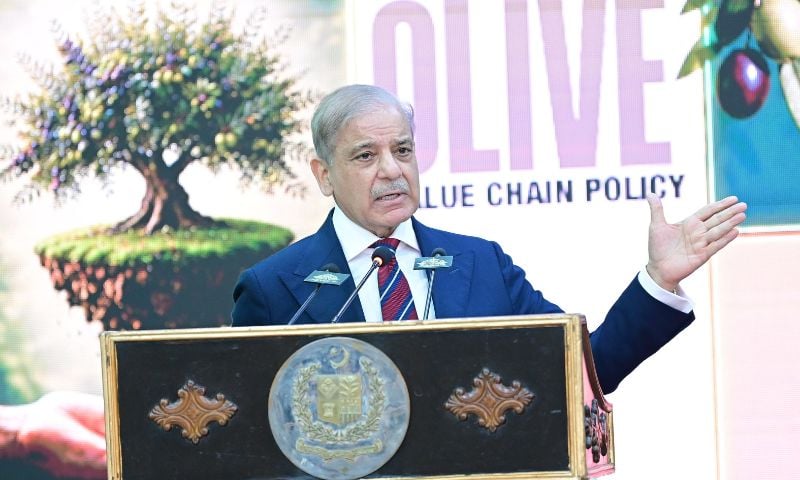
ISLAMABAD: Pakistan has taken a major step towards agricultural self-sufficiency as Prime Minister Shehbaz Sharif launched the Pakistan National Olive Value Chain Policy, a comprehensive initiative aimed at harnessing the country’s vast olive potential to reduce dependence on costly edible oil imports.
With Pakistan currently importing edible oil worth a staggering $4 billion annually, the new policy signals a determined push towards domestic production, value addition, and eventual self-sufficiency in the critical sector.
“Pakistan deeply values Italy’s longstanding support and our excellent trade and economic cooperation, particularly in areas such as textile machinery and tractor manufacturing.
It is now time to further focus on olive production, its value chain, processing, value addition and… pic.twitter.com/a2RydHWoyt
— Government of Pakistan (@GovtofPakistan) August 24, 2026
Prime Minister vows to save billions through domestic production
Addressing the launching ceremony, Prime Minister Shehbaz Sharif emphasised the urgent need to reduce Pakistan’s heavy reliance on imported edible oil, stating that even saving $400 million in a single year through enhanced domestic production would be a remarkable achievement.
“It will be a great achievement if the country can save four hundred million dollars in a single year by enhancing domestic edible oil production,” the Prime Minister said, expressing confidence that Pakistan can become self-sufficient in edible oil within a few years.
He extended his gratitude to the Italian Government for its continued cooperation in promoting olive cultivation and production across Pakistan. The Prime Minister noted that the country now needs to focus more intensively on oil production, processing, and value addition to fully realize the sector’s potential.
Prime Minister Muhammad Shehbaz Sharif visiting different stalls at the launch of Pakistan National Olive Value Chain Policy. Islamabad, 24 August 2026. pic.twitter.com/wqXOXRKsNH
— Prime Minister’s Office (@PakPMO) August 24, 2026
Pakistani graduates to receive training in Italy
In a significant move to build local expertise, the Prime Minister announced that the Government of Pakistan, at its own expense, would send 100 young agricultural graduates to Italy for advanced training in various aspects of olive cultivation, production, processing, and marketing.
The initiative aims to equip Pakistani professionals with world-class knowledge and skills that can be applied locally to transform the olive sector into a thriving industry.
Italy reaffirms longstanding partnership
Speaking on the occasion, Italian Ambassador to Pakistan Ugo Ciarlatani highlighted the enduring partnership between Italy and Pakistan, which spans more than seven decades and now covers agriculture, science, education, trade, and security.
Prime Minister Shehbaz Sharif says the government is committed to developing Pakistan’s agriculture sector, facilitating agricultural research and promoting olive cultivation. He stressed that public-private partnerships are vital for sustainable growth and development in the… pic.twitter.com/dLULy6dmfe
— Pakistan TV (@PakTVGlobal) August 24, 2026
“The National Olive Value Chain Policy reflects years of cooperation, including the 100-million-dollar Pakistan-Italy Debt Swap Programme, which helped establish olive orchards across the country,” the Ambassador said.
He revealed that Pakistan now boasts more than seven million olive plants, while Italy’s Olive Culture Project has supported laboratories, nurseries, business groups, and provided training to more than 700 stakeholders across the country.
Prime Minister Muhammad Shehbaz Sharif addresses a ceremony to launch Pakistan National Olive Value Chain Policy to harness the true potential of olive cultivation and processing. Islamabad, 24 August 2026. pic.twitter.com/32umVBFXDt
— Prime Minister’s Office (@PakPMO) August 24, 2026
Italy commits €20 million for capacity building
The Italian Ambassador further announced that Italy is supporting Pakistan’s technical and vocational education through a €20-million capacity-building programme focusing on high-value agriculture, including olive cultivation and production.
He expressed hope that the new policy would transform Pakistan’s olive sector into a thriving agro-industry, benefiting farmers, women, and youth while further strengthening the longstanding Italy-Pakistan bilateral relations.
Read Also: Can Pakistan Become the Next Olive Oil Powerhouse?
A New Era for Pakistan’s Agriculture
The Pakistan National Olive Value Chain Policy represents a strategic shift towards agricultural diversification and import substitution. With vast tracts of land across Balochistan, Khyber Pakhtunkhwa, and Punjab suitable for olive cultivation, the policy aims to unlock the country’s untapped potential in the sector.
The Prime Minister reiterated the government’s commitment to supporting farmers and investors in the olive sector, ensuring that Pakistan not only meets its domestic edible oil needs but also emerges as a regional player in olive production and exports.
Read Also: Pakistan Becomes Permanent Member of International Olive Council
The launching ceremony was attended by federal ministers, diplomats, agricultural experts, and stakeholders from across the country, all united in their vision of a prosperous and self-reliant Pakistan through sustainable olive cultivation.