Key Points
- Pakistan says India cannot selectively apply international law
- Adeel Mumtaz Khokhar cites cases of Indian state terrorism
- Pakistan says the Indus Waters Treaty remains fully in force
- Diplomat says India cannot unilaterally suspend or escape treaty obligations
GENEVA: Pakistan has strongly rejected India’s allegations of “cross-border terrorism” at the United Nations Human Rights Council, saying New Delhi always selectively apply international law but it cannot “bully its way out” of its obligations under the Indus Waters Treaty (IWT).
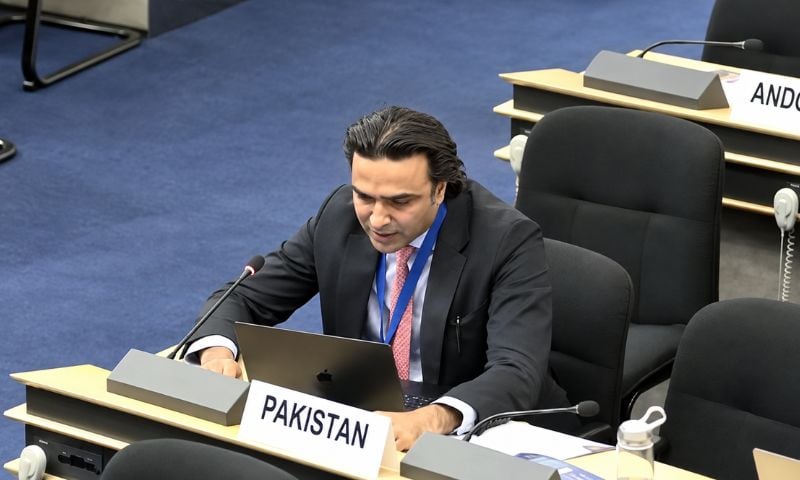
Exercising his right of reply at a Human Rights Council session in Geneva, Pakistan’s First Secretary Adeel Mumtaz Khokhar said India’s claims of cross-border terrorism “ring hollow” in view of the apprehension of its serving naval officer, Commander Kulbhushan Jadhav, on Pakistani soil.
Khokhar also referred to the involvement of Indian agents in cases outside the region, citing the killing of Canadian Sikh leader Hardeep Singh Nijjar in British Columbia in 2023 and the ongoing US case against Nikhil Gupta for plotting the targeted killing of Gurpatwant Singh Panun.
Canadian authorities charged an Indian national, who was later arrested in the Czech Republic and extradited to the United States, in an alleged plot to assassinate a US-based Sikh leader of the Khalistan movement.
Khokhar said the cases challenged India’s attempt to portray itself as a victim while ignoring allegations and evidence concerning its own conduct beyond its borders.
Turning to the Indus Waters Treaty, the Pakistani diplomat said international law was not “a menu of options” that states could pick and choose from.
He said the Permanent Court of Arbitration had affirmed that the IWT remained fully in force and that India was bound to observe its obligations under the treaty.
READ ALSO: Arbitration Court’s Ruling Strengthens Pakistan’s Position On Indus Waters Treaty: Legal Experts
“India may fancy itself the regional bully, but it cannot bully its way out of the IWT,” Khokhar said, delivering a sharp rebuttal to New Delhi’s position on the water-sharing accord.
India announced in April 2025 that it was placing the treaty in abeyance following a false-flag operation in the Indian Illegally Occupied Jammu and Kashmir and blamed Pakistan.
Islamabad rejected the allegation and has maintained that the treaty contains no provision allowing either side to suspend it unilaterally.
Pakistan has since challenged India’s position through diplomatic and legal channels, arguing that treaty obligations cannot be switched on and off according to political circumstances.
Permanent Court of Arbitration backs Pakistan
The Permanent Court of Arbitration has also rejected India’s position that its unilateral action could prevent the court from exercising jurisdiction over a dispute concerning the treaty.
The arbitration process has remained a major element of Pakistan’s argument that the 1960 agreement continues to govern relations over the shared river system.
Khokhar reiterated that position at the Geneva forum, saying Pakistan expected India to comply with international law and its treaty obligations.
The dispute over the IWT has become one of the most sensitive issues between the two nuclear-armed neighbours because the western rivers covered by the treaty are central to Pakistan’s irrigation, agriculture, drinking-water supplies and hydropower generation.
Khokhar’s intervention linked the water dispute to Pakistan’s wider response to India’s allegations of terrorism, arguing that New Delhi could not invoke international law selectively while disregarding its own obligations under international agreements.
Pakistan has maintained that disputes with India should be addressed through established legal and diplomatic mechanisms rather than unilateral measures.
The Geneva exchange comes amid continuing tensions between the two countries over security, Kashmir and the future of the Indus Waters Treaty, which has survived wars and prolonged periods of diplomatic confrontation since it was signed in 1960.