
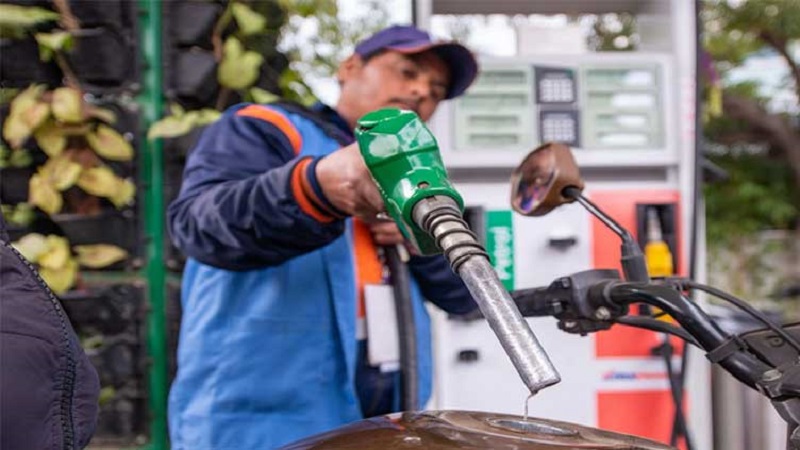
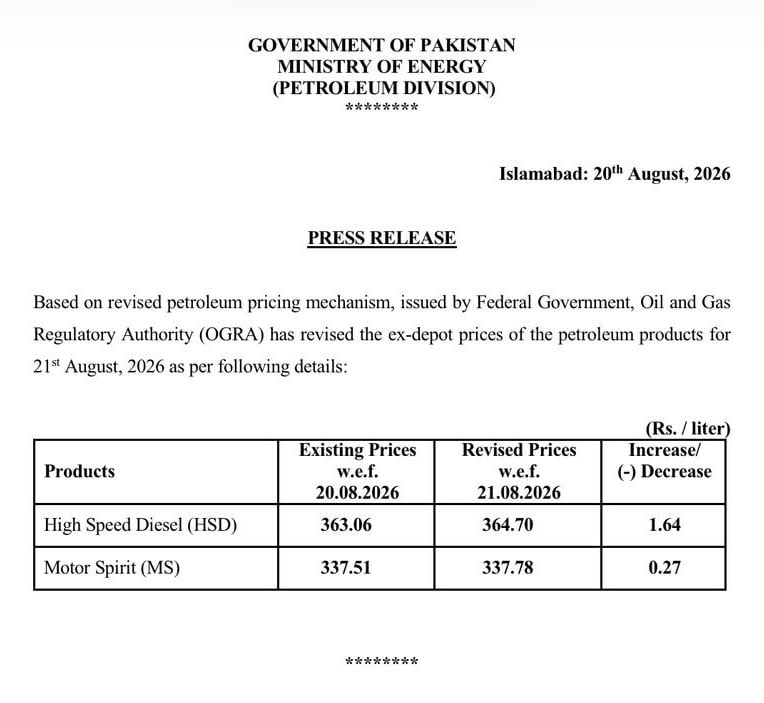
ISLAMABAD: Pakistan’s government on Thursday increased the prices of high-speed diesel (HSD) by Rs 1.64 and petrol by Rs 0.27 per litre under a new price mechanism.
Following the revision, high-speed diesel will be available at Rs 364.70 per litre, while the price of petrol rises to Rs 337.78 per litre.
According to a notification issued by the Petroleum Division, the revised prices will take effect from Friday, August 21.
The government on Wednesday announced a major reduction of Rs 32.63 per litre in the price of high-speed diesel (HSD), while increasing the petrol price by Rs 2.97 per litre under the new price mechanism.
Pakistan daily fuel price review mechanism
The government of Pakistan shifted to a daily fuel price review mechanism amid heightened volatility in global oil markets triggered by renewed tensions in the Middle East. The move is aimed at ensuring that changes in international oil prices are reflected more quickly in domestic fuel rates.
Fuel prices have been revised for August 21, 2026.
Petrol increases by Rs. 0.27 per litre to Rs. 337.78, while High Speed Diesel rises by Rs. 1.64 per litre to Rs. 364.70. pic.twitter.com/Xy6KVhuNq9
— PakWheels.com (@PakWheels) August 20, 2026
The government had earlier replaced the fortnightly pricing system with weekly reviews following the outbreak of the Middle East conflict.
Petrol is mainly used in private transport, small vehicles, rickshaws and two-wheelers, and changes in its price affect the middle and lower-middle classes.
Similarly, changes in diesel prices also impact the public at large, as it is mainly used in the heavy transport sector, power plants and large generators.

Oil nears $92
Oil prices hovered near $92 a barrel on Thursday as investors were wary of the prolonged US-Iran conflict and uncertainty about shipping through the Strait of Hormuz, keeping a geopolitical risk premium in crude markets.
Brent crude futures for October delivery rose 25 cents, or 0.3 per cent, to $91.87 a barrel. Unlike Brent, US West Texas Intermediate (WTI) crude for September slipped two cents to $85.81.
However, the more active October WTI contract gained 14 cents to $84.53. Both benchmarks have risen for four consecutive sessions and settled on Wednesday at their highest levels since July 24.
Also Read: Oil Nears $92 as Hormuz Risk Persists
The latest gains coincides shipping through the Strait of Hormuz remains severely constrained. Kpler data showed nine commodity vessels transited the Strait of Hormuz on Wednesday, after traffic fell to six on Tuesday from nine on Monday. The figure is still below a recent average of 11 daily transits, and much lower than the pre-war average.
The strait normally carries about 20 per cent of global crude oil and liquefied natural gas shipments. The United States says the waterway remains open, but Iran maintains that it is closed, leaving many ship owners reluctant to send vessels through the route.
The market received some relief from US inventory data. US crude stocks unexpectedly increased by 4.4 million barrels to 428.8 million barrels last week. According to the Energy Information Administration, the fresh increase would be countering some concerns about an immediate global supply shortage.