LAHORE/ISLAMABAD: Pakistan’s flood crisis entered a new, more dangerous phase on Sunday evening as swollen waters in the Sutlej, Ravi, and Chenab rivers pushed through central Punjab toward southern barrages, with the National Disaster Management Authority (NDMA) warning that flows at Guddu Barrage could reach at least one million cusecs by September 5
At an evening press conference alongside Climate Change Minister Dr Musadik Malik, NDMA Chairman Lt Gen Inam Haider Malik said authorities are monitoring flows through the river system to keep barrages from being overwhelmed.
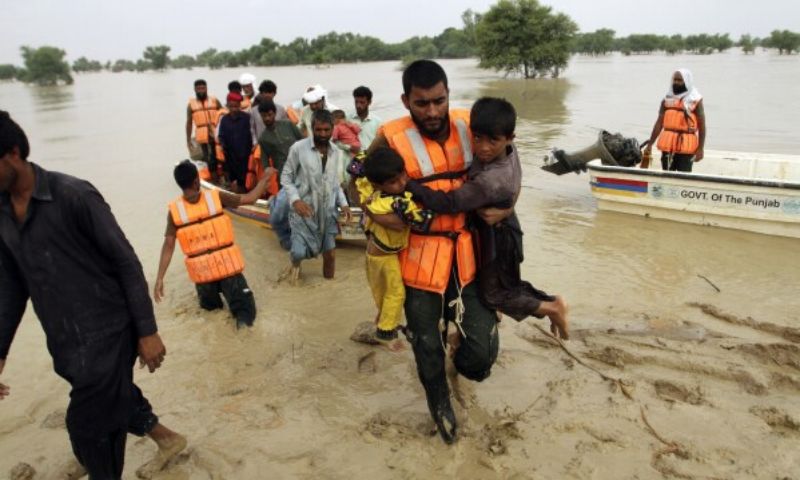
The NDMA Chairman said that about 600,000 people have been evacuated so far from high-risk belts. He also cautioned that a fresh low-pressure system from the Bay of Bengal in the first 10 days of September could bring more rain to eastern Punjab and Azad Kashmir—though not at last week’s intensity.
Where the water stands tonight
By late afternoon, the Flood Forecasting Division (FFD) reported a “very high flood” at Trimmu Barrage on the Chenab, with 455,051 cusecs passing through; Balloki on the Ravi registered 186,515 cusecs (falling), and Ganda Singh Wala on the Sutlej 253,068 cusecs, both at “exceptionally high” levels.
Upstream gauges at Marala (Chenab) had returned to normal, and Shahdara (Ravi) had eased to medium, but authorities stressed that the surge is now moving south toward Panjnad and then Guddu/Sukkur.
Punjab’s relief chief earlier confirmed more than 2,000 villages affected. District officials in Mandi Bahauddin said a protective dyke was breached for the first time in the district’s history as a controlled measure to spare critical head-works if flows surpass capacity.
Nationwide, NDMA’s daily sitrep put cumulative monsoon fatalities at 854 since June 26, with Punjab, Khyber Pakhtunkhwa and Gilgit-Baltistan accounting for most losses.
For the last 24 hours alone, the report recorded 23 deaths (18 in Punjab, 4 in Khyber Pakhtunkhwa and 1 in Balochistan), largely from riverine flooding and house collapses. NDMA underscored that Punjab’s relief tallies are preliminary, given ongoing evacuations.
Measures to address flood situation
Laying out the government’s strategy, Dr Musadik Malik said the immediate priority is keeping system flows below one million cusecs by using targeted, small breaches where necessary. He said the decision will be taken with provincial administrations to minimize harm to settlements.
The minister framed the relief focus around “protecting eight million poor people displaced by flooding,” noting that “around two million” have already been rescued to safer ground and that contingencies center on potable water, medical care, tents, mosquito nets, and food.
The minister and NDMA chief said months of advance modeling and community-level trainings guided this year’s response, which they argued helped reduce fatalities despite the scale of inundation.
The NDMA chief reiterated confidence in forecasts—around 95 per cent accuracy, he said—while urging vigilance as the monsoon persists into September.
Sindh braces for the crest
In Sindh, Chief Minister Murad Ali Shah said the province is preparing for a “super flood” scenario and has mapped impacts across flow bands between 500,000–900,000+ cusecs at Guddu–Sukkur, estimating up to 224,313 people at risk in the worst case.
The province has 192 PDMA boats, Navy assets staged on both banks, and plans for up to 948 relief camps (with 514 to be set up initially), including mobile health units stocked for snakebites and waterborne disease.
Urban flooding & fresh rain risk
With the surge still moving through central Punjab—and soils already saturated—authorities warned of urban inundation during cloudbursts.
Through Sunday, the FFD/NDMA stream showed Shahdara receding but Balloki and Ganda Singh Wala holding at dangerously high levels, while intermittent rain fell over Lahore and nearby districts.
Provincial advisories pointed to heavy showers and urban flooding risk in Lahore, Gujranwala and Gujrat divisions into the short term.
The big picture
Independent tallies and wire services described Punjab’s worst river flooding in decades, with over two million people affected and vast crop belts at risk—an echo of 2022’s devastation but driven this time by a triple-river surge amplified by cross-border reservoir releases.
International agencies noted the monsoon is likely to linger through September, sustaining humanitarian pressure even as today’s crest migrates downstream.
Snapshot (as of Sunday evening, Aug 31)
Trimmu (Chenab): very high flood at 455,000 cusecs; surge traveling toward Panjnad
Balloki (Ravi):186,500 cusecs, falling; Ganda Singh Wala (Sutlej): 253,000 cusecs, both flagged “exceptionally high.”
Evacuations: 600,000 people shifted from high-risk belts, per NDMA chief.
Fatalities (monsoon cumulative): 854 nationwide; 23 in the last 24 hours.
Outlook: Another low-pressure system likely in early September; Guddu projected to receive ≥1,000,000 cusecs by Sept 5
This story reflects the situation and official figures available Sunday evening, Aug 31, based on NDMA’s daily sitrep, FFD river gauges, and televised briefings by the NDMA chairman and the climate minister.