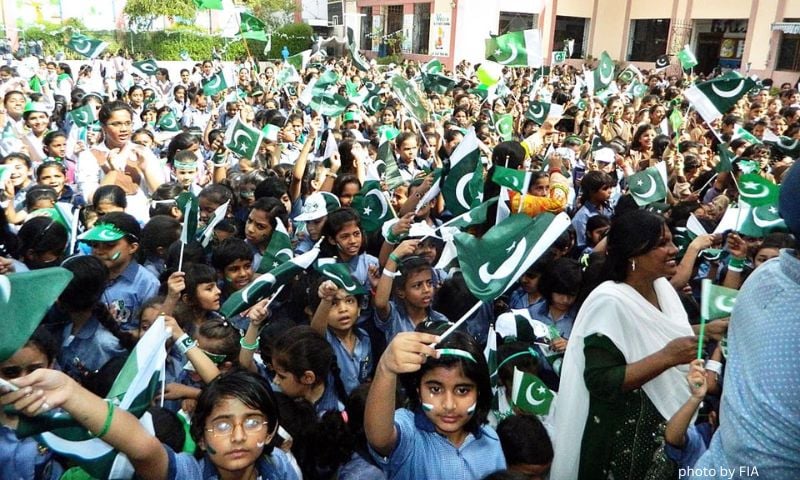
ISLAMABAD: Pakistan is celebrating its 79th Independence Day today (Friday) with nationwide flag-hoisting ceremonies, military and cultural events, prayers for the country’s peace and prosperity, and tributes to the founders and martyrs who sacrificed for the creation and defence of the country.
The day began with a 31-gun salute in the federal capital and 21-gun salutes at provincial headquarters, while special prayers were offered in mosques for the country’s solidarity, peace and prosperity. Flag-hoisting ceremonies were held at federal, provincial, divisional and district headquarters across the country, with public and private buildings, markets and streets decorated with national flags, buntings and lights.
The celebrations come 79 years after Pakistan emerged as an independent state on August 14, 1947, and are being marked with a renewed emphasis on the ideals of the Pakistan Movement and Quaid-i-Azam Muhammad Ali Jinnah’s vision for the country.
Wide range of seminars, exhibitions, cultural programmes and other activities had been organised nationwide to highlight the sacrifices of the country’s forefathers and the historical struggle that culminated in independence. The national broadcaster is also airing special programmes highlighting the services and contributions of heroes of the Pakistan Movement.
Yadgar-e-Fatah unveiled in Islamabad
One of the most prominent events associated with this year’s celebrations has been the inauguration of Yadgar-e-Fatah, or Monument of Victory, in Islamabad. President Asif Ali Zardari and Prime Minister Shehbaz Sharif inaugurated the monument, which has been built to honour Pakistan’s martyrs and commemorate the country’s victory during the 2025 Marka-e-Haq.
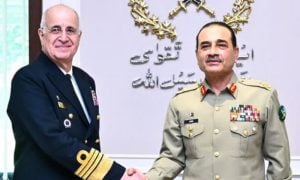
Chief of Defence Forces and Chief of Army Staff Field Marshal Syed Asim Munir, Chief of Air Staff Air Chief Marshal Zaheer Ahmad Babar Sidhu and Chief of Naval Staff Admiral Naveed Ashraf also attended the ceremony.
In his address, Prime Minister Shehbaz Sharif said Pakistan wanted peace with honour and dignity but warned that any future challenge to the country’s sovereignty would invite a strong response. He also described Pakistan’s water resources as a red line, warning India against any attempt to deprive Pakistan of its water.
The prime minister also stressed the importance of information technology and artificial intelligence for Pakistan’s future, calling for the country to adapt to technological change and pursue development across all provinces, Gilgit-Baltistan and Azad Kashmir.
President Zardari, meanwhile, praised the country’s political and military leadership for advancing Pakistan’s interests internationally and promoting greater unity among Islamic countries. He said much more needed to be done for the welfare of the people and future generations and expressed confidence that Pakistan could be transformed into a developed country in line with Quaid-i-Azam’s vision.
Ceremonies honour Quaid-i-Azam
In Karachi, a change-of-guard ceremony was held at the Mazar of Quaid-e-Azam Muhammad Ali Jinnah, another central feature of the national celebrations. The ceremony was held as part of the Independence Day observances in the country’s largest city.
The mausoleum traditionally serves as one of the country’s most important focal points on August 14, with national institutions and citizens paying tribute to the founder of Pakistan and renewing their commitment to the principles associated with the Pakistan Movement.
Across the country, the national flag was hoisted at official buildings and public institutions, while citizens marked the occasion through patriotic gatherings, national songs, cultural programmes and community events.
Public celebrations planned in Islamabad
Islamabad’s civic authorities have also arranged a large public programme at the Old Parade Ground at D-Chowk, scheduled to begin at 5pm. The event is being organised by the Capital Development Authority and the Islamabad Capital Territory Administration and is scheduled to feature musical performances, cultural displays, parade units and family entertainment.
The programme includes performances by Nimra Mehra, Sahir Ali Bagga and Khumariyan Band, along with police squads, cultural groups, dhol performers, pipe and percussion bands and a camel band. The evening programme is also scheduled to include vintage cars and motorcycles, mascots and a fireworks display, giving families and children an opportunity to participate in the public celebrations.
Celebrations nationwide
Independence Day activities extending well beyond the federal capital, with flag-hoisting ceremonies and patriotic programmes taking place at government institutions and public bodies across Punjab, Sindh, Khyber Pakhtunkhwa, Balochistan, Gilgit-Baltistan and other parts of the country.
The celebrations have also included cultural events, educational programmes, community gatherings and activities aimed at highlighting national unity, public service and the sacrifices associated with the independence struggle.
In Gilgit-Baltistan, Independence Day observances have included a 21-gun salute and a main ceremony at Chinar Bagh, while various institutions and public bodies in Punjab and Khyber Pakhtunkhwa have organised their own flag-hoisting ceremonies and patriotic programmes.
A day of celebration and reflection
The celebrations have combined traditional expressions of patriotism with messages calling for national unity, economic progress, institutional responsibility and the protection of Pakistan’s sovereignty. The country was marking the occasion with a renewed pledge to follow the spirit of the Pakistan Movement and work towards building Pakistan as an Islamic welfare state.
As Pakistan marks 79 completed years of independence, the ceremonies across the country are therefore serving not only as expressions of national pride but also as reminders of the sacrifices that accompanied the creation of the state and the responsibilities of successive generations to strengthen it.