
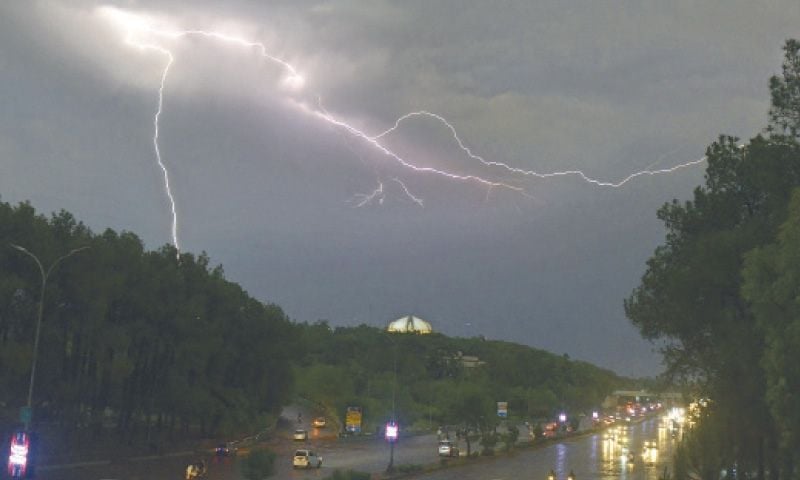
ISLAMABAD: Pakistan is set to experience dust storms, windstorms, rain and thunderstorms from June 16 to 20, with officials warning of urban flooding, landslides, and potential damage to solar panels, electric poles and billboards, the Pakistan Meteorological Department (PMD) said on Monday.
🌧️ PMD Seasonal Monsoon Outlook 2026 ( 15 June, 2026)
For Further Information Please Visit the Link: https://t.co/jH4tihttuv#MonsoonOutlook2026 #PMD #MonsoonForecast #SeasonalOutlook #PakistanWeather #RainfallOutlook #TemperatureOutlook #ClimateOutlook #Monsoon2026 pic.twitter.com/s6y6P7oXBg— Pak Met Department محکمہ موسمیات (@pmdgov) June 15, 2026
The culprit is a potent westerly wave, an atmospheric disturbance typically associated with winter rains in Pakistan, set to arrive unusually late in the season. According to the Met Office, the system will approach the country’s upper regions from Tuesday and persist through Saturday.
Adding fuel to the fire, moisture currents from the Arabian Sea are also expected to penetrate upper and central parts starting June 16, creating a volatile mix.
Weather Forecast | 15-06-2026#PMD #Pakistan #Weather pic.twitter.com/qaTQdesSvc
— Pak Met Department محکمہ موسمیات (@pmdgov) June 15, 2026
Under the influence of this dual weather system, Islamabad and several Punjab cities, including Rawalpindi, Murree, Lahore, Sialkot, Faisalabad, Jhang, Sahiwal, Sargodha, Bhakkar, DG Khan and Multan, are likely to receive scattered dust storms, windstorms and rain-thunderstorms, with isolated heavy falls and hailstorms expected during the period, occasionally interrupted by gaps.
The PMD warned that strong windstorms, hailstorms and lightning could damage weak structures such as solar panels, a growing feature of Pakistan’s energy landscape, as well as electric poles and billboards.
Farmers have been advised to manage their crops according to the prevailing weather conditions, while tourists and travelers have been urged to remain extra cautious and avoid unnecessary travel during the forecast period.
PMD Flash Flood Division (FFD Lahore): Major rivers flowing within normal limits; moderate rain expected over upper catchments of Indus and Jhelum rivers, Islamabad, Rawalpindi, Jhelum, Gujranwala and Lahore divisions.#PMD #FFD #FloodForecast #RiverSituation #WeatherUpdate pic.twitter.com/kleHlU6FFU
— Pak Met Department محکمہ موسمیات (@pmdgov) June 15, 2026
Urban flooding and landslides
The weather department issued specific flood warnings, saying heavy rains may cause urban flooding in Rawalpindi, Gujranwala, Sialkot, Lahore and Faisalabad, cities where drainage systems have historically struggled to cope with sudden downpours.
Additionally, landslides may occur in vulnerable areas of upper Khyber-Pakhtunkhwa, Gilgit-Baltistan and Kashmir from Tuesday to Sunday, potentially blocking roads and disrupting transport in mountainous regions.
Weather Forecast for Farmers | 15-06-2026#PMD #Pakistan #Weather pic.twitter.com/yMAUFogeEI
— Pak Met Department محکمہ موسمیات (@pmdgov) June 15, 2026
Regional breakdown
Scattered rain-wind and thunderstorms, with isolated heavy falls and hailstorms, are expected in Kashmir’s Neelum Valley, Muzaffarabad, Rawalakot, Poonch, Hattian, Bagh, Haveli, Sudhanoti, Kotli, Bhimber and Mirpur from Tuesday to Sunday. In Gilgit-Baltistan, areas including Diamir, Astore, Ghizer, Skardu, Hunza, Gilgit, Ghanche and Shigar will see similar weather from Thursday to Sunday.
Khyber-Pakhtunkhwa is also in the crosshairs. Districts including Dir, Chitral, Swat, Kohistan, Malakand, Bajaur, Battagram, Kohat, Bannu, Dera Ismail Khan, Khyber, Waziristan, Mansehra, Abbottabad, Haripur and Peshawar are expected to experience scattered dust storms, windstorms and rain-thunderstorms, with a few heavy falls and hailstorms.
Even Balochistan is not spared. Zhob, Sherani, Ziarat, Kohlu, Naseerabad, Quetta, Qillah Saifullah, Qillah Abdullah, Harnai, Sibbi, Barkhan, Khuzdar and Dera Bugti are likely to receive similar weather from Tuesday onward.
In Sindh, rain is expected to hit upper districts including Sukkur, Larkana, Jacobabad, Khairpur, Dadu, Ghotki, Kashmore, Shikarpur and Shaheed Benazirabad throughout the week. Even Karachi may see dust storms with light rain during the forecast period, the PMD added.
Authorities have advised citizens to stay updated with the latest weather alerts and take necessary precautions as multiple weather systems converge over the country.