NEW DELHI: More than 120 scientists have left India’s space agency in recent months following a series of launch failures, raising concerns over a loss of experienced expertise at the Indian Space Research Organisation (ISRO) as the agency faces growing challenges in its space programme.
The departures come at a time when questions are also being raised about the cost and competitiveness of India’s satellite-launching programme, putting fresh scrutiny on the organisation’s ability to retain expertise and maintain its position in the increasingly competitive global space industry.
According to a new study by researchers at the University of Cambridge, sending satellites into space from India is more expensive per kilogram than other major space programmes in the world.
The combination of rising costs and the loss of experienced scientists has fuelled debate over whether structural and financial challenges could undermine India’s ambitions to expand.
In a research paper published in the journal ‘Economic Letters’, economist Alessio Terzi of the University of Cambridge and Francesco Nicoli of the Polytechnic University of Torino in Italy have said that sending satellites into space from India is about four times more expensive than in the United States in terms of cost per kilogram.
According to the study, based on an analysis of the costs of 6,740 rockets launched between 1960 and 2025, the cost per kilogram in India was $13,302, while in the US it was $3,325.
Launching satellites is more expensive in India
It said India is more expensive than the European Union, Russia, China and Japan, while the cost of launching a satellite from the United States is the lowest.
The study has cited several reasons for the high cost of space travel in India.
One reason is that most of ISRO’s rockets have a relatively low payload capacity compared to modern commercial rockets in the US.
Another important reason is that companies like US SpaceX are now using reusable rockets, which significantly reduces the cost per launch. In contrast, ISRO still mainly uses rockets that can be used only once and has not yet developed reusable rockets.
The third reason is the number of launches. ISRO launches relatively few times a year, which does not make it profitable, while European and American space agencies conduct large-scale commercial launches.
According to scientific analyst Palo Bagla, SpaceX, founded in 2002, launched “165 Falcon 9s in 2025 alone.” While ISRO was founded in 1969 and has launched “only 105 satellites in its entire 75-year history.”
Palo Bagla also made the comparison: SpaceX employs about 22,000 people, while ISRO employs 16,000.
Scientists’ departure and ISRO’s internal challenges
The Cambridge study comes at a time when ISRO is facing some administrative and technical challenges.
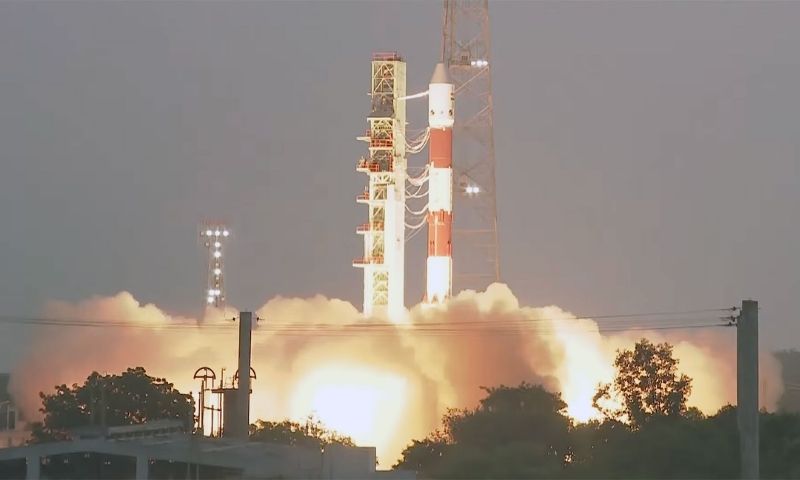
ISRO’s key Polar Satellite Launch Vehicle experiment has failed, and it has not been able to conduct any successful launches in the past year.
According to Smita Bhardwaj, a researcher in space management and astropolitics at Delhi’s Jawaharlal Nehru University, this trend cannot be called just a normal personnel turnover, as ISRO is already suffering from a staff shortage.
According to the researcher, 18,142 posts were approved for running science, technology and administrative affairs in the institution, out of which about 2,613 are lying vacant, meaning that more than 14 percent of the posts could not be filled.
ALSO READ: 16 Satellites Lost as India Suffers Second Consecutive Space Launch Failure
Smita Bhardwaj said that the departure of experienced scientists is not just a loss of individuals but also a loss of expertise that comes with years of experience.
According to her, the manned space programme ‘Gaganyaan’, which was supposed to be launched in the first quarter of 2026, is now facing delays.
Smita said, ‘Scientists who had gained knowledge from various experiments over the decades left at a time when they were needed the most for the continuity of the project.’
To stop this trend, India’s space department issued a memo last July in which scientists working on important space missions will have to take approval from ISRO headquarters before resigning.