

Key Points
- Brent crude falls about 1.5 per cent to near $108 a barrel
- US West Texas Intermediate declines to around $101 a barrel
- Gulf crude flows plunge to 8.5 million barrels per day
ISLAMABAD: Oil prices fell on Monday after reaching a five-month high last week, as investors booked profits and assessed whether a US move to ease restrictions on Russian oil could increase global supplies despite severe disruptions to shipments from the Gulf.
Traders were still assessing whether a US decision to waive sanctions on Russia could increase fuel supplies.
Brent crude futures fell about 1.5 per cent to $108.27 a barrel in a Monday market update published by Moneycontrol, while US West Texas Intermediate (WTI) crude declined about 0.6 per cent to $100.83.
Business Recorder separately reported Brent at $108.43, down 1.3 per cent, in its Monday update. The figures reflect different reporting times during a volatile trading session.
Earlier in the session, Reuters reported Brent at $107.57 a barrel, down $2.29, or 2.08 per cent, by 0619 GMT. WTI stood at $99.46, down $1.95, or 1.92 per cent. Both benchmarks had closed Friday at their highest levels in months.
The retreat followed US President Donald Trump’s decision to waive key sanctions and tariffs on Russian oil, potentially allowing more Russian fuel to reach international markets.
 The move offered traders a possible source of additional supply even as security threats continued to disrupt energy shipments from the Middle East.
Trump signed an executive order on Friday suspending key measures under the Graham Act, which was adopted last month to pressure Moscow over its war in Ukraine.
US Secretary of State Marco Rubio said the administration would take up to 60 days to assess the economic impact of the sanctions and tariffs.
The decision followed an agreement between Trump and Russian President Vladimir Putin involving diesel exports to the United States and other countries.
The proposed shipments were expected to begin at about 2.3 million barrels this month, before gradually rising to nearly 7.6 million barrels a month.
Ukrainian President Volodymyr Zelenskiy criticised the US actions, saying they would hurt Ukraine.
Oil supply disruptions persist
The decline in oil prices contrasts with mounting concerns over the physical availability of crude, particularly as attacks on commercial shipping threaten traffic in the Strait of Hormuz and surrounding Arabian Gulf waters.
Brent briefly reached $110 a barrel on Friday for the first time since May, reflecting fears that escalating hostilities could further restrict exports from one of the world’s most important energy-producing regions.
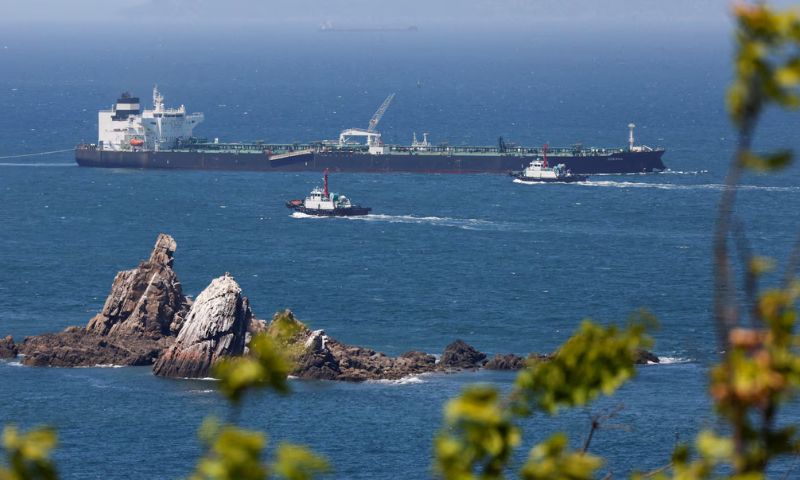
Analytics firm Kpler reported that intensified attacks on commercial ships had reduced Gulf crude flows to an average of about 8.5 million barrels per day over seven days last week.
They are comparable to more than 20 million bpd the previous week. At least 10 confirmed incidents of commercial ship attacks were reported during the week.
The disruption has raised concerns about the availability of crude oil and refined fuel.
READ ALSO: Oil Posts Weekly Gains on Persistent Shipping Risks
Shipping and insurance costs have added to the oil price premium. Reports on Monday continued to highlight risks to maritime traffic and the possibility of further escalation in the Middle East.
Egypt has also said it is prepared to support Saudi Arabia in defending its security and stability against Yemen’s Houthis, underscoring regional concerns over the threat to shipping and energy infrastructure.
According to the International Energy Agency, member countries were assessing whether to release additional diesel from emergency stocks, reflecting concerns over refined fuel supplies.
The market is therefore balancing two opposing forces: the prospect of additional Russian supplies is encouraging profit-taking, while continuing attacks on vessels and uncertainty over Gulf oil exports are limiting the scope for a sustained decline.
Monday’s retreat does not necessarily indicate that the underlying supply crisis has eased. Prices remain elevated, and any further deterioration in shipping conditions could renew upward pressure on crude and refined fuels.