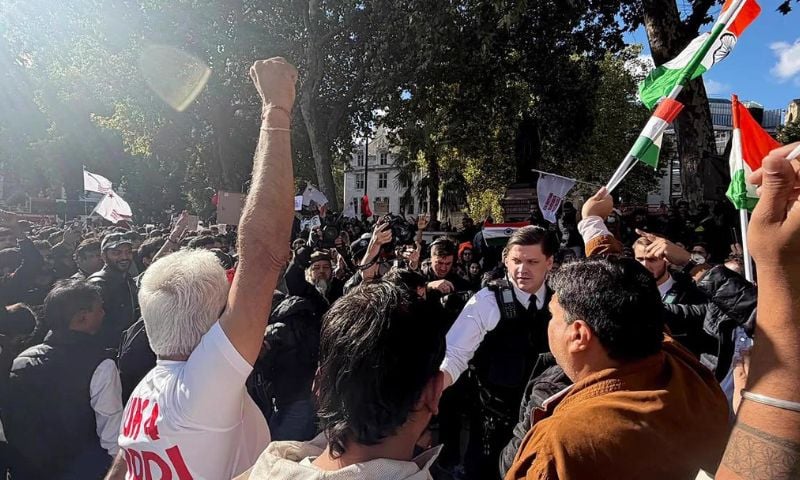
LONDON: Hundreds of Indian students gathered at Parliament Square in the British capital on Saturday to protest against India’s ruling Bharatiya Janata Party (BJP) and demand the removal of Chief Election Commissioner Gyanesh Kumar over a controversial revision of electoral rolls.
The demonstration, organised by the Indian Overseas Congress Youth wing and supported by UK-based Indian students’ groups and other diaspora organisations, featured calls to end “vote theft” and protect India’s democratic institutions.
HAPPENING NOW – Indian students stage protest against Modi government in London https://t.co/flTzXYstzS
— Insider Paper (@TheInsiderPaper) October 17, 2026
Activist Dhruv Rathee addressed the gathering as the keynote speaker at the “Stop Vote Chori” (Stop Vote Theft) protest. He called for the chief election commissioner to be replaced through a process agreed upon by the government and the leader of the opposition.
Irony 🤯 Indians wave Tiranga freely in LONDON but arrested in India!
Even 1st season villain is supporting the protest to save democracy!
Vote Chor protest reached London. Democracy dead in India, alive in Britain! 🇮🇳🇬🇧
#LondonProtest #VoteChor https://t.co/YOPwss0bjI
— Sananda Banik (@Sbwritesco) October 17, 2026
“It is important to spread the message against ‘vote chori’ in our country,” Rathee said in Hindi. “These protests will stop the moment the Chief Election Commissioner is replaced by a candidate that is chosen in agreement between the government and the Leader of the Opposition.”
Protests against Modi in London are being held. It is being said that the Election Commission in India has made Modi win by rigging the votes, that is why the opposition is protesting. https://t.co/oz5qMTXmZt
— رضوانہ (@Rizvana_72) October 17, 2026
The gathering also featured slogans of “Inquilab Zindabad” and “Vande Mataram”, as well as a reading of the preamble to India’s constitution.
The demonstration was organised by the Indian Overseas Congress Youth wing, with support from diaspora platforms including Save Democracy, the UK chapter of the Students’ Federation of India (SFI) and the South Asia Solidarity Group.
The London protest was part of a wider wave of demonstrations in India over the revision of electoral rolls and demands for Kumar’s resignation.
Election Chief Under Fire
The protests have centred on the Special Intensive Revision (SIR) of voter lists. Opposition parties and activists say the exercise risks removing eligible voters from electoral rolls to benefit Modi’s BJP.
Opposition leaders have called for Kumar’s resignation, alleging that the Election Commission’s actions undermine electoral fairness.
Congress leader Rahul Gandhi and other opposition lawmakers were detained last week while attempting to march to the Election Commission’s headquarters.
Opposition leaders have also taken their concerns to President Droupadi Murmu and marched towards the Supreme Court.
Gandhi has condemned the arrests of leaders of the youth-led Cockroach Janata Party (CJP) and called for Jantar Mantar, a designated protest site near parliament, to be reopened for demonstrations.
The CJP emerged as a youth-led movement after India’s chief justice likened some unemployed young people to “cockroaches” in May.
The group’s founder, Abhijeet Dipke, adopted the term as the movement’s name, turning it into a rallying cry for young people frustrated with the political system.
Arrests and Police Crackdown
In New Delhi, Dipke was released from detention on Saturday, a day after his arrest during a police crackdown on protesters. Two other senior CJP leaders, Ashutosh Ranka and Saurav Das, remained in custody after being arrested earlier in the week.
Dipke, 31, was detained on Friday while heading to join a CJP rally in Connaught Place, a commercial district in the capital.
“Abhijeet Dipke released,” CJP legal affairs chief Ratna Singh said on social media.
Thousands of protesters gathered in Connaught Place on Friday, demanding Kumar’s resignation despite a heavy security presence. Police sealed off Central Park, the planned site of the demonstration, and deployed thousands of police and paramilitary personnel to prevent the gathering.
Police initially appeared to hold back but later used force against protesters as darkness fell. Officers pushed demonstrators into buses to take them to jails. Two people were injured during the police action.
Anish Gawande, an opposition politician who had hosted Dipke, questioned the police action.
“Detaining a lone man walking with the national flag in his hand is a bit of a joke,” he said.
Ranka and Das were arrested on October 14 after returning to Jantar Mantar, where police had prohibited demonstrations. They were sent to jail for five days after police said they had breached the conditions of their release by entering the restricted site.
The arrests followed an earlier crackdown in which police detained CJP leaders and supporters seeking to reach a rally.
CJP spokesperson Mehr Pasricha said the arrests would not stop the movement.
“They may detain three people, but how will they stop 30 tomorrow? How will they stop 300 leaders?” she told the BBC.
Pasricha said the party had a team and a plan to sustain demonstrations if its leading figures remained behind bars.
“If the top three continue to stay behind bars, we will continue to protest peacefully,” she said.
Authorities imposed strict restrictions during demonstrations the previous weekend, sealing roads, shutting metro stations and deploying thousands of security personnel across Delhi. Ahead of Friday’s protest, Central Park was closed for two days.
The CJP instead urged supporters to enter Connaught Place in groups of fewer than five, unfurl the national flag, take photographs and leave. It encouraged participants to share the images online, maintaining that waving India’s flag was not a crime.
Unemployment Fuels Youth Anger
The demonstrations have also reflected wider frustration among young Indians over unemployment, examination paper leaks and what protesters describe as a lack of economic opportunity.
Modi came to power in 2014 promising to create millions of jobs each year. Employment remains a major concern, particularly among young people and graduates.
Research published in Azim Premji University’s State of Working India 2026 report found that unemployment among graduates aged 15 to 25 was nearly 40%, while about one in five graduates aged 25 to 29 remained jobless.
In May, unrest spread after the government invalidated examinations for admission to national medical colleges following the leaking of test papers. The examinations are an important route into professional careers for students from poorer and middle-income families.
Growing Challenge to Modi
Rights groups and opposition leaders have criticised Modi’s government over the erosion of democratic freedoms during more than a decade in power. They have cited concerns over pressure on journalists, civil society groups and political opponents.
The youth-led protests have given wider visibility to discontent over electoral fairness, employment and governance.
The CJP and independent news channels on YouTube have helped amplify demonstrations that have received limited coverage in India’s mainstream media.
Protesters have used mobile phones to document police actions and circulate footage online.
Opposition parties that have struggled to challenge Modi’s political dominance have also returned to the streets. Gandhi and tens of thousands of his supporters have joined protests against the Election Commission.