
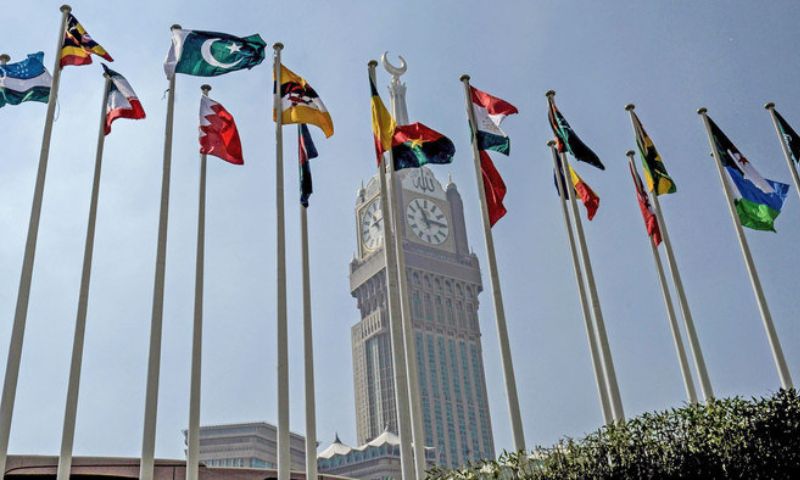
Key Points
- OIC condemns attacks on Makkah and Madinah region
- Calls attacks on holy sites and civilians terrorism
- Expresses solidarity with Saudi Arabia
ISLAMABAD: The Organisation of Islamic Cooperation (OIC) has condemned “heinous attacks” carried out by the Houthi group against Makkah and the Madinah region, as well as its continued aggression against Saudi Arabia.
In a statement, the OIC General Secretariat said the attacks had instilled fear among innocent civilians, violated the sanctity of Islamic holy sites and mosques, and provoked the sentiments of Muslims around the world.
It said the Houthi group’s actions targeting holy sites, mosques and civilian infrastructure “constitute terrorism” and were incompatible with Islamic values and international norms, principles and law.
The OIC stressed that any violation of the sanctity of Islamic holy sites was unacceptable and intolerable, calling for measures to deter those responsible and prevent further attacks against the sites.
OIC solidarity and support

The organisation expressed full solidarity with Saudi Arabia, supporting measures taken by the Kingdom to deter the attackers, preserve the sanctity of the holy sites and protect the lives of Muslims.
The OIC also affirmed its support for Saudi Arabia’s efforts to safeguard its security and sovereignty.
Recent weeks have seen a sharp escalation in attacks affecting Saudi Arabia and Red Sea shipping.
READ ALSO: Ismail Ould Cheikh Ahmed Elected OIC Secretary-General
On September 8, Houthi forces struck the southern Saudi cities of Abha, Jazan, Khamis Mushait and Najran, with at least 73 people reported wounded and several energy facilities temporarily affected, according to the Council on Foreign Relations.
The Houthis have also attacked Saudi-linked oil tankers in the Red Sea and threatened Saudi-linked shipping through the Bab el-Mandeb, a vital maritime chokepoint connecting the Red Sea with the Gulf of Aden.
More recently, Houthi advances along Yemen’s Red Sea coast have heightened concerns over commercial shipping and regional energy supplies, according to the AP News.