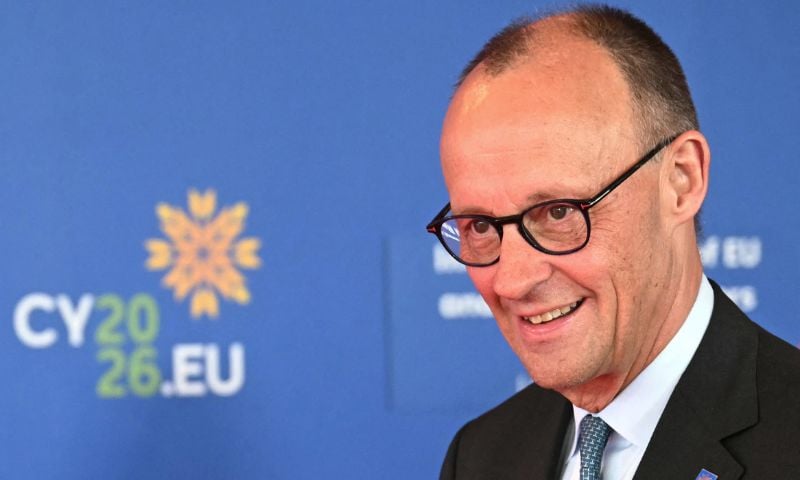
NICOSIA, Cyprus: German Chancellor Friedrich Merz said Friday there was no prospect of Ukraine’s “immediate accession” to the EU, but suggested Kyiv could join meetings of the bloc’s members without voting rights.
Kyiv’s progress has been blocked by Hungary’s premier Viktor Orban, but his defeat in elections earlier this month raised hopes it can move to the next step.
EU leaders broadly back moving Ukraine forward by opening the first of the negotiating “clusters”.
“It is clear to everyone that an immediate accession of Ukraine to the EU is, of course, not possible,” Merz said after an EU summit in Cyprus that Ukrainian leader Volodymyr Zelensky attended.
“I also want to enable closer integration into the European institutions, for example, through participation in European councils without voting rights,” Merz added.
Just ahead of the gathering in Cyprus, Zelensky appeared to pour cold water on any plans to grant Kyiv some form of lesser status instead of full membership.
He insisted that Kyiv “does not need symbolic EU membership”.
“We are defending common European values. I believe that we deserve full-fledged EU membership,” Zelensky told journalists.
Ukraine is desperate to keep up momentum towards joining the bloc and fears that any suggested interim solutions will see it stranded for years in a halfway house.
Kyiv’s ‘impressive’ strides
European Council chief Antonio Costa, who chairs EU summits, said that the strides Kyiv had made on reforms even during wartime were “very impressive”.
But he called the painstaking negotiations towards membership “a long process, a very hard one.”
“We cannot try to fix artificial moments — to say it is in three months or is in 10 years,” he said.
“We need to work very hard and to continue to work very hard to deliver on this, and as soon as possible.”
Standing alongside Costa, European Commission head Ursula von der Leyen said that ultimately letting Ukraine in would be a “political decision” for EU leaders.
But she insisted that if countries wanting to join carry out the necessary reforms then they should be moved closer to membership.
“It’s a two-way contract,” said von der Leyen. “If they deliver on the reforms, they have a certain right to move forward in the process.