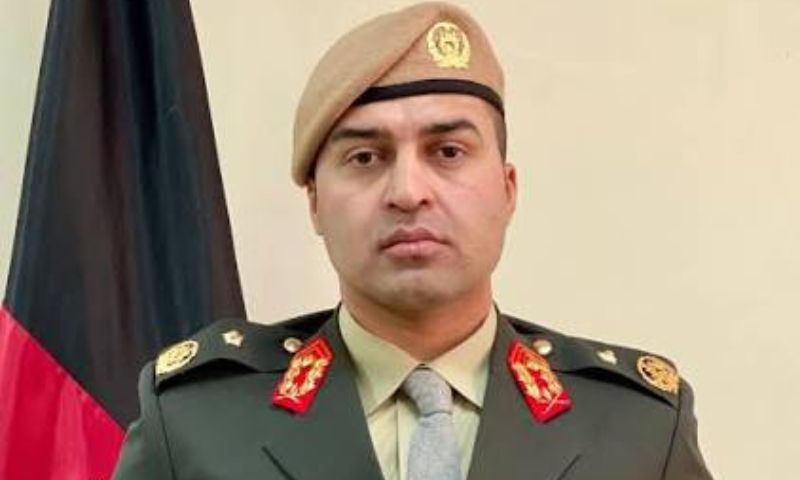
KABUL: A newly formed Afghan resistance group led by former deputy chief of the Afghan National Army Lieutenant General Sami Sadat has announced that it will intensify armed operations against the Taliban, after claiming a series of attacks across several provinces since the beginning of August.
The Afghan United Front (AUF), which emerged publicly on August 1, said it had launched its first operation in Kandahar, killing two Taliban fighters. It subsequently claimed responsibility for further attacks in Helmand, Badghis, Ghor, Faryab and Kandahar provinces.
Sadat, a former commander of the Afghan National Army’s 215th Corps in Helmand, said the group had spent years preparing for the campaign and had concluded that efforts to reach a political settlement with the Taliban had failed.
“Historically, Afghans first fight and then come to politics,” Sadat told the Foundation for Defence of Democracies’ Long War Journal. He said the AUF had sought to learn from previous failures by developing a strategy, assembling experienced former Afghan military commanders and establishing an international network before beginning military operations.
In a video released on X following the initial attacks, Sadat formally announced the beginning of the group’s combat campaign.
Wearing the uniform of the former Afghan National Army, he said the failure of negotiations had left Afghans facing serious human rights abuses and what he described as the resurgence of international terrorism in the country.
Sadat also appealed to the international community for support, particularly NATO, while making clear that the group was not seeking the deployment of foreign troops.
“We do not want your soldiers,” he said, while calling for material assistance in fighting the Taliban as well as Al Qaeda, Islamic State and Tehreek-e-Taliban Pakistan.
The AUF leader also sought to reassure Afghanistan’s neighbours that the group’s campaign was directed against terrorist organisations inside Afghanistan rather than neighbouring states.
A series of claimed attacks
The group said it carried out several further operations following its initial attacks. On August 2, the AUF claimed responsibility for an attack in Badghis province in which it said two Taliban members were killed. The group accused the men of torturing former Afghan security personnel.
The same day, it claimed another operation in Ghor province, describing it as retaliation for the killing of a former female Afghan police officer.
On August 3, the AUF said it attacked a Taliban police facility in Kandahar, killing two guards stationed at the entrance. It said the operation was carried out in response to alleged torture and the detention of civilians.
On August 4, the group claimed that one member of the Taliban’s intelligence service was killed in an attack in Qaysar district of Faryab province.
The AUF then reported two separate attacks in Kandahar province on August 6. According to the group, Taliban intelligence officials were targeted in Spin Boldak and Kandahar City, with both officials killed.
READ ALSO: India-Afghan Taliban Supporting Terrorism Against Pakistan: Former Afghan General
Focus on southern Afghanistan
The emergence of the AUF could add a new dimension to the armed opposition facing the Taliban. Unlike several established anti-Taliban resistance groups that have historically operated mainly in northern Afghanistan, the AUF is led by Pashtun figures and appears intent on expanding its campaign into the country’s predominantly Pashtun south.
Sadat said the decision to begin operations in Kandahar -the Taliban’s historic heartland and the home province of Supreme Leader Haibatullah Akhundzada – was deliberate.
“We want to show them that no place is beyond the reach of our attacks,” he said. The former Afghan general said the group’s immediate objective was not necessarily to defeat the Taliban militarily, but to maintain pressure on the authorities and prevent them from consolidating their control.
“Success for us at this stage of the conflict is keeping the Taliban busy fighting us so they do not have time to torture our people,” Sadat said.
He said the longer-term goal was to build momentum towards a united Afghan resistance under the tricolour flag used by the former Islamic Republic of Afghanistan.
Additional pressure on the Taliban
The AUF’s operations could further complicate an already difficult security environment. The Taliban face armed opposition from several groups, including the National Resistance Front and Afghanistan Freedom Front.
While the Islamic State-Khorasan continues to carry out attacks inside Afghanistan. Tensions along the country’s border with Pakistan have also added to the security challenges facing the Taliban authorities.
With the fifth anniversary of the Taliban’s return to power approaching on August 15, anti-Taliban groups may seek to increase attacks in an attempt to challenge the authorities’ claims of stability and effective control across the country.
Sadat has vowed that the AUF’s campaign will continue for as long as necessary. “We are going to go all the way, as long as it takes, and whatever it takes,” he said.
The former military commander said the AUF’s objective was ultimately to establish a political order in which civil liberties and citizens’ rights would be protected by law, describing its desired outcome as a “free Afghanistan from the Taliban” and a return to constitutional government.