Key points
- Fresh river surges threaten already devastated communities
- China reports 16 deaths and 546 people missing
KATHMANDU: Devastating floods that swept through Nepal’s Bhotekoshi and Trishuli river systems have killed 734 people and left 2,498 missing, as rescue teams continue searching for survivors and authorities warn of surging flows threatening affected areas.
Nepal’s National Disaster Risk Reduction and Management Authority (NDRRMA) confirmed the latest figures on Sunday, with more than 3,700 people rescued so far.
The disaster has destroyed homes, roads, bridges and hydropower infrastructure across several northern and central districts.
The disaster began on August 26 when a massive collapse of ice and rock in the Himalayan region triggered a surge of water and debris that entered the Lhende River system and swept downstream into Nepal.
The resulting floods devastated communities along the Bhotekoshi River before the water reached the Trishuli system.
Scientists and geological agencies have linked the event to a glacier collapse and subsequent landslide.
The United States Geological Survey said the seismic signal initially interpreted as an earthquake was actually generated by the landslide, which was powerful enough to register at magnitude 5.2.
The flooding has severely disrupted transport and communications. Bridges and sections of roads have been washed away, making some communities difficult to reach and complicating the movement of rescue teams and heavy equipment.
Nepal rescue underway
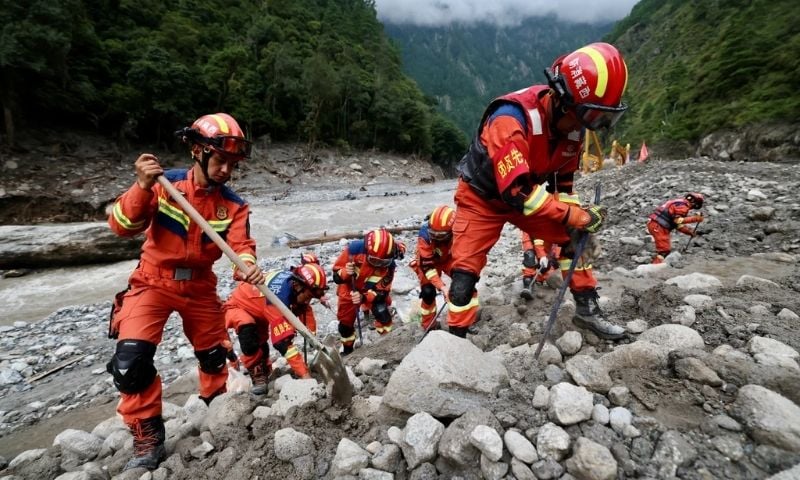
A major rescue operation is underway at hydropower facilities along the Trishuli River, where more than 100 workers are feared trapped inside tunnels.
The Nepalese Army has managed to insert a pipe into one tunnel to provide air to people believed to be trapped underground. Officials have reported that 933 hydropower workers are among those missing nationwide.
Fresh concerns have emerged over rising water levels in the Bhotekoshi River, prompting authorities to move people from vulnerable areas to safer ground.
The continuing threat is complicating rescue efforts and raising fears of further destruction in communities already hit by the initial flood.
READ ALSO: Nepal Flood Death Toll Rises to 675, More Than 2,400 Still Missing
The disaster has also affected areas across the border in China.
Chinese authorities have confirmed 16 deaths and 546 people missing following the mudslide at Gyirong Port in China’s Xizang Autonomous Region. Of those missing, 261 are foreign nationals from 23 countries.
The missing foreign nationals include 104 Nepalis, 49 Indians, 33 Latvians, 18 Americans and 15 Britons, according to Chinese authorities.
China said the figures were compiled after searches, site inspections, and cross-checks by foreign affairs, public security, tourism and emergency management authorities.
The combined death toll in Nepal and China has therefore reached at least 750, with more than 3,000 people unaccounted for.
China has deployed more than 2,100 rescue personnel and provided financial and technical assistance following the disaster.
Chinese authorities are also coordinating with foreign governments over missing nationals and identification efforts.
The scale of the destruction has raised a major reconstruction challenge for Nepal.
Finance Minister Swarnim Wagle has estimated that rebuilding could cost between $4 billion and $5 billion, equivalent to nearly one-tenth of the country’s economy.
The floods have damaged major infrastructure and hydropower facilities, adding to the economic cost of the disaster.
The disaster has also renewed concerns over the vulnerability of Himalayan communities to sudden glacier-related events.
Scientists say warming temperatures are contributing to instability in high-altitude ice and rock formations, although determining the precise chain of events behind the latest collapse will require further investigation.
For Nepal, the immediate priority remains the search for thousands of missing people, evacuation from areas threatened by renewed flooding and restoring access to communities cut off by destroyed roads and bridges.