
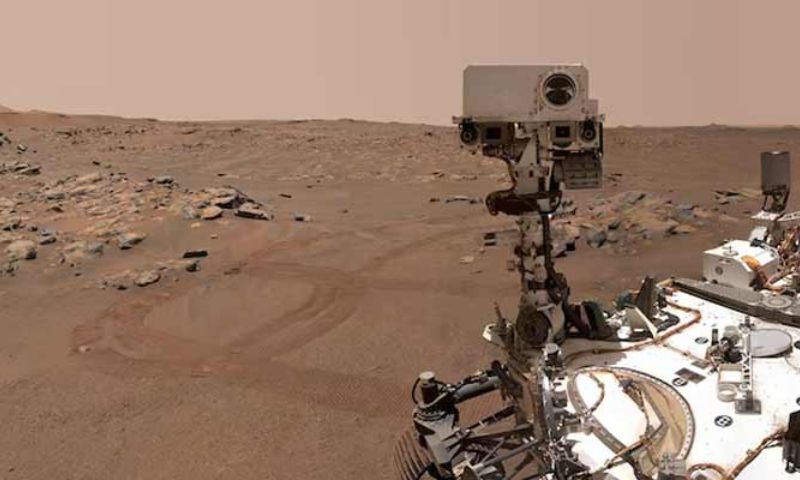
WASHINGTON: NASA’s Perseverance rover has set a new record for the longest distance driven by a vehicle on the surface of another world, covering 45.2 kilometres (28.1 miles) since landing on Mars in 2021, the US space agency said on Tuesday.
The car-sized, six-wheeled robotic rover achieved the milestone about five and a half years into its mission to investigate whether conditions suitable for microbial life ever existed on the Red Planet.
During its journey, Perseverance has been exploring some of the oldest terrain in the Solar System, gathering scientific data and examining rocks that could preserve evidence of ancient life.
Perseverance has set a new off-world record! 🏅
On Oct. 11, the rover’s odometer hit 28.10 miles (45.22 kilometers), eclipsing the distance record set by NASA’s Opportunity rover. 1/2 https://t.co/IThlI7dl2z
— NASA Mars (@NASAMars) October 12, 2026
“Perseverance’s engineering hardware and instruments are in excellent shape with all redundant systems still available,” Steven Lee of NASA’s Jet Propulsion Laboratory in California said.
Lee, the project manager for NASA’s Perseverance and Curiosity rovers, said a recent assessment had found that the systems were capable of operating well into the 2030s, and potentially beyond.
Perseverance has surpassed the previous record of 45 kilometres (28.06 miles), achieved by NASA’s Opportunity rover during its mission from 2004 to 2018. Both rovers have also travelled farther than any vehicle operating on the Moon.
Exploring Mars’s ancient landscape
Perseverance has concentrated its scientific investigations on Jezero Crater in the northern hemisphere of Mars. Scientists believe the region was flooded with water billions of years ago and once contained a lake.
The rover reached the latest milestone while travelling towards an area known as Idubi, crossing terrain beyond the crater’s western rim called Lac de Charmes. Its companion, Curiosity, continues to explore Gale Crater near the Martian equator.
According to Lee, Perseverance is showing no signs of slowing down. Engineers are testing its mobility systems to demonstrate their ability to support journeys of 100 kilometres (62 miles) or more.
The hardware is also being tested to the equivalent of distances ranging from 150 to 300 kilometres (93 to 186 miles). NASA credited much of the rover’s driving success to AutoNav, an autonomous navigation system that allows it to travel with limited human intervention.
READ ALSO: NASA Rover Finds Ancient River Delta Buried on Mars
Lee said around 90 per cent of Perseverance’s drives were completed autonomously. The rover captures stereo images of the terrain ahead, creates a three-dimensional digital map and selects a safe route towards its destination.
Another important component is the Vision Compute Element, a high-speed co-processor that enables Perseverance to process images and run its autonomous driving software almost continuously while moving.
Earlier Mars rovers had to pause more frequently to process information before proceeding along their routes. “Perseverance builds on the 29-year legacy of our past Mars rovers – Sojourner, Spirit, Opportunity and Curiosity — each incorporating prior lessons and improving our ability to drive on another world,” Lee said.
Searching for evidence of ancient life
Lee identified the rover’s discovery of a potential biosignature, announced last year, as arguably its most significant scientific achievement. A biosignature is evidence that may indicate the presence of past or present life, although further investigation is needed to establish its origin.
The potential biosignature was detected in reddish rock believed to have formed between 3.2 billion and 3.8 billion years ago in a river channel that once fed the lake in Jezero Crater.
Scientists are also interested in the Lac de Charmes region because it could provide clues about early geological processes on Mars, including the effects of major meteorite impacts that helped shape the planet’s surface.
Orbital observations suggest that some parts of the crater rim may once have hosted hydrothermal systems, where warm or hot groundwater circulated through rocks.
“ These areas may once have provided a warm, watery subsurface environment conducive to life,” Lee said, adding that some palaeontologists believe life on Earth may have originated in similar environments.
Perseverance was originally designed to travel about 20 kilometres (12.4 miles), but its mission has since been extended. NASA recently approved a further extension to explore the crater rim until approximately the end of 2028.
The rover’s plutonium-powered energy system is also performing as expected, with Lee saying it still has many years of useful energy available.