
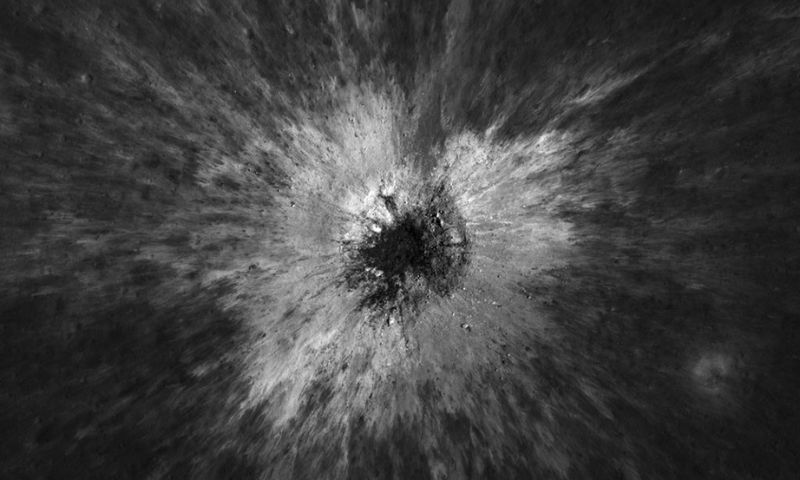
WASHINGTON: A NASA researcher has discovered a newly formed crater on the Moon, an extremely rare event that scientists estimate occurs only once in a century or longer.
The crater, named “McGetchin”, measures around 730 feet (222 metres) in diameter and is believed to have formed in spring 2024 after an asteroid or comet struck the lunar surface.
NASA said the object responsible for the impact was likely the size of a three-to-six-storey building, creating one of the largest recently observed lunar impact sites.
Rare Lunar Discovery
The crater was identified by Robert Wagner, a researcher working with NASA’s Lunar Reconnaissance Orbiter (LRO), after analysing new scans of the Moon’s surface.
The LRO, which has been studying the Moon since 2009, detected the feature as a bright area surrounded by a darker halo.
Although the crater had existed for several years, it remained undiscovered until Wagner’s analysis revealed the unusual surface mark.
ALSO READ: What AI Means for the Fate of Mathematics
A study published Wednesday in the journal Science Advances described McGetchin as the largest newly discovered crater formed during the modern era of solar system observation.
Scientific Importance
Scientists said studying a crater shortly after its formation provides valuable information about the Moon’s geological processes.
While the lunar surface contains countless craters, most were created millions or billions of years ago, making real-time observations of new impacts extremely rare.
Researchers believe findings from McGetchin could improve understanding of lunar conditions and help support future crewed missions planned by the United States and China.
Moon Impact Risks
Unlike Earth, the Moon has almost no atmosphere to slow down or burn up incoming space objects before they reach the surface.
As a result, asteroids and other debris can strike the Moon directly, leaving visible marks that remain preserved for long periods.
The discovery highlights the continuing changes occurring on the lunar surface and provides scientists with a rare opportunity to study a fresh impact event.