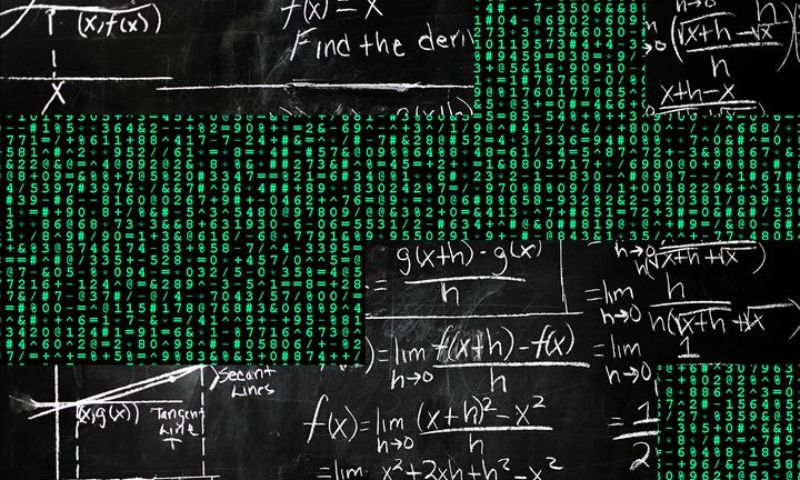
NEW YORK: Artificial intelligence is challenging long-held ideas about the future of mathematics after OpenAI used thousands of AI agents to solve the long-standing Navier-Stokes equations, one of the most difficult problems in modern mathematics.
The breakthrough, achieved earlier this month after four days of AI-driven work, has sparked debate over whether advanced systems will transform mathematical research or threaten the traditional role of mathematicians.
AI Breakthrough Sparks Debate
Terence Tao, a UCLA professor and Fields Medal winner, said the development had created a major moment of uncertainty for the field.
“I am currently completely overwhelmed with an existential crisis in my field,” Tao told the media.
Other mathematicians said AI’s growing ability to produce complex mathematical arguments represents a significant shift. Steven Strogatz, a Cornell University professor, said AI could potentially solve many research problems if it focused on questions considered important by mathematicians.
ALSO READ: AI To Take Centre Stage At Xi-Trump Summit
Antonio Auffinger, a mathematics professor at Northwestern University, said AI systems have improved significantly, moving beyond earlier problems with incorrect or incomplete responses.
Creativity Remains Challenge
Despite AI’s advances, researchers said creativity and the ability to identify meaningful questions remain areas where humans continue to play a central role.
Benjamin Antieau of Northwestern University described the achievement as impressive but noted that the AI approach built upon years of work by mathematicians studying similar problems.
The breakthrough has also raised questions after researchers Tristan Buckmaster and Levent Alpoge said they had developed a similar approach before OpenAI’s announcement. They questioned whether their work had been used, a claim OpenAI has denied.
Future of Mathematics
Tao and 24 other Fields Medal winners recently warned that rapid AI development could have a damaging effect on mathematics by reducing opportunities for human learning, collaboration and discovery.
Stanford University professor Mohammed Abouzaid said AI has not yet demonstrated the kind of creative leaps that lead to entirely new areas of mathematics.
Anima Anandkumar, a Caltech professor working on AI and mathematics, said some AI models have solved simplified mathematical problems independently using physics-informed neural networks, though these systems still require human design and testing.
Researchers said AI is likely to become a powerful tool for mathematicians, but many believe humans will remain essential for choosing problems, developing new ideas and deciding how mathematical discoveries can benefit society.