
Key points
- PMD warns of urban flooding over the next 48 hours
- Ravi, Chenab may reach low-to-medium flood levels
- Flash floods threaten KP, DG Khan and Kabul tributaries
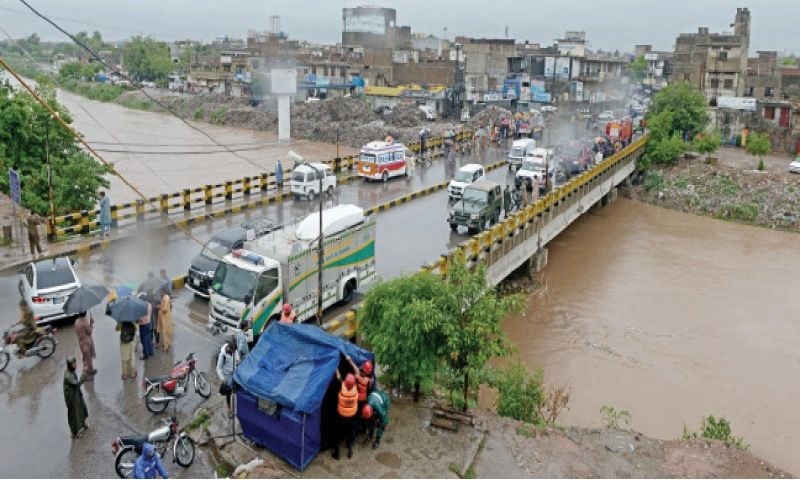
ISLAMABAD: Pakistan’s ongoing monsoon spell intensified on Wednesday, bringing heavy rain to Rawalpindi, Islamabad and parts of northern and central Punjab as the meteorological authorities warned of urban flooding, flash floods and rising river flows over the next 24 to 48 hours.
Pakistan Meteorological Department (PMD) recorded up to 98 millimetres of rain at Shamsabad (Rawalpindi), 97mm at PMD Headquarters (H-8) and 94mm at Saidpur in Islamabad during the 24 hours ending at 8 am on Wednesday.
New Kattarian and Golra received 90mm each, while Bokra and Pirwadhai recorded 86mm each.
Attock received 79mm, while Chaklala recorded 55mm. The heavy downpour also extended into Pakistan’s highly populated province Punjab, with 83mm recorded at Daulat Nagar, 65mm at Lahore Airport and 39mm in Gujranwala.
The FFD said widespread rain and thunderstorms, with isolated heavy falls, are expected over the upper catchments of the Jhelum, Chenab, Ravi and Sutlej rivers, Islamabad, Kashmir, upper Khyber Pakhtunkhwa (KP) and upper Punjab during the next 48 hours.
For Rawalpindi and Islamabad, the immediate threat is urban flooding. The FFD has forecast urban flooding in Rawalpindi, Lahore, Gujranwala, Sialkot, Faisalabad and Gujrat during the next 24 hours, with the same risk continuing upt to 48 hours.
READ ALSO: Pakistan Monsoon Death Toll Rises to 159 as Heavy Rains Trigger Flash Floods and Landslides
The latest spell has already caused widespread waterlogging and disruption in the twin cities. Nullahs and drainage channels are under particular watch because intense short-duration rainfall can rapidly increase runoff and overwhelm urban drainage systems.
Pakistan’s Rivers under watch
Pakistan’s latest flood bulletin issued at 11:30am on Aug 19 shows that the major rivers are not uniformly at flood levels, but several are expected to rise significantly.
At 6am, the Indus was at low flood level downstream at Kalabagh, Chashma, Taunsa and Guddu. The Kabul, Jhelum, Chenab, Ravi and Sutlej were listed as below low flood level at the monitoring stations used in the bulletin.
The FFD, however, forecast that the Ravi and Chenab, including their associated nullahs, would attain low-to-medium flood levels within the next 36 hours. Its 48-hour outlook maintains the same warning.
The latest quantitative forecast puts the next 24-hour Indus inflows at 235,300 cusecs at Tarbela, 334,200 at Kalabagh, 285,200 at Chashma, 315,900 at Taunsa and 268,900 at Guddu. All remain in the low-flood category in the FFD forecast.
On the Chenab, inflows are forecast at 80,000-120,000 cusecs at Marala, 80,000-110,000 at Khanki and 80,000-100,000 at Qadirabad, all forecast to remain at low flood level. Trimmu and Punjnad are expected to remain below low flood level.
The Ravi presents a more immediate concern. Balloki recorded an inflow of 42,400 cusecs at 6am and is forecast to receive 40,000-70,000 cusecs over the next 24 hours, placing it in the low-to-medium flood category. Shahdara is forecast to reach low flood level, with inflows of 25,000-50,000 cusecs.
Tarbela reservoir is already at its maximum conservation level and 100% of live storage, according to the FFD. Mangla is 70.15 per cent full. The high storage at Tarbela leaves less room to absorb additional inflows if substantial rainfall continues over the upper Indus catchment.
Threat extends beyond Punjab
The Pakistan Met office expects widespread rain and thunderstorms in Khyber Pakhtunkhwa’s Abbottabad, Bajaur, Battagram, Buner, Haripur, Dir, Malakand, Mansehra, Mardan, Shangla, Swabi, Swat and Tor Ghar during the next 24 hours.
Scattered rain and thunderstorms are also expected in Charsadda, Chitral, Khyber, Kohat, Kohistan, Mohmand, Nowshera and Peshawar, while parts of Gilgit-Baltistan, including Astore, Diamir, Ghizer, Gilgit and Tangir, remain under the weather outlook.
Pakistan’s weekly significant outlook for Aug 20-26 indicates that the wet pattern is likely to continue, with widespread rain and thunderstorms and isolated heavy falls expected over the upper catchments of the Jhelum, Chenab, Ravi and Sutlej, Islamabad, Kashmir, Gilgit-Baltistan, upper KP and upper Punjab, with occasional gaps.
The division has specifically warned that the Ravi and Chenab and their associated nullahs could reach low-to-medium flood levels during the next 48 hours.
It has also forecast flash flooding in the hill torrents of Dera Ghazi Khan and tributaries of the Kabul River, alongside continued urban flooding in Rawalpindi and several Punjab cities.
Human toll and preparedness
The continuing rainfall comes after a deadly start to the monsoon season. The latest widely reported NDMA situation figures put the nationwide death toll at 151, with 418 people injured since the monsoon began on June 26.
The deaths have included casualties from drowning, house collapses and other rain-related incidents.
Pakistan’s National Disaster Management Authority (NDMA) has maintained heightened preparedness through its emergency operations and early-warning mechanisms as the latest spell moves across the country.
The latest FFD assessment points to a two-pronged threat: intense rainfall over already vulnerable urban areas, particularly Rawalpindi and Islamabad, and continued rain over river catchments that could push the Ravi and Chenab into low-to-medium flood levels.