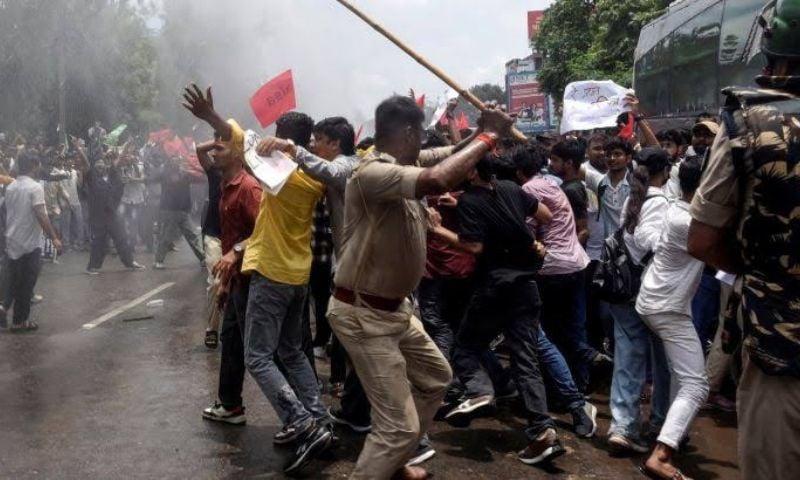
NEW DELHI: Indian opposition Congress party President Mallikarjun Kharge on Saturday accused Prime Minister Narendra Modi’s government of crushing the aspirations of young people and pushing them towards a “dead end”, forcing them onto the streets to protest.
Speaking at the Congress headquarters on India’s 80th Independence Day, Kharge said the government was failing to address the concerns of young people while taking credit for achievements of previous administrations.
He also accused the government of avoiding accountability to Parliament.
“We want an India where the voice of the poor is heard, where farmers move forward with dignity, where young people can fulfil their dreams and where no one has to be afraid to speak the truth to those in power,” Kharge said.
Congress President Mallikarjun Kharge says, “Modi ji created the Ram Temple trust and appointed his most trustworthy people to this trust. Questions being raised on theft of donations made by people are obvious. Under Modi ji, even the Rs 50 offering made in the temple is not… pic.twitter.com/rVi5lIGNQp
— WION (@WIONews) August 15, 2026
Kharge’s remarks came as student protests and concerns over education and government recruitment remain a major issue in India.
Warning of wider student protests
Meanwhile, Yoga guru Ramdev also warned the Modi government on Saturday that protests over irregularities in education and recruitment examinations could intensify.
Speaking to reporters at Patanjali Yogpeeth, he said the government needed to address what he described as a “ghapla”, or scam, or face further agitation.
Yoga guru Swami Ramdev has raised concerns over student protests and alleged irregularities in India’s education and government recruitment systems.
Speaking at Independence Day celebrations at Patanjali Yogpeeth, he said protests indicate serious gaps in education and… pic.twitter.com/T91iIdeka1
— The Siasat Daily (@TheSiasatDaily) August 15, 2026
Ramdev also said he could join the protests himself if the authorities failed to resolve the grievances.
Ramdev said students were protesting over lack of basic facilities in schools and colleges, including a shortage of teachers and a lack of electricity, water and toilets.
He also said that corruption and money power were influencing recruitment to government jobs.
“There is chaos everywhere in the country,” Ramdev said, citing complaints about missing teachers, inadequate facilities, alleged cheating and examination paper leaks.
He further alleged corruption in government recruitment interviews and claimed that selections were being influenced by caste and religion.
Ramdev also alleged that candidates had been asked to pay as much as 1 crore rupees in bribes for government jobs.
“If everyone starts protesting, then how will the country run? Hence, mend your ways; otherwise, agitation would escalate further,” he said.
Student movement beyond streets
The comments come after a student-led protest movement that has used the satirical name Cockroach Janata Party (CJP).
The movement began on social media after activists raised allegations over the leaking of a question paper for the National Eligibility-cum-Entrance Test (NEET), a highly competitive examination for students seeking admission to medical colleges.
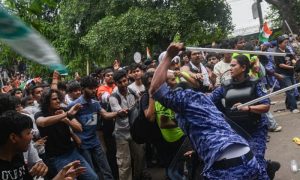
The movement later expanded into wider demands for reforms to India’s examination system.
Education Minister Dharmendra Pradhan stepped down following weeks of protests calling for his removal.
The government also promised to withdraw police cases against peaceful protesters, compensate families affected by the NEET controversy and continue talks on a five-point charter put forward by the movement.
Student leaders, lawyers and activists now say the dispute has moved from the streets to police stations, courts and social media.
Indian lawyer and politician Kapil Sibal told German broadcaster DW that government actions after the protests were called off had raised fresh questions over whether official assurances were being honoured.
“The way Dharmendra Pradhan was celebrated after his resignation shows the government has learned nothing from the protests or the message the students were trying to convey,” Sibal told DW.
The agreement that ended the protests appeared to provide for the withdrawal of protest-related police cases and the release of detained students in Delhi, Bihar, Assam, Maharashtra and West Bengal.
Protesters report continued pressure
Student protesters say police action has continued despite the end of large-scale demonstrations.
They allege that officers have visited homes, questioned people using photographs and CCTV footage, continued investigations and monitored social media activity.
A senior Delhi Police official rejected allegations of intimidation. The official said police were following up on registered cases and investigating alleged offences using CCTV footage, photographs and other digital evidence.
Among those who have approached the courts is Mohammad Junaid Malik, a law student who ran a free community kitchen for protesters at Delhi’s Jantar Mantar for 35 days.
Malik has petitioned the Supreme Court, alleging illegal detention, interrogation and harassment of his family after the protests ended.
In Uttar Pradesh, a young protester told DW anonymously that he was detained after police identified him from a photograph taken during a solidarity demonstration.
In Bihar, student organisations said several protesters, including minors, were detained before the state began withdrawing protest-related cases.
Student leaders say such incidents have left protesters uncertain about whether government assurances are being implemented on the ground.