
Key points:
- Major economies remain outside proposed bank
- Founders target autumn charter signing
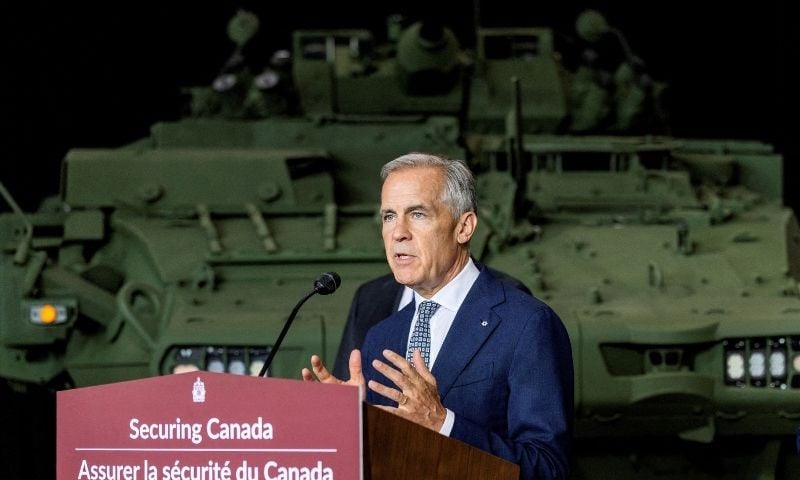
ISLAMABAD: Major powers are holding back from Canada’s proposed global defence bank, leaving the €100 billion initiative short of the financial backing it needs to establish a strong credit profile and offer cheaper funding for defence projects.
The Defence, Security and Resilience Bank (DSRB) has secured about €5 billion in commitments so far, against plans for €20 billion in paid-in capital and a further €80 billion in callable capital, according to the latest reporting.
Canada is seeking to build the institution as a multilateral source of low-cost loans and guarantees for governments and defence companies, including smaller firms that struggle to obtain commercial financing.
Nine countries have pledged support: Canada, Albania, Belgium, Greece, Latvia, Luxembourg, Romania, Türkiye and Ukraine. The proposed institution is intended to be based in Canada.
The bigger economies that could give the institution financial weight have yet to sign up. Germany and Britain remain noncommittal, and Japan has not yet decided whether to participate.
Their absence raises questions over whether the project can secure the triple-A rating sought by its founders, which would be crucial to borrowing at sufficiently low rates.
The hesitation reflects both financial and strategic concerns. Potential members must weigh the capital they would commit against the benefits of borrowing through a new multilateral institution.
Some also question whether it would provide cheaper financing than countries with strong sovereign credit ratings can obtain directly.
The DSRB would also enter an already crowded defence-financing landscape. The European Union has established its €150 billion Security Action for Europe, or SAFE, programme, while Britain is pursuing a separate Multilateral Defence Mechanism.
The overlap has raised questions over whether governments need another institution to finance the rapid expansion of defence spending.
Canada moves ahead with bank project
Canada is nevertheless moving ahead with the project and is seeking additional participants before the planned autumn signing of the bank’s charter. The founding group could proceed even if some larger economies decide to join later.
The proposed bank is designed to address a financing gap that its supporters say is particularly acute for defence companies and supply chains. Its guarantees could encourage commercial lenders to finance smaller and higher-risk firms, potentially allowing them to expand production and participate in allied rearmament programmes.
Private financial institutions are also supporting the initiative. JPMorgan and Deutsche Bank are among banks that have provided funding or services to help establish the institution, according to the latest reporting.
The central test now is whether Canada can turn the initial coalition into a sufficiently large shareholder base.
Without substantial participation from financially powerful economies, the bank could struggle to achieve the scale, credit rating and borrowing costs needed to distinguish it from existing national and regional defence-financing schemes.
READ ALSO: Saudi Cabinet Praises Makkah Summit for Joint Defence
The initiative is in line with allied governments accelerating military spending and seeking to expand weapons production, defence technology, infrastructure and strategic supply chains.
Supporters argue that a permanent multilateral financing institution could help channel private and public capital into those areas and strengthen the defence industrial base across participating countries.
For Canada, however, the immediate challenge is no longer securing support for the concept. It is persuading major economies to put enough capital behind it to make the proposed bank financially credible.
Rising defence spending among NATO allies has increased demand for financing to expand weapons production, military infrastructure and strategic supply chains.
Supporters say a dedicated multilateral lender could mobilise private capital for projects that conventional banks often consider too risky, particularly for smaller defence companies and emerging defence technologies.