
Key Points
- The 1,200-year-old Major Oak in Sherwood Forest, linked to Robin Hood, is believed to have died after failing to produce leaves this year.
- Experts say long-term visitor pressure, soil compaction, and climate change-driven heatwaves and drought likely contributed to its decline.
- Conservationists warn the loss highlights the fragility of ancient trees and the need for stronger protection of historic natural landmarks.
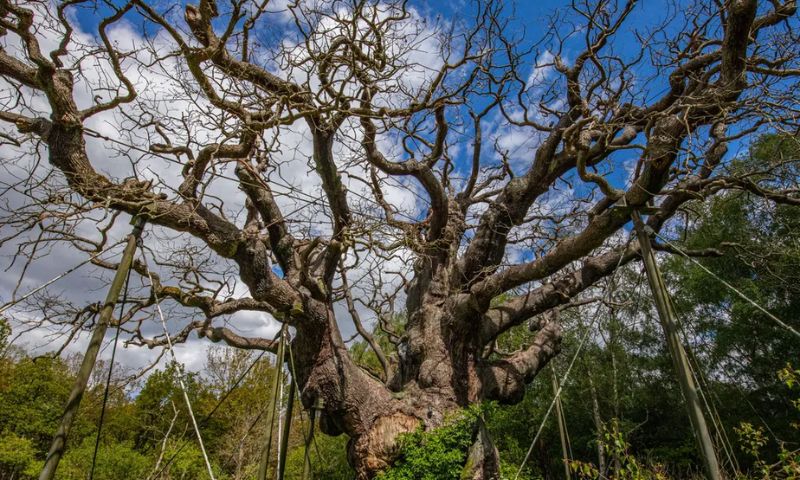
LONDON: The famed Major Oak in Sherwood Forest, a tree estimated to be around 1,200 years old and closely tied to the legend of Robin Hood, is believed to have died after showing no signs of leaf growth this spring, conservation officials have confirmed.
The Royal Society for the Protection of Birds (RSPB) said the historic oak failed to leaf out this season, a development experts described as “heartbreaking” for those involved in its long-term care. The tree had previously survived periods of decline, leading to repeated uncertainty over its condition in past years.
A 1,200-year-old oak tree linked to the legend of Robin Hood has died, according to scientists in the United Kingdom. https://t.co/oKvEu7bvuY pic.twitter.com/1TREK4MuRF
— ABC News (@ABC) June 19, 2026
Specialists believe the oak’s decline was driven by a combination of prolonged human pressure and environmental stress. Centuries of visitor footfall are said to have compacted the surrounding soil, restricting water absorption and damaging the root system.
Conservationists also point to extreme weather patterns, including heatwaves and drought linked to climate change, as contributing factors.
Tree experts found evidence that the root network had become severely weakened, with limited access to nutrients and moisture. The Major Oak had also been supported over recent decades with cables and structural braces to prevent collapse, further complicating its long-term health.
The tree gained its name in the late 18th century after being referenced by Major Hayman Rooke in a publication on ancient oaks, which helped turn it into a national attraction.
Since then, it has drawn millions of visitors to Sherwood Forest, where it has stood as one of Britain’s most iconic natural landmarks.
The Woodland Trust described ancient trees like the Major Oak as “conservation white rhinos”, highlighting their ecological importance and the difficulty of preserving them as they age. The organisation warned that many such trees disappear quietly despite their historical and environmental value.
Although the Major Oak was fenced off in the 1970s to protect it from direct damage, conservationists say long-term pressures have still taken their toll.
Despite its apparent death, experts note that the tree will continue to play a role in the forest ecosystem as it decays naturally, supporting biodiversity in Sherwood Forest.