Key Points
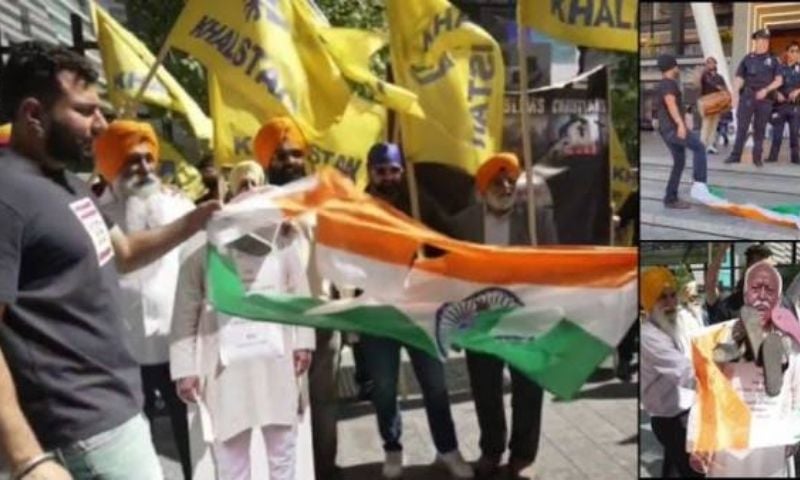
- Khalistan supporters demonstrated outside Madison Square Garden against Mohan Bhagwat.
- Protesters raised Khalistan slogans and condemned Hindu nationalist politics.
- Protesters cited discrimination against Sikhs, Muslims and Christians.
- Manipur violence was cited as evidence of minority persecution.
NEW YORK: Khalistan movement supporters staged a demonstration outside Madison Square Garden in New York against the appearance of Rashtriya Swayamsevak Sangh (RSS) chief Mohan Bhagwat, raising slogans against the Indian government and Hindu nationalist ideology.
Bhagwat addressed an Indian-American gathering at Madison Square Garden on Saturday as part of the RSS’s international outreach during its centenary year. The event, titled the “Universal Oneness Celebration”, was presented by its organisers as an interfaith gathering promoting peace, harmony and the idea of a shared human family.
The demonstration brought together Sikh and other civil-rights activists who opposed Bhagwat’s appearance and accused the RSS of promoting an exclusionary vision of India.
Sikh organisations participating in the protest included Sikhs for Justice (SFJ), the American Gurdwara Management Committee, Shiromani Akali Dal (Amritsar), the Khalistan Affairs Center and other Sikh groups, according to reports.
Protest against Hindutva
Protesters condemned the Indian government and what they described as the RSS-BJP’s Hindutva agenda, expressing concern over the treatment of religious minorities in India.
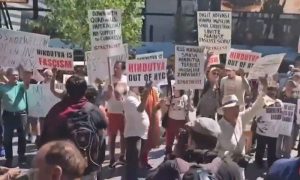
They raised slogans regarding discrimination against Sikhs, Muslims and Christians and voiced concerns about the broader human-rights situation in the country.
Gurpatwant Singh Pannun, general counsel of the US-based Sikhs for Justice, held the RSS and BJP leadership responsible for pursuing the creation of a “Hindu nation”.
Pannun referred to the 1984 Indian military operation at the Golden Temple, the 1992 demolition of the Babri Masjid and violence against Christians in Manipur while criticising what he called the Hindu nationalist project.
He also accused Indian state institutions of being used against Sikhs, Muslims and Christians.
Minority rights under scrutiny
The allegations raised by protesters come against the backdrop of repeated concerns from international human-rights organisations over religious freedom, minority rights, dissent and accountability in India.
Human Rights Watch’s 2026 World Report said India’s “slide to authoritarianism” continued in 2025, citing increased vilification of Muslims, restrictions on dissent, arrests under counterterrorism laws and the expulsion of Bengali-speaking Muslims and Rohingya refugees without due process.
The organisation also reported that India’s National Human Rights Commission registered 113 deaths in police custody, 1,535 deaths in judicial custody and 132 alleged extrajudicial killings during the first eight months of 2025.
Human Rights Watch further said allegations of arbitrary detention, torture and extrajudicial killings continued in Jammu and Kashmir, while journalists and critics remained vulnerable to criminal cases and other forms of state pressure.
Kashmir rights concerns
Jammu and Kashmir has remained one of the principal areas of international concern over India’s human-rights record.
Human Rights Watch has documented restrictions on freedom of expression and assembly, detention of activists and journalists, and the continued use of India’s Unlawful Activities (Prevention) Act (UAPA) against critics and rights defenders.
Human Rights Watch also reported that the Armed Forces (Special Powers) Act remained in force in Jammu and Kashmir and parts of northeastern India, providing security forces with significant protection from prosecution even in cases involving serious abuses.
Amnesty International’s assessment of India in 2025 likewise pointed to the use of sedition and anti-terror laws against journalists, academics, students and activists, alongside restrictions on peaceful protest and freedom of expression.
Religious minorities
Rights organisations have also documented violence and discriminatory measures affecting Muslims and Christians.
Human Rights Watch reported attacks on Muslims by Hindu vigilantes, unlawful demolitions of Muslim homes and businesses, and violence against Christians accused of involvement in religious conversions.
The organisation said BJP-ruled states had used demolitions described as “bulldozer justice”, with the Supreme Court later ruling that such demolitions were illegal and establishing due-process requirements before homes could be destroyed.
The US Commission on International Religious Freedom (USCIRF) has separately reported deteriorating religious-freedom conditions in India, saying legislation and policies disproportionately affect religious minorities, particularly Muslims and Christians.
In August 2026, USCIRF again expressed concern over the RSS chief’s US visit, alleging that RSS-linked groups have been involved in attacks against Christians, Dalits, Muslims and Sikhs and accusing the Indian government of policies aligned with Hindutva ideology.
Manipur violence
The protesters’ reference to Manipur also reflects a major episode in India’s recent human-rights record.
Human Rights Watch reported that ethnic violence in Manipur since May 2023 had killed at least 260 people and displaced more than 60,000 by 2025.
The violence involved clashes between the predominantly Hindu Meitei community and the predominantly Christian Kuki-Zo community, with reports of attacks on homes, religious sites and civilians.
Babri mosque legacy
Pannun also invoked the 1992 demolition of the Babri Masjid in Ayodhya, an event that triggered deadly communal violence across India and remains one of the most contentious episodes in the country’s modern religious history.
His reference to the episode was intended to underline his argument that Hindu nationalist politics has deepened religious divisions in India.
International repercussions
India’s human-rights record has increasingly become an international issue, particularly over religious freedom, treatment of minorities, restrictions on civil society and alleged transnational repression.
Human Rights Watch reported that Canada, the United States and Pakistan had accused Indian intelligence agencies of targeting separatist leaders and terrorism suspects abroad.
In its latest assessment, USCIRF said religious-freedom conditions in India remained on a downward trajectory in 2026 and highlighted continuing attacks and harassment against Muslims, Christians and Dalits.