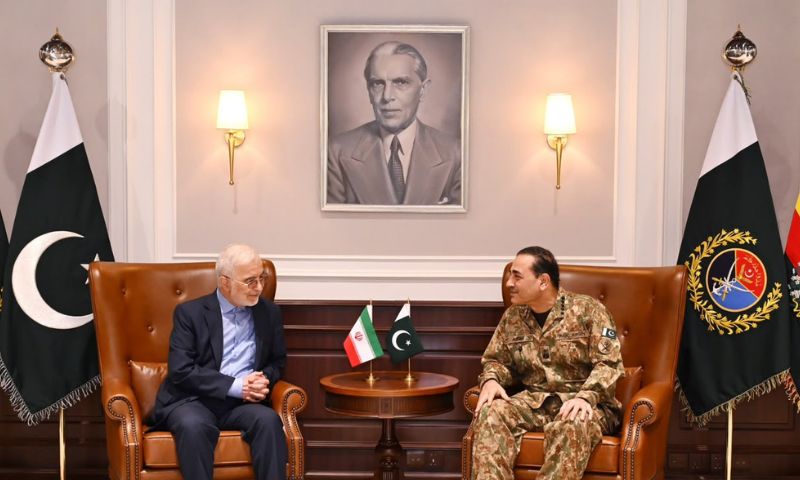
RAWALPINDI: Iranian Interior Minister Eskandar Momeni met Pakistan’s Chief of Defence Forces and Chief of Army Staff, Field Marshal Syed Asim Munir, at the General Headquarters (GHQ) in Rawalpindi on Tuesday, where the two sides discussed regional and bilateral security and effective border management, the military’s media wing said.
During the meeting, the Iranian Interior Minister appreciated Pakistan’s consistent efforts and indispensable diplomatic role in easing regional tensions, encouraging de-escalation and serving as an anchor for peace, the military’s media wing, Inter-Services Public Relations (ISPR), stated.
The meeting concluded with a reaffirmation of resolve to maintain close coordination and cooperative mechanisms to safeguard regional security and mutual prosperity, ISPR said.
#ISPR
Rawalpindi, 21 July 2026H.E. Eskandar Momeni, Interior Minister of the Islamic Republic of #Iran called on Field Marshal Syed Asim Munir, NI (M), HJ, Chief of Army Staff & Chief of Defence Forces of #Pakistan, at the General Headquarters (GHQ), Rawalpindi.
During the… pic.twitter.com/2XzurdCjxx
— Pakistan Armed Forces News 🇵🇰 (@PakistanFauj) July 21, 2026
The Iranian Interior Minister is on an official visit to Pakistan.
Pakistan to continue mediation for Middle East peace
Earlier, the Iranian Interior Minister called on Pakistan’s Prime Minister Shehbaz Sharif at the Prime Minister House.
Prime Minister Sharif reaffirmed Pakistan’s commitment to promoting peace and stability in the Middle East, assuring the Iranian Interior Minister that Islamabad would continue to play the role of an “honest and sincere mediator and facilitator” to de-escalate regional tensions and encourage dialogue.
Interior Minister of Iran H.E. Iskander Momeni called on Prime Minister Muhammad Shehbaz Sharif. Islamabad, 21 July 2026. pic.twitter.com/DFB48bDZuK
— Prime Minister's Office (@PakPMO) July 21, 2026
Welcoming the Iranian delegation, Prime Minister Sharif recalled his recent visit to Tehran to attend the funeral ceremony of the late Supreme Leader Ayatollah Sayyid Ali Khamenei and conveyed his respectful regards and best wishes to Supreme Leader His Eminence Sayyid Mojtaba Hosseini Khamenei and President Dr Masoud Pezeshkian.
Pakistan urges all sides to exercise restraint
Expressing deep concern over the recent escalation in the Gulf region, the prime minister urged all sides to exercise restraint and avoid actions that could further destabilise the region.
PM Sharif reiterated Pakistan’s unwavering commitment to regional peace and stability, stressing that Islamabad would continue supporting dialogue and diplomatic engagement.
Also Read: Pakistan Will Continue as Mediator and Facilitator for Middle East Peace: PM Sharif
Interior Minister Eskandar Momeni said he was leading a high-level delegation to Pakistan to further strengthen bilateral relations and expand cooperation between the two neighbouring countries.
The Iranian minister expressed deep appreciation for Prime Minister Shehbaz Sharif, Chief of Defence Force and Chief of the Army Staff Field Marshal Syed Asim Munir and Deputy Prime Minister Ishaq Dar and for their tireless mediation efforts that led to the Islamabad Memorandum of Understanding.
وزیراعظم محمد شہباز شریف سے ایرانی وزیر داخلہ سکندر مومنی کی ملاقات
وزیراعظم کا خلیج میں حالیہ کشیدگی پر گہری تشویش کا اظہار
وزیراعظم شہباز شریف کا تمام فریقین کو تحمل کا مظاہرہ کرنے پر زور
پاکستان دیانتدار، مخلص ثالث اور سہولت کار کے طور پر کردار جاری رکھے گا
وزیراعظم کا خطے… pic.twitter.com/neZRcbgBlZ
— PTV News (@PTVNewsOfficial) July 21, 2026
He also thanked the prime minister for travelling to Tehran to attend the funeral of the late Iranian Supreme Leader, describing the visit as a reflection of the close and enduring ties between the two countries.
The meeting underscored the shared resolve of Islamabad and Tehran to deepen bilateral engagement while working together to promote peace, stability and dialogue in the region.
Deputy Prime Minister and Foreign Minister Ishaq Dar, Interior Minister Mohsin Naqvi, Information Minister Attaullah Tarar, Advisor to the Prime Minister Dr Syed Tauqir Shah, Minister of State for Interior Talal Chaudhry and other senior officials attended the meeting.
US, Iran signal openness to diplomacy
The US and Iran signalled on Monday that they remain open to diplomacy despite escalating military confrontation, raising hopes of renewed negotiations under the Islamabad Memorandum of Understanding (MoU) framework.
The Islamabad MoU, brokered by Pakistan, was signed in June to end hostilities between the two countries and pave the way for a lasting peace agreement to permanently end the conflict.
The Islamabad MoU was signed on June 18 by US President Donald Trump, Iranian President Masoud Pezeshkian, and Pakistan’s Prime Minister Shehbaz Sharif, following Islamabad brokered a ceasefire between Washington and Tehran.
Under the Islamabad MoU, the US and Iran committed to halt military operations, reopen the Strait of Hormuz to commercial shipping, and negotiate a comprehensive agreement covering Iran’s nuclear programme, US sanctions, and a permanent ceasefire within 60 days.
A senior Iranian official, cited by Reuters, said mediators had conveyed a proposal for a 10-day ceasefire aimed at de-escalating the conflict and reviving an interim agreement reached last month between Tehran and Washington.
At a weekly press conference in Tehran, Iranian Foreign Ministry spokesman Esmaeil Baghaei said intermediaries had delivered fresh proposals to Iran in recent days and that negotiations with the United States could continue if they served Iran’s national interests, AFP reported.
Asked whether the door to talks with Washington had closed, Baghaei rejected the notion that diplomacy and military action were mutually exclusive.
“I reject the duality of either war or diplomacy. Diplomacy is a tool through which we pursue our national interests, just like war,” he said.
Rubio says US will continue diplomacy with Iran
US Secretary of State Marco Rubio said Washington would continue pursuing a diplomatic solution while insisting that any agreement with Tehran must be meaningful and fully implemented.
Speaking before departing for the Philippines for the Association of Southeast Asian Nations (ASEAN) Foreign Ministers’ Meeting, Rubio accused elements within Iran of attempting to use the Strait of Hormuz as leverage against the international community.
“It is evident that some within Iran want to use the Strait of Hormuz as leverage against the rest of the world,” Rubio said.
He stressed that any disruption to one of the world’s busiest shipping lanes posed a threat to global maritime security and international trade.