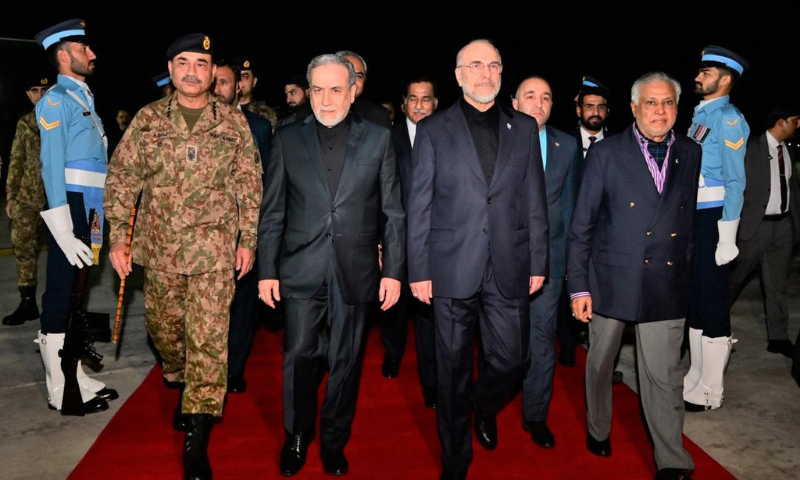
ISLAMABAD: A high-powered delegation from Iran arrived in Islamabad early Saturday to participate in critical talks with the United States, aimed at securing a lasting solution of their ongoing conflict.
The 14-member delegation led by Iran’s Parliament Speaker Mohammad Bagher Ghalibaf, includes Foreign Minister Abbas Araghchi, Secretary of the Supreme National Security Council Ali Akbar Ahmadian, Central Bank Governor Abdolnaser Hemmati, former IRGC commander Mohammad Bagher Zolghadr and others.
Upon arrival, the Iranian delegation was received by Deputy Prime Minister and Foreign Minister Ishaq Dar, National Assembly Speaker Sardar Ayaz Sadiq, Chief of Defence Forces Field Marshal Syed Asim Munir, and Interior Minister Mohsin Naqvi.
Arrival of the delegation of the Islamic Republic of Iran for Islamabad Talks pic.twitter.com/aJYU9cx5t2
— Ministry of Foreign Affairs – Pakistan (@ForeignOfficePk) April 10, 2026
Welcoming the delegation, Dar expressed optimism that all sides would engage constructively and reaffirmed Pakistan’s commitment to facilitating dialogue for a durable and peaceful resolution to the ongoing conflict.
🔊PR No.9️⃣8️⃣/2️⃣0️⃣2️⃣6️⃣
Arrival of the delegation of the Islamic Republic of Iran for Islamabad Talks pic.twitter.com/wanC34wBKK
— Ministry of Foreign Affairs – Pakistan (@ForeignOfficePk) April 10, 2026
The Islamabad talks come in the wake of a two-week truce, brokered with Pakistan’s support, following weeks of heightened military tensions involving Iran, the United States, Israel and Middle East. Prime Minister Shehbaz Sharif has described the negotiations as a “make-or-break” moment for achieving a permanent ceasefire.
The American delegation to be led by Vice President JD Vance, who has voiced cautious optimism ahead of the talks while warning of dire consequences if progress stalls.
Despite the ceasefire, deep mistrust remains between the parties. Tehran has demanded the unfreezing of its overseas financial assets and strict adherence to ceasefire commitments, particularly in conflict zones such as Lebanon. Meanwhile, tensions persist around strategic waterways and ongoing hostilities involving regional allies.
The high-stakes negotiations in Islamabad are being closely watched, with Pakistan positioned as a key diplomatic intermediary at a critical juncture for regional stability.