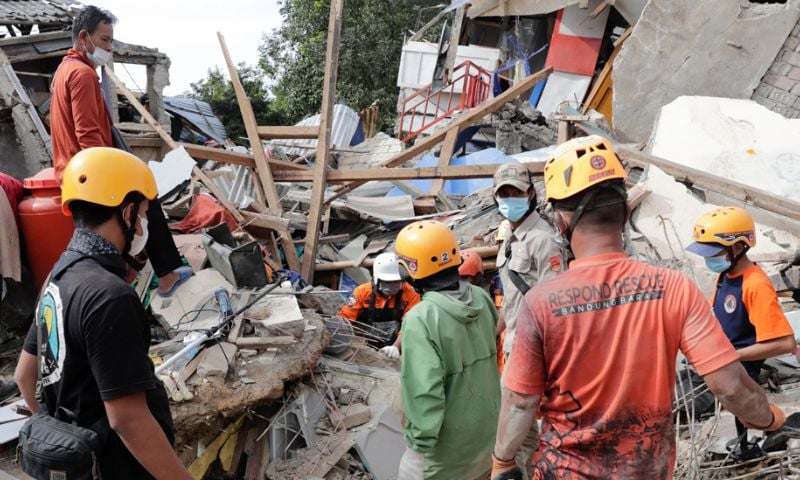
JAKARTA: Indonesia has recorded more than 2,100 aftershocks since a powerful earthquake struck the eastern part of the country on Saturday, as authorities warned that seismic activity could continue for several more weeks.
The Meteorology, Climatology and Geophysical Agency said 2,119 aftershocks had been recorded following the 7.7-magnitude earthquake that struck East Nusa Tenggara, according to local media reports.
The aftershocks ranged in magnitude from 1.3 to 6.2, with 24 measuring above magnitude 5.0. At least 70 of the tremors were felt by residents, agency director of earthquake and tsunami Wijayanto said.
The agency warned that the aftershock sequence could persist for another three to four weeks, raising concerns among residents who have already been forced from their homes by the initial quake and subsequent tremors.
The Saturday earthquake caused widespread damage across parts of East Nusa Tenggara, including areas around the popular tourist destination of Labuan Bajo.
At least 68 people have been confirmed dead, while more than 200 others have been injured, according to Indonesian authorities and state-run Antara News.
Thousands of residents have been evacuated and many are continuing to shelter outdoors because of fears that further tremors could damage already weakened buildings.
Tourist sites closed for safety checks
Authorities have temporarily closed several tourist attractions on the island of Flores while safety inspections are carried out. The sites include Rangko Cave in West Manggarai, Wae Rebo Traditional Village in Manggarai and Kelimutu National Park in Ende.
The closures are intended to protect visitors and staff while officials assess possible structural and geological hazards caused by the earthquake and continuing aftershocks.
Extensive damage reported
Indonesia’s National Disaster Management Agency said more than 12,000 people remained displaced, with many staying in compounds and villages because they were afraid to return home.
Joint assessment teams reported that at least 914 houses were severely damaged, while another 126 suffered moderate damage and 317 sustained light damage. The earthquake also damaged 93 educational facilities, 36 health facilities and 38 government offices, according to the disaster agency.
Landslides triggered by the earthquake have also blocked roads in several areas, including parts of Sikka and Manggarai, complicating relief and rescue operations.
Rescue teams have continued searching damaged buildings for people who may remain trapped beneath the rubble, while residents in affected communities have appealed for food, clean water and medical assistance.
Residents struggle as tremors continue
The continuing seismic activity has added to the difficulties facing displaced communities. Residents have reported a lack of basic supplies in some areas. People sheltering in temporary camps have also raised concerns about access to clean water and healthcare.
The earthquake has cast a shadow over Indonesia’s Independence Day celebrations and has become the country’s deadliest earthquake-related disaster since a 2022 earthquake in West Java killed hundreds of people.
Meanwhile, a separate earthquake struck the Batu Islands area of North Sumatra on Tuesday.
The Euro-Mediterranean Seismological Centre reported the quake at magnitude 5.8, while the United States Geological Survey recorded it at 5.6. There was no immediate indication that the separate tremor was directly linked to the deadly earthquake in East Nusa Tenggara.