
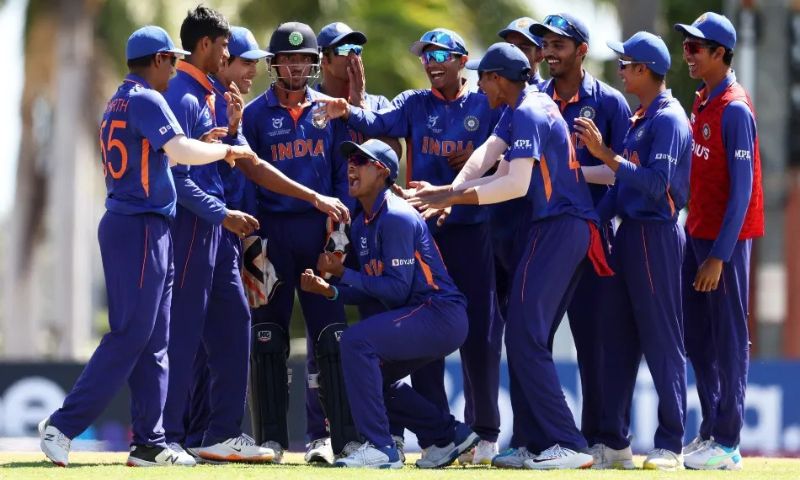
ISLAMABAD: Indian cricket woke up this week to a scandal that has shattered the illusion of purity in its junior development system. Ravi Kumar, the left-arm pacer who became a national icon after his match-winning performance in the 2022 U-19 World Cup final, stands exposed as a fraud, his age falsified by more than 40 months, his records wiped out, his legacy in ruins.
But the real scandal isn’t just one player’s deception. It’s that 64 others have been caught in the same dragnet. It’s that coaches, selectors, and officials either didn’t notice or chose not to look.
It’s that a system designed to nurture young talent has instead become a breeding ground for grown men masquerading as teenagers.
Age-Fraud Crackdown Hits Indian Cricket: 65 Players Banned
The menace of age fraud has resurfaced in Indian cricket, with the BCCI and Cricket Association of Bengal (CAB) taking action against 65 players and imposing bans. Among those banned are Rohit Yadav, currently part of… pic.twitter.com/LaCumbunzv
— Goa News Hub (@goanewshub) September 4, 2026
The ugly truth behind the glory
Let’s be brutally honest: Ravi Kumar wasn’t a prodigy. He was a 21-year-old man bullying 17-year-old boys. Every wicket he took in that World Cup final, every celebration, every moment of adulation, it was all built on a lie. He wasn’t outplaying his peers; he was outgrowing them, leveraging physical maturity that his genuine teenage opponents could never match.
For every over-aged player who makes it, there is a legitimate 17-year-old who is denied a spot, a chance, a dream. The CAB’s investigation has now exposed a conveyor belt of deception that has been running for years, with players and their families treating age fraud not as cheating but as a necessary shortcut to success.
A culture of complicity
How does a player with a 40-month discrepancy slip through the cracks? How does he play in age-group tournaments, represent India, and win a World Cup without anyone raising serious questions?
The answer is uncomfortable: because the system enables it.
The BCCI requires birth certificates and school records, but these documents are often falsified with the active help of parents, coaches, and even academy owners. The CAB’s pre-season documentation drive, a routine check, was enough to expose 65 players. This means hundreds more across the country are likely operating under false ages, waiting to be caught.
The 2020 amnesty scheme was a tacit admission that the BCCI knew the scale of the problem. But instead of aggressive enforcement, the board offered a way out. And when players like Kumar chose not to come clean, they gambled on never being caught. For years, they won that gamble.
🚨65 Bengal cricketers barred over documentation & age fraud by the @CabCricket! The biggest shocker? Arun Kumar Chaurasiya was flagged for a massive 115-month discrepancy. U-19 stars Ravi Kumar and Rohit Yadav have also been suspended.@CricSubhayan ✍️https://t.co/S0wau6QQJq
— RevSportz Global (@RevSportzGlobal) September 4, 2026
The convenient blindness
Let’s not pretend selectors and coaches were naive. A 17-year-old with the physique and development of a 21-year-old is not subtle. Yet Kumar was selected, celebrated, and fast-tracked into the senior Bengal team. Did no one notice? Or was winning more important than integrity?
This is the uncomfortable question that the BCCI and state associations must now confront. Were they complicit in looking the other way because results mattered more than rules? The answer, for many, will be a damning yes.
Empty sanctions, hollow justice
Ravi Kumar’s age-group records have been wiped out. Rohit Yadav has been banned for two years. Sixty-three others have been de-registered. But what does any of this actually achieve?
Reason why India are why too dominant in the Under-19 World Cup – https://t.co/0D3iUXszIO
— Susruth Sirupa (@SusruthS) September 4, 2026
Kumar is already a senior player. His ban from age-group cricket is meaningless, he wasn’t going to play U-19 again anyway. His senior records remain intact. He could theoretically return to first-class cricket tomorrow, his cheating forgiven, his ill-gotten World Cup medal still polished.
The punishments are cosmetic. They make the headlines, but they don’t address the root cause: the desperation that drives families to cheat, the financial incentives that make fraud worthwhile, and the systemic corruption that allows it to persist.
The real victims
Lost in the outrage over the 65 banned players are the thousands of honest youngsters who played by the rules and got nowhere. The 15-year-old who watched a 19-year-old take his spot. The 16-year-old who was told he “wasn’t developed enough” while competing against full-grown adults. The families who followed every rule and still couldn’t break through.
Every over-aged player who succeeded stole from them. Every fraudulent record denied a genuine talent a platform. And every official who looked the other way is complicit in that theft.
The road ahead
The CAB deserves credit for conducting the audit that exposed these 65 players. But one state association’s investigation is not a solution. What Indian cricket needs is a fundamental overhaul of its age-verification process, biometric data, bone-age testing, and severe, meaningful penalties that extend to parents, coaches, and officials who facilitate fraud.
Read Also: Canada Rejects Most Indian Study Permit Applications Amid Fraud Concerns
Until the BCCI treats age fraud as the existential threat it is, this scandal will repeat itself. Another World Cup hero will be exposed. Another batch of honest youngsters will be robbed. And Indian cricket will continue to celebrate champions who were never really teenagers at all.
The 2022 U-19 World Cup trophy still sits in India’s cabinet. But it should carry an asterisk, a permanent reminder that victory, when built on lies, is hollow.