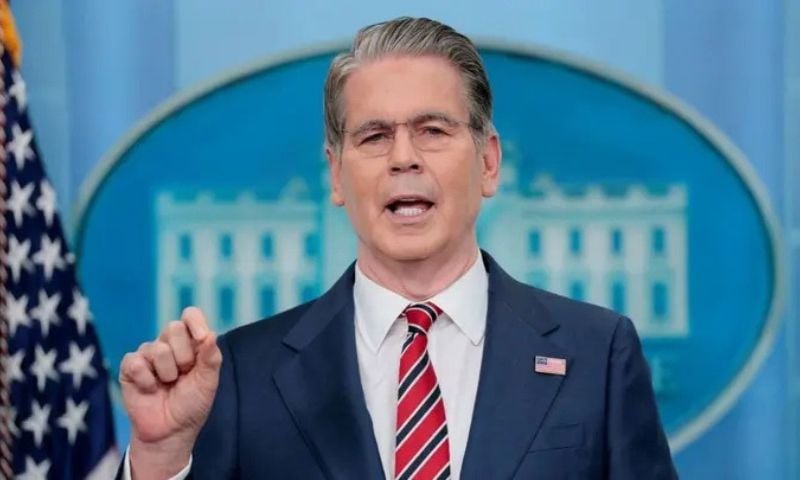
WASHINGTON: US Treasury Secretary Scott Bessent said Tuesday that Washington was no longer seeking to manage the threat from Iran but was working to end it, as the Trump administration steps up economic pressure on Tehran amid the Middle East war.
Speaking before the House of Representatives, Bessent claims that economic “resurgence” has enabled Washington to launch the isolation campaign against Tehran and its facilitators.
“America is no longer managing the Iranian threat. We are ending it,” Bessent said in remarks before the House Financial Services Committee.
.@SecScottBessent: “Under @POTUS‘ leadership America is no longer managing the Iranian threat —we are ending it.” pic.twitter.com/rV8eEENyX6
— Rapid Response 47 (@RapidResponse47) September 15, 2026
He said the United States had launched “the greatest economic isolation campaign in the history of the world” against Iran and those facilitating its activities.
Economic pressure on Iran
Bessent linked the campaign to an economic resurgence under President Donald Trump, saying stronger US economic conditions had increased Washington’s ability to act against its adversaries “from a position of strength”.
He said Trump had taken measures that previous administrations had deferred against what he called a regime devoted to “Death to America” and seeking nuclear weapons.
In August, the US announced broader sanctions, what it described as an “economic D-Day” against Iran to try to isolate it from the global economy.
Announcing a raft of measures, Bessent said that any nation financially partnering with Iran would be isolated, and that banks and businesses dealing with Iran would share its isolation if they refused to cut ties.
Bessent described the measures as “the single greatest financial offensive ever” against Iran, which would “tighten the noose and block every potential source of revenue”.
Iranian Economy Minister Ali Madanizadeh said that Tehran is confident it can counter widened US sanctions.
Madanizadeh said Tehran was “fully prepared” for the sanctions, which he said would lead to “another defeat” for the US.