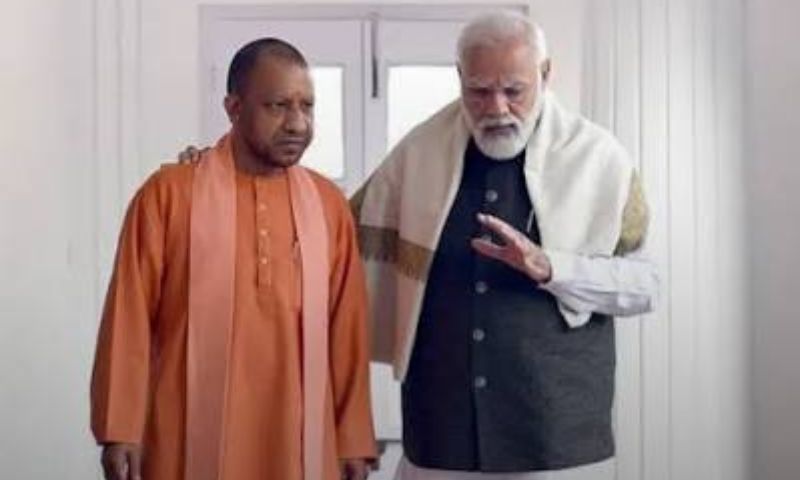



NEW DELHI, India: While Indian Prime Minister Narendra Modi’s central government blew INR 6,000 crore on advertising in 11 years, Uttar Pradesh Chief Minister Yogi Adityanath’s administration burned through nearly INR 7,000 crore in just eight, a spending spree that has laid bare the ruling establishment’s obsession with self-glorification.
Opposition parties have erupted in fury, accusing both leaders of treating the public exchequer as their personal war chest and mainstream media as their obedient lapdog.
According to official budget documents analysed by Newslaundry, the Uttar Pradesh government spent a staggering INR 6,811.94 crore on advertising and publicity between financial years 2017-18 and 2024-25, an average of INR 2.32 crore per day over eight years. This figure comfortably surpasses the Modi government’s estimated daily advertising expenditure of approximately INR 1.5 crore over 11 years, which totals roughly INR 6,000 crore.
The Yogi Adityanath government in Uttar Pradesh has spent nearly ₹7,000 crore on advertisements over the past eight years—an average of ₹2.3 crore a day, according to a report by Newslaundry.
The report says this exceeds the Union government’s advertising expenditure of around… pic.twitter.com/QbGMZtOOQN— National Herald (@NH_India) August 6, 2026
The spending, routed through the state’s Information and Public Relations Department, has grown exponentially during Adityanath’s tenure, surging from INR 294.86 crore in 2017-18 to a staggering INR 1,420.03 crore in the election year 2022-23, before settling at INR 1,391.18 crore in 2024-25. Over 83 percent of this massive outlay, INR 5,658.16 crore, went to “advertising and visual publicity,” covering newspapers, television channels, and increasingly, digital platforms.
Congress: ‘Self-Congratulatory’ Propaganda
Congress leader Pawan Khera launched a blistering attack on both the Modi and Adityanath governments, accusing them of squandering public funds on self-promotion while millions of Indians struggle for basic sustenance.
Yogi Adityanath sets world record by spending ₹7,000 crore on ‘cosmetic facial’, says Akhilesh – The Hindu https://t.co/2ywTAiyFQd
— call myself (@testing7951) August 7, 2026
“The master has been outdone by the apprentice,” Khera said on X, drawing a pointed comparison between Prime Minister Modi and Chief Minister Adityanath. He alleged that the Modi government had blown nearly INR 6,000 crore on “self-congratulatory advertisements” over 11 years, while the Yogi government had surpassed that figure in just eight years, spending INR 7,000 crore at an average of INR 2.3 crore daily.
“In a country where 800 million people depend on free rations just to afford two meals a day, this is an indictment of misplaced priorities,” Khera added.
The Congress’s criticism also extends to the mainstream media’s coverage of the BJP, with opposition leaders alleging that massive advertising outlays have effectively turned many news outlets into government cheerleaders, a phenomenon critics have derisively labelled “Godi Media” (Lapdog Media).
बनाने चले Brand, बज गया Band!
अब 7000 करोड़ एक साल में भी खर्च कर दें तो भी कुछ बदलनेवाला नहीं।
डबल इंजन के आपसी कम्पटीशन में गुरु गुड़ रह गया, चेला शक्कर हो गया… ये बात अलग है कि ज़्यादा मीठे के चक्कर में सब कड़वा हो गया।
अच्छे व्यवहार, अच्छे करम और जन हित के काम से बड़ा… pic.twitter.com/UHdoFXqfuo
— Akhilesh Yadav (@yadavakhilesh) August 6, 2026
Transparency concerns and RTI defiance
Perhaps more concerning than the sheer scale of spending is the government’s consistent refusal to disclose where the money is going. According to the Newslaundry report, the Uttar Pradesh government has repeatedly declined to share advertising distribution data in response to Right to Information (RTI) queries, either leaving applications unanswered or rejecting them on grounds that compiling such information would be too time-consuming.
A previous RTI response obtained in 2021, however, offered a glimpse into the government’s advertising priorities. Between April 2020 and March 2021, the UP government spent INR 160.31 crore on television news channel advertisements alone. The Network18 group, led by Mukesh Ambani, emerged as the single largest beneficiary, cornering INR 28.82 crore, followed by the Zee Media group at INR 23.48 crore and the ABP group at INR 18.19 crore.
Significantly, channels known for critical coverage of the Uttar Pradesh government, such as NDTV, were conspicuously absent from the list of beneficiaries. This pattern has fuelled allegations that the government is using advertising expenditure as a tool to shape media narratives and reward favourable coverage while punishing independent journalism.
Alarming trend: Election year spending
The data reveals a clear pattern: spending surges during election years. The highest annual outlay, INR 1,420.03 crore, was recorded in 2022-23, the year of the Uttar Pradesh assembly elections. With another election looming in Uttar Pradesh next year, critics fear a fresh wave of taxpayer-funded propaganda is imminent.
The advertising blitz extends beyond traditional media. The state government has placed banner campaigns on digital platforms including ShareChat, Asianetnews.com, and Oneindia.com, with contracts worth nearly INR 1 crore each for month-long campaigns. The Department of Industries and Enterprise Promotion has separately spent INR 60 crore on publicity, including approximately INR 12 crore during the Kumbh Mela in Prayagraj.
Read Also: Modi Government Used Pellet Guns Against Cockroach Protesters
Defenders: ‘Public awareness, not propaganda’
Supporters of the Yogi Adityanath government argue that the massive advertising expenditure is justified in a state of over 240 million people, where communicating welfare schemes and public health campaigns requires substantial outreach. They point to schemes like Mission Shakti, Ujjwala, and One District One Product (ODOP) as examples of legitimate public information campaigns.
However, critics counter that the fine line between public communication and political branding has been crossed, pointing to advertisements prominently featuring the Chief Minister’s image and the government’s slogans, which they argue serve more to burnish the ruling party’s electoral prospects than to genuinely inform citizens.
Read Also: India’s Viral ‘Cockroach Party’ Leads Massive Protests Against Modi Government Policies
The bigger picture: Democracy’s price tag
Government advertising is not inherently problematic. Citizens need information about vaccination drives, welfare schemes, and disaster preparedness. But the Supreme Court of India has previously held, in the landmark Common Cause v. Union of India (2015) judgment, that publicly funded advertisements must primarily educate citizens and avoid functioning as instruments of political glorification.