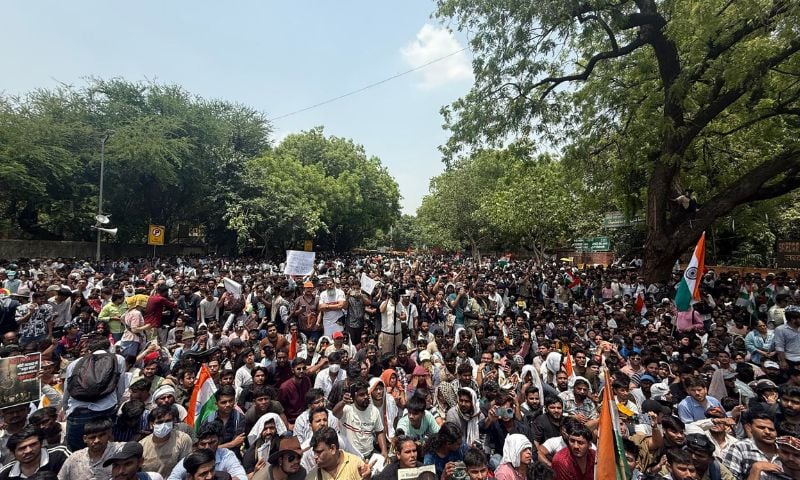



NEW DELHI: Thousands of students and young people gathered in New Delhi on Saturday for the first street protest organised by the satirical “Cockroach Janta Party” (CJP), a viral youth movement that has gained millions of followers online amid growing frustration over India’s education system and job prospects.
Protesters assembled at the Jantar Mantar demonstration site carrying books, while some wore paper cockroach masks. The symbolism was linked to remarks made by India’s Chief Justice Surya Kant during a court hearing that sparked widespread controversy.
They said cockroaches will never come on the ground… pic.twitter.com/awz1GdoKVq
— Abhijeet Dipke (@abhijeet_dipke) June 6, 2026
The demonstrators demanded the resignation of Education Minister Dharmendra Pradhan over irregularities in major examinations, including question paper leaks and technical failures.
“We want accountability from the government,” 16-year-old student Utkarsh Raj, who hopes to pursue a medical career, told AFP.
“How is it that exam papers get leaked in this country? How is this right?” he said.
The protest was led by Abhijeet Dipke, founder of the Cockroach Janta Party, a parody of Prime Minister Narendra Modi’s Hindu-nationalist Bharatiya Janata Party (BJP).
धर्मेंद्र प्रधान इस्तीफ़ा दो!
शिक्षा मंत्री को हमने चुन कर भेजा है, हमारे टैक्स से उनको तनख्वाह मिलती है!
उनके शासन काल में करोड़ों युवाओं का भविष्य अंधकार में है।
cockroach आ रहे हैं, धर्मेंद्र प्रधान जा रहे हैं! #cjpprotest pic.twitter.com/LYcOUY7Shc
— Cockroach is Back (@Cockroachisback) June 6, 2026
Dipke, a former political communications strategist for the opposition Aam Aadmi Party and a student at Boston University, launched the movement last month after comments attributed to Chief Justice Surya Kant drew criticism from young Indians online.
Kant had likened government critics among the youth to “cockroaches” and “parasites” during a court hearing. The chief justice later said his remarks had been taken out of context.
Protest against education minister Dharmendra Pradhan at Jantar Mantar.
Education minister should resign! pic.twitter.com/j3hEJVjjnr
— Cockroach Janta Party (@CJP_for_India) June 6, 2026
Dipke subsequently adopted the term as a symbol for a youth-led movement focused on education, employment and political representation.
“This protest is for the future of this country. This protest is for jobs,” Dipke told the rally after returning from the United States on Saturday.
“The youth of the country … will fight,” the 30-year-old organiser said.
Within days of its launch, the movement’s social media accounts attracted massive attention. By Saturday, the CJP’s Instagram page had amassed more than 22 million followers.
The party describes itself as “a political front for the youth, by the youth, for the youth.”
The demonstration was fuelled by recent controversies surrounding major examinations in India.
Last month, authorities cancelled a nationwide medical college entrance examination after investigators uncovered a question paper leak.
The scandal followed criticism of an online marking system used for examinations taken by nearly two million high school students.
Many protesters said the incidents reflected deeper problems within India’s education system.
“India deserves better administration of such crucial exams,” 20-year-old protester Sarthak, who gave only one name, told AFP.
Sapan Gyan, 52, who attended the rally with his sons, said young people could not be expected to trust examination systems that had lost credibility.
“Young people … can’t have a situation where these exam systems have no credibility left,” he said.
Supporters chanted slogans including: “Cockroaches are coming, Dharmendra Pradhan is going!”
Organisers urged participants to remain peaceful and avoid confrontations with police.
Ahead of the protest, police tightened security around New Delhi’s airport and the Jantar Mantar protest venue, installing steel barricades at key locations.
Supporters of the CJP have embraced the cockroach as a symbol of resilience and endurance, often jokingly describing themselves as unemployed and perpetually online.
India’s youth account for more than a quarter of the country’s population, yet many face limited employment opportunities.
“This is a youth-first movement,” student protester Satya Prakash Yadav told the Associated Press.
“Youth is the future and we will ensure that our future is secure,” he said.
Supporters of Modi’s BJP have dismissed the movement as a social media phenomenon with limited political significance, arguing that its online popularity may not translate into sustained street mobilisation.