Key Points
- Suspect vaccine batch failed critical potency test
- Manufacturer denies producing seized Abhayrab vials
- Four arrested as India probes possible counterfeit
ISLAMABAD: India’s drug regulator has flagged a batch of the widely used Abhayrab rabies vaccine as substandard and potentially spurious after a government laboratory found that a sample failed a critical potency test.
The regulator’s probe has raised fresh concerns over the circulation of counterfeit medical products in a country that supplies medicines and vaccines to much of the world.
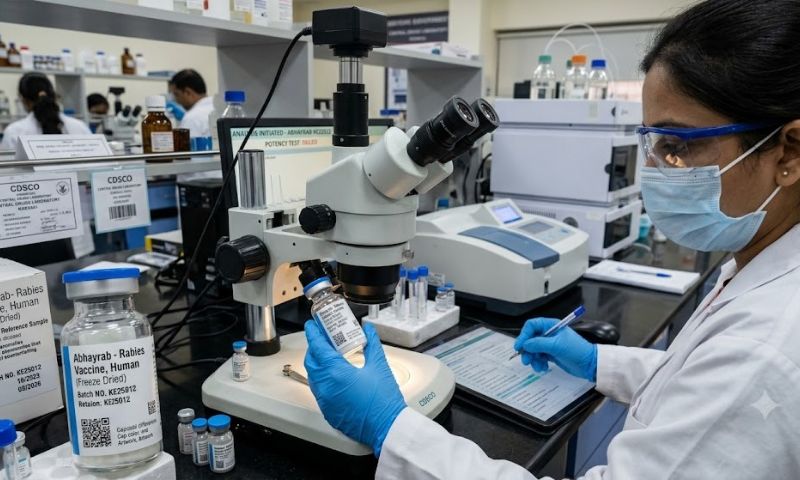
The Central Drugs Standard Control Organisation (CDSCO) has ordered state drug regulators to maintain strict vigilance over Abhayrab batch KE25012 after the Central Drugs Laboratory in Kasauli classified a field sample as “not of standard quality” and “misbranded”.
The regulator is investigating whether the product meets the definition of a spurious drug under India’s Drugs and Cosmetics Act.
India’s second fake vaccine
The case has an extended international significance because it is the second time in less than two years that a potentially counterfeit Abhayrab batch has been identified in India.
The vaccine is used for both pre- and post-exposure protection against rabies, a disease that is almost invariably fatal once clinical symptoms appear.
Indian Immunologicals Ltd (IIL), which manufactures Abhayrab and has about 40 per cent of India’s domestic rabies vaccine market, claimed that the seized vials were not manufactured by it.
The suspect vials, carrying batch number KE25012, were seized from an unlicensed residential premises in Mukherjee Nagar, Delhi.
READ ALSO: Pakistani Authorities Recover Smuggled Indian Medicines in Quetta Raid
Four people have been arrested by Delhi Police in connection with the case, with further investigation under way. The regulator has said no part of the batch under investigation was exported to another country.
The government laboratory found that the sample passed tests for sterility, moisture and identity but failed the potency test.
It also identified significant differences between the seized product and a retained reference sample of the same batch submitted by IIL for regulatory testing.
The differences included labelling, packaging artwork, QR code verification, cap colour, licence details and packaging text. IIL said the laboratory report identified 17 discrepancies between the seized samples and its genuine retained samples.
The potential danger extends beyond the question of counterfeit packaging. If a person exposed to rabies receives a vaccine that lacks the required potency, they may believe they have received life-saving post-exposure treatment when they have not.
Given the near-fatal nature of symptomatic rabies, a failure of vaccine protection can have consequences that cannot be reversed once the disease develops.
India records an estimated 5,726 human rabies deaths annually, according to a 2024 study by the Indian Council of Medical Research’s National Institute of Epidemiology.
The latest investigation also revives concerns raised internationally by an earlier Abhayrab counterfeit episode.
In January 2025, IIL notified Indian regulators that counterfeit doses bearing batch number KA24014 had entered the market. Health authorities in the United States, Britain and Australia subsequently issued alerts for travellers who might have received the suspect vaccine in India.
That earlier episode demonstrated how a counterfeit medicine originating in India’s domestic market can become an international public-health issue when foreign travellers receive it or when questions arise over the integrity of pharmaceutical supply chains.
IIL has supplied more than 210 million Abhayrab doses in India and other countries over more than two decades and exports the vaccine to more than 40 countries, including South Africa, Turkey, Vietnam, Cambodia, Zimbabwe, Thailand and the United Arab Emirates.
Although Indian authorities say the latest ‘suspect batch’ was not exported, the recurrence of counterfeit Abhayrab products raises critical questions about regulators’ and manufacturers’ ability to detect and prevent unauthorised products from entering legitimate pharmaceutical channels.
The case is therefore more than a routine drug-quality failure. It highlights the vulnerability of critical medicines to counterfeiting and the potential for a domestic supply-chain breach to undermine confidence in pharmaceutical products across borders.