NEW DELHI: Supporters of India’s viral Cockroach Janta Party (CJP), a youth-led political movement that emerged from social media satire and frustration over unemployment and education irregularities, have camped in the capital New Delhi demanding the resignation of Education Minister Dharmendra Pradhan.
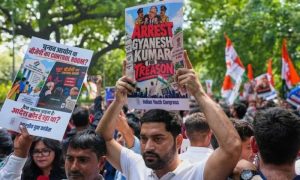
Hundreds of students and young supporters gathered near Parliament and at Jantar Mantar, a designated protest site in the capital, defying police pressure and vowing to continue their demonstration until the minister steps down.
The movement is led by Abhijeet Dipke, a political communications strategist and recent graduate of Boston University in the United States, who returned to India earlier this month to take the campaign from social media platforms to the streets.
The protests come amid growing anger among young Indians over repeated examination paper leaks, allegations of irregularities in competitive examinations and concerns over employment prospects.
Protest expands beyond social media
According to participants, the movement began after comments by India’s chief justice comparing the country’s youth to cockroaches.
Dipke subsequently posted on social media platform X: “What if all cockroaches came together?”
The message quickly gained traction online. Dipke later launched an official website for the movement, while its Instagram following reportedly surpassed 22 million.
Since staging its first demonstration in New Delhi on June 6, the CJP has expanded its campaign to several cities, including Mumbai, Bengaluru and Nagpur, attracting hundreds of supporters.
The movement has adopted the cockroach as a satirical political symbol and combines self-deprecating humour with criticism of government policies.
Supporters frequently describe themselves as unemployed and politically ignored, while online videos and memes have focused on issues such as corruption, unemployment and government accountability.
Anger over examination leaks
The immediate trigger for the protests has been the leak of question papers for a nationwide medical entrance examination.
Authorities postponed the examination after the paper was circulated through the messaging application Telegram. The government has said the leak is under investigation.
India also temporarily banned Telegram in an effort to curb further leaks, a move critics described as inadequate.
Nearly 1.7 million students retook the examination on Sunday. However, some protesters chose to remain at the demonstration site.
A 18-year-old Sachin Kumar said that he had spent a year preparing for the examination before it was cancelled.
“It broke my resolve. Students slip into depression, and no one cares,” Kumar told Al Jazeera, adding that he had not resumed studying since the examination was cancelled.
Kumar said he had lost confidence in the fairness of competitive examinations.
“I have no faith in the fairness of this exam anymore, or any other competitive exam for that matter,” he said.
Another student, Vicky Kumar, expressed frustration over the impact of the leak on candidates who had spent years preparing.
“We study in poverty, live in poverty for 24 hours every day, for years at length, and after that our papers get leaked. Will I not get angry at this?” he said during the protest.
Overnight sit-in
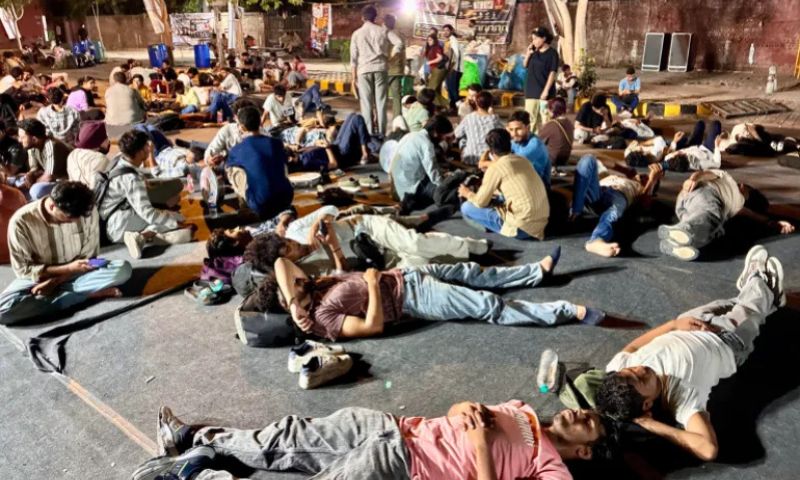
Protesters remained at Jantar Mantar overnight despite the intense summer heat in New Delhi.
Witnesses reported that hundreds of demonstrators slept on roads and pavements, while more supporters joined on the second day of the sit-in.
Many protesters carried placards, while others banged steel plates with spoons in a symbolic protest.
The action appeared to mock Prime Minister Narendra Modi’s 2020 appeal for Indians to bang utensils from balconies and rooftops in support of frontline health workers during the COVID-19 pandemic.
Dipke had urged supporters on social media to bring plates and spoons to the demonstration.
“There is a virus called Dharmendra Pradhan that has to be removed,” he told the crowd, adding that the movement would be open to talks with the government if the education minister resigned.
Wider youth frustrations
The protest has evolved beyond concerns about examination integrity and now encompasses broader issues affecting young Indians, including unemployment, rising living costs and political accountability.
India has one of the world’s youngest populations, with nearly half of its 1.4 billion people under the age of 25.
For many protesters, Prime Minister Narendra Modi’s government is the only national administration they have known, having first come to power in 2014.
Dipke and his supporters insist they will remain at the protest site until Pradhan resigns, a move that would mark a rare ministerial departure during Modi’s more than a decade in office.
“If the government thinks they can exhaust us, they are mistaken,” Dipke said. “We will remain here.”