
Key points
- July floods killed more than 100 people in Assam
- Damage assessment has reached about $16 million
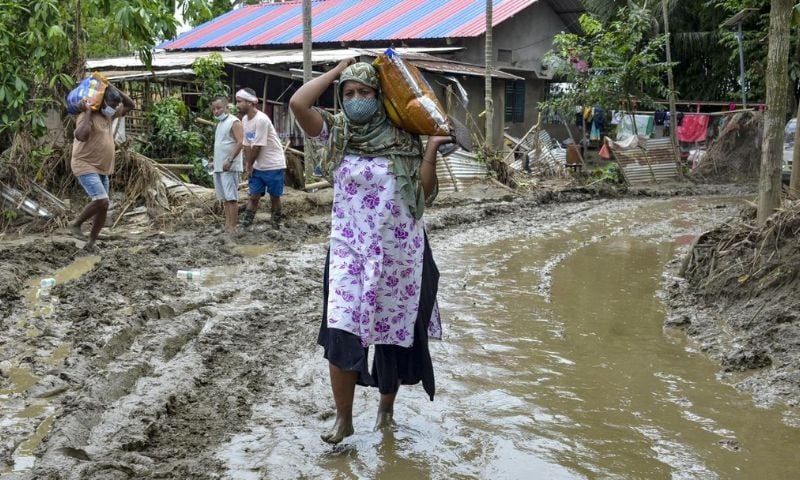
ISLAMABAD: Weeks after devastating floods swept across India’s northeastern Assam state, survivors are returning to villages buried in mud and silt, confronting destroyed homes, lost livestock and livelihoods as authorities assess the scale of the damage.
The floods, which began in July after intense monsoon rainfall, killed more than 100 people and displaced more than 700,000, according to official figures and recent reports. The final post-disaster damage assessment survey is still underway, they added.
The disaster was concentrated particularly in Upper Assam, where Sivasagar, Charaideo, Jorhat and Golaghat were among the worst-hit districts.
In flood-hit areas around Sivasagar, residents described water rising with extraordinary speed, leaving little time to evacuate.
Local reporting from Nazira documented families returning to mud-filled homes and attempting to salvage damaged possessions. One resident, Pankaj Dutta, said the flooding had destroyed his home and business, leaving him struggling to rebuild.
In Betbari, Sivasagar, residents have been clearing mud and debris from their homes as the floodwaters recede.
The Assam Tribune reported that the disaster had left entire communities counting losses and struggling to restore normal life, with Sivasagar among the districts suffering particularly heavy casualties.
The damage assessment is now providing a clearer picture of the disaster’s economic cost. Assam authorities have estimated losses at about $16 million, based on assessments covering roughly 26,000 families, according to regional reports. The survey is continuing, meaning the final figure could rise.
Chief Minister Himanta Biswa Sarma has said a rehabilitation package of more than $36 million may ultimately be required.
READ ALSO: India’s Assam Hit by Worst Floods in Decades
An initial rapid assessment covering more than 8,000 families put damage at about $5.4 million, with authorities expecting to assess 50,000 to 60,000 families in the worst-affected Upper Assam districts.
The state has also begun direct financial assistance. Assam recently released about $1.7 million to 31,951 flood-affected families in Sivasagar,
Charaideo, Jorhat and Golaghat, taking total relief distributed to about $5.2 million. Each family covered by the latest tranche received roughly $54.
But for many survivors, financial assistance is only the beginning of recovery. Homes need rebuilding, farmland must be restored, and roads, electricity and other infrastructure damaged by the floods need repairs.
Recent regional reporting has described families facing a second crisis after the floodwaters receded, as temporary relief gives way to the harder task of restoring livelihoods.
The disaster has also renewed scrutiny of Assam’s vulnerability to extreme flooding. Environmental researchers and local observers have pointed to deforestation, sand mining, wetland degradation and development in vulnerable areas as factors that can amplify the impact of intense rainfall.
Assam lies in the Brahmaputra river basin and experiences seasonal flooding almost every year. But the scale and speed of this year’s flooding have intensified concerns over the adequacy of early-warning systems, flood-control infrastructure and disaster preparedness.
For the state’s flood-hit communities, the emergency phase may be ending, but the recovery is only beginning. The final damage assessment and rehabilitation programme will determine how quickly families can rebuild homes and livelihoods lost in one of Assam’s most destructive floods in decades.
India faces devastating floods in 2026
India’s 2026 monsoon has caused widespread destruction across the country, with floods, flash floods and landslides killing people and displacing communities in several states.
Assam has suffered its worst flooding in decades, with more than 100 deaths and over 700,000 people displaced.
Torrential rains have also triggered deadly floods and landslides in Kerala, Maharashtra, Indian Illegally Occupied Jammu and Kashmir (IIOJK), Uttarakhand and parts of northern and northeastern India.
The India Meteorological Department has reported significant regional variations in rainfall, with some areas experiencing exceptionally heavy downpours.
The damage has included destroyed homes, submerged farmland, damaged roads and bridges, disrupted transport and major losses to livelihoods, underscoring India’s growing vulnerability to extreme monsoon weather.