NEW DELHI: India’s government issued nearly 195,000 orders to social media platforms to block or remove content between March and July, according to figures cited by Congress president Mallikarjun Kharge, prompting accusations from the opposition that the authorities are using online censorship to silence dissent.
Kharge said the government had issued about 195,000 blocking orders in five months. He described the figure as an attack on Indians’ right to speak, question the government and dissent.
The figures were also reported by The Indian Express, which said government departments and agencies had sent a sharply higher number of directives to platforms including Instagram, Facebook and YouTube during the March-July period.
According to the figures cited by Kharge, the orders amounted to roughly one every 68 seconds, or about 1,275 a day.
Modi Govt has launched its most brazen and calculated attack on the democratic right of every Indian to speak, to question and to dissent.
It's Social Media Censorship is as condemnable as the lathicharge & pellet guns they used on our youth!
What we are seeing today is only… pic.twitter.com/pTCsfipAus
— Mallikarjun Kharge (@kharge) August 18, 2026
The Congress leader alleged that many of the orders targeted content linked to students and young people involved in protests over examination irregularities.
Systematic censorship in India
“Modi Govt has launched its most brazen and calculated attack on the democratic right of every Indian to speak, to question and to dissent,” Kharge said in a post on X.
He compared what he called social media censorship with the police use of force against young protesters.
Kharge alleged that posts and videos supporting the protesters were being removed from the internet through direct government orders.
“What we are seeing today is only the tip of the iceberg,” he said, referring to the reported 195,000 orders.
The Congress president also alleged that journalists, content creators and ordinary citizens who post criticism of the government face takedown notices, police cases and intimidation.
He further accused supporters of the ruling Bharatiya Janata Party (BJP) of online harassment, including the doxxing of women and rape threats, and alleged that such behaviour was not adequately addressed by the authorities.
Kharge also criticised changes to the government’s content-removal process, alleging that takedown deadlines had been reduced to three hours and that censorship had become increasingly automated.
Instagram main target of Indian govt
According to Indian media reports, more than half of the government orders during the five-month period were directed at Instagram.
The platform had become an important channel for young protesters, who used social media to organise, share information and criticise the government.
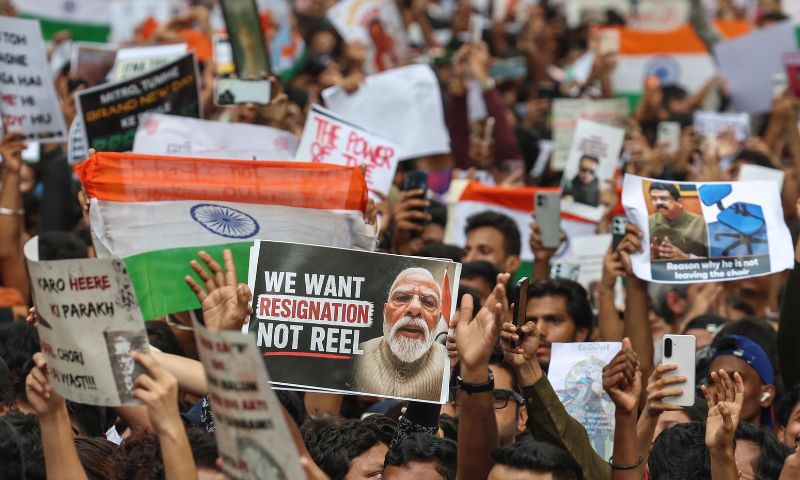
The protests also featured satirical videos, songs, memes and other material aimed at Prime Minister Narendra Modi and his government.
The increase in blocking orders has therefore raised wider questions about the balance between India’s efforts to regulate online content and the right to political expression.
Students’ protests against Modi govt
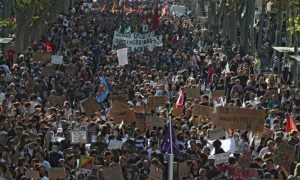
The reported surge in blocking orders coincided with youth-led demonstrations in New Delhi over alleged examination irregularities and paper leaks.
The Cockroach Janata Party (CJP), a youth-oriented political movement, was among the groups involved in the protests at Jantar Mantar.
Activist Sonam Wangchuk joined the demonstration and began an indefinite hunger strike in June. The protest movement called for action over alleged irregularities in the National Eligibility cum Entrance Test (NEET) and demanded the resignation of Education Minister Dharmendra Pradhan.
Delhi Police later moved Wangchuk to hospital after his health deteriorated. Police said the action was taken on medical advice and in accordance with directions from the Delhi High Court.
Also Read: India’s BJP Replaces Social Media Head After Youth Protests Challenge Modi’s Govt
CJP founder Abhijeet Dipke alleged that police had used excessive force and said he had been beaten and detained.
India regulation of social media
India has expanded its regulatory framework for social media platforms through its information technology rules and government content-blocking mechanisms.
Critics argue that broad blocking powers can be used against political criticism and dissent.
The reported blocking figures have intensified that debate, particularly because they cover a period when social media played a prominent role in protests involving students and young people.
Despite tighter regulation and the government’s ability to order content removals, young Indians continue to use social media as a major platform for political expression and mobilisation.
During the protests, memes, songs, short videos and other forms of digital content became tools for challenging official narratives and drawing public attention to the students’ demands.