
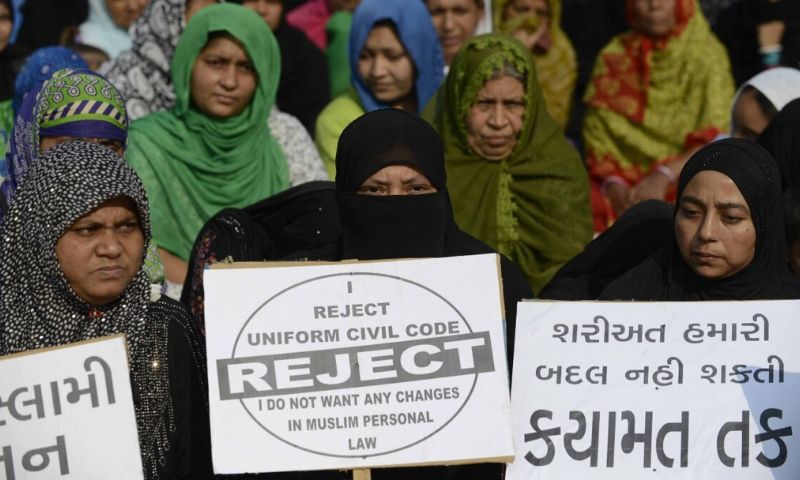
NEW DELHI: India’s controversial plan to implement a Uniform Civil Code (UCC) across BJP-led states has raised renewed concerns among Muslims after Home Minister Amit Shah pledged to extend the legislation to all 21 states governed by the BJP-led alliance by 2029.
The UCC would replace community-specific rules governing personal matters such as marriage, divorce and inheritance with a common legal framework.
While the BJP says the move would promote equality and uniformity, Muslim groups and critics fear it could undermine religious freedoms and restrict rights protected under their personal laws.
India’s 1.4 billion people are subject to a common criminal law, but rules on personal matters such as marriage, divorce and inheritance vary based on the customary traditions of different communities and faiths.
The introduction of a Uniform Civil Code (UCC) to replace those diverse rules has been a long-standing goal of Prime Minister Narendra Modi’s ruling Bharatiya Janata Party (BJP).
At least four states have implemented the UCC so far.
ALSO READ: Why Climate Change Poses Grave Danger to Indian Economy?
“We have introduced the UCC in several states… I am confident that we will implement (it) in all 21 states governed by the BJP-led National Democratic Alliance by 2029,” Home Minister Amit Shah said on Sunday.
The campaign for a standardised civil code has raised concerns, especially among Muslim citizens, who say such a move would infringe on their religious freedoms.
India, the world’s most populous country, is majority Hindu. It is also home to an estimated 220 million Muslims, giving it the world’s third-largest Muslim population.
India’s next national elections are due in 2029, after Modi won a third successive term in 2024, when he was forced into a coalition government.