Key Points
- IMF calls for taxing under-taxed sectors and simplifying tax concessions to improve compliance.
- Finance Minister Muhammad Aurangzeb warns against consumption-led growth and past boom-and-bust cycles.
- Pakistan must strengthen revenue collection while protecting investment, social spending and private-sector expansion.
ISLAMABAD: The International Monetary Fund (IMF) has urged Pakistan to bring under-taxed sectors into the tax net, rationalise tax concessions and reduce disproportionate tax burdens.
The Fund said a fairer, simpler system is essential to improve revenue collection, encourage compliance and support private-sector growth.
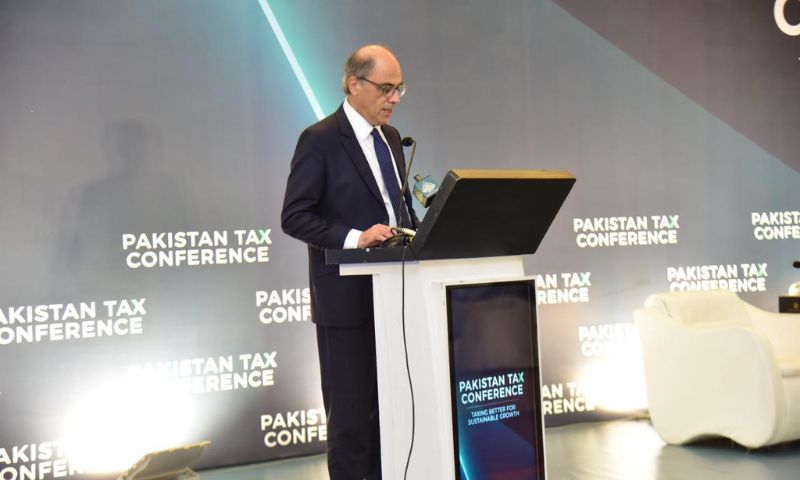
Jihad Azour, Director of the IMF’s Middle East and Central Asia Department, made the remarks on Tuesday at a high-level workshop on modernising Pakistan’s tax system. Pakistan’s Ministry of Finance and Revenue and the IMF jointly organised the workshop in Islamabad.
“Addressing under-taxed sectors, rationalising concessions, and reducing disproportionate burden are elements of a fair tax system,” Azour said.
According to the IMF Director, tax policy changes must be accompanied by stronger revenue administration to ensure effective implementation.
He said Pakistan had made “important progress” towards restoring macroeconomic stability, rebuilding confidence, strengthening external buffers and supporting a gradual economic recovery.
The next challenge, he added, was to turn those gains into stronger and more durable growth.
“Many countries have strong reform ideas, but few translate them into durable results. Implementation requires ownership, coordination, engagement, and communication,” Azour said.
ُُPakistan stabilisation to sustainable growth
Finance Minister Muhammad Aurangzeb said Pakistan needed to move from economic stabilisation towards sustainable, export-led growth. According to the Finance Minister, Pakistan must avoid a return to consumption-driven expansions and excessive liquidity that contributed to previous boom-and-bust cycles.
READ ALSO: Pakistan To Chair IMF And World Bank Boards After 74 Years
“How do we move from stabilisation to growth? Because that’s the whole point,” he said, emphasising that economic expansion must be sustainable rather than fuelled by short-term consumption.
“We have seen those experiments in the past. The consumption economy has led us to the boom-and-bust cycles. And one thing is for sure, we will not let that repeat,” Aurangzeb said.
He described taxation as a critical part of the government’s structural reform agenda, arguing that tax policy should reflect economic considerations rather than being designed primarily to meet revenue targets.
“We have to continue to have a tax design which is led by economic value considerations, not by making the math work,” he said, while acknowledging the government’s continuing revenue requirements.
Aurangzeb said Pakistan’s economic performance had improved from a contraction of around 0.3 per cent to estimated growth of approximately 3.65–3.7 per cent. However, he stressed that the quality and sustainability of growth mattered as much as its pace.
Fiscal policy and economic resilience
Azour said Pakistan remained exposed to higher energy and food prices, disruptions to trade and supply chains, changes in external demand and tighter global financing conditions. These risks made it important to preserve stability while supporting economic recovery.
Fiscal policy, he said, must do more than meet primary balance targets and safeguard debt sustainability. It should also strengthen policy credibility, support the recovery and create room for public investment and social spending needed for long-term growth and public welfare.
“Pakistan’s stabilisation gains create opportunity; it needs to be amplified through transformative reforms,” Azour said.
Earlier this month, the IMF and Pakistani authorities reached a staff-level agreement on the fourth review of Pakistan’s $7 billion Extended Fund Facility (EFF) and the third review of its Resilience and Sustainability Facility (RSF).
The agreement also followed the completion of the 2026 Article IV consultation. The reviews remain subject to the IMF’s applicable approval procedures.
Two-day tax reform workshop
The October 20–21 workshop brings together senior government officials, representatives of the IMF and World Bank, international tax experts, academics and private-sector leaders to identify priorities for modernising Pakistan’s tax system and strengthening its contribution to sustainable growth.
Participants are expected to discuss ways to develop a broader, fairer, simpler and more predictable tax framework that supports revenue mobilisation, investment, business expansion and productivity.
The workshop will conclude with a high-level panel to consolidate recommendations, identify priority actions and establish arrangements for continued engagement among stakeholders.