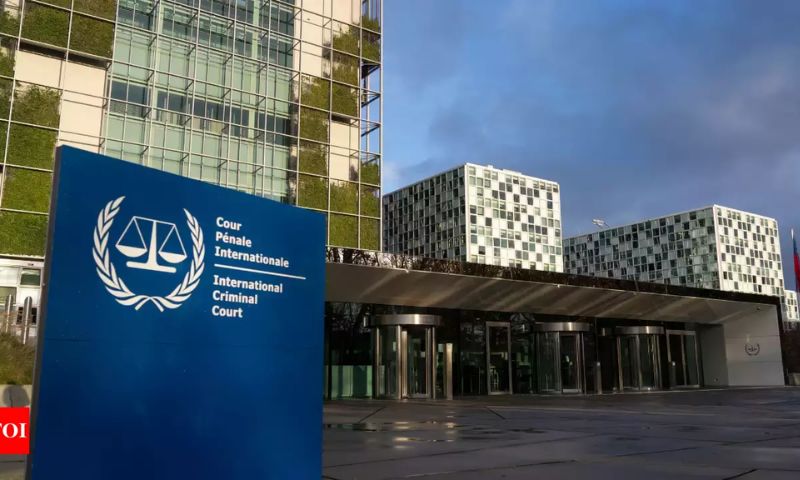
THE HAGUE, Netherlands: The International Criminal Court announced on Tuesday that it had issued arrest warrants for two senior Russian officials over the Ukraine war, including attacks that targeted Ukraine’s electricity infrastructure.
The move comes after a court last March issued an international arrest warrant targeting Russian President Vladimir Putin for war crimes over the deportation of Ukrainian children since the start of the war in February 2022. Received and executed.
Authorities identified the subjects of the new warrant as Viktor Nikolayevich Sokolov and Navy Admiral and Vice Admiral Sergey Ivanovich Kobylash, and the alleged crimes occurred between October 2022 and March 2023. She said she was sexually assaulted.
The court said the two men were each “responsible for war crimes for directing attacks on civilians and were also charged with crimes against humanity.”
The court said there are reasons to believe that the two suspects were involved in missile attacks on Ukraine’s electricity infrastructure from at least October 10, 2022, to at least March 9, 2023.
According to the court, during this period, there have been attacks by Russian forces on power plants and substations in several places in Ukraine.
“There are reasonable grounds to believe they bear individual criminal responsibility for the aforementioned crimes,” the Hague-based ICC said in a statement.
The newspaper said the two men either directly carried out or ordered the attack or failed to “adequately control the forces under their command.”
Ukrainian President Volodymyr Zelensky welcomed the court’s action, saying it would send a message to Russian military commanders that “justice will be served” for attacks on civilians and critical infrastructure.
“Every perpetrator of such crimes must know that they will be held accountable,” he said.
‘Another milestone’
The country’s defense ministry said in a document on its website that Kobylash, 58, is in command of aviation units linked to Russia’s nuclear deterrent system.
Sokolov, 61, is the commander of Russia’s Black Sea Fleet, according to his official biography.
The International Criminal Court, established in 2002 to investigate war crimes worldwide, opened an office in Kyiv in September as part of efforts to hold the Russian military accountable for possible war crimes.
The move comes after the International Office to Investigate Russia’s war crimes opened in The Hague in March 2023, which Kiev called a “historic” visit to the court for Moscow’s leadership. I called it a step.
Along with Putin, the International Criminal Court also issued a verdict against Maria Luyeva-Belva, the Russian presidential commissioner for children’s rights, on similar charges of illegal deportation of children during the Ukraine war.
The Russian authorities reacted strongly to the court order for President Putin, and the Russian government issued a retaliatory arrest warrant for Karim Khan, the prosecutor of the British International Criminal Court, and other court officials.
The court action appears to have limited Putin’s activities abroad, and the Russian president was absent from last year’s BRICS summit in South Africa.
Neither Russia nor Ukraine are full members of the International Criminal Court, but Kiev is cooperating with the court to present what it believes is evidence of Russian crimes.
“It took us many months of dedicated work of prosecutors, investigators of Ukraine, different Ukrainian agencies, who supplied the office of the prosecutor of the ICC with thousands of evidences and information,” Ukraine’s prosecutor general Andriy Kostin said Tuesday.
“Today, we reached another milestone in ensuring justice for all victims and survivors of this war. I’m really grateful for prosecutor of the ICC Karim Khan and his team,” Kostin said in Brussels, where he was attending a meeting of European justice ministers.
The International Criminal Court does not have its own police force to enforce arrest warrants and relies on its 123 member states to assist in the travel of wanted individuals to their territories.
“Those responsible for actions that impact innocent civilians or protected objects must know that this conduct is bound by a set of rules reflected in international humanitarian law,” Khan said in a statement on Tuesday’s move.
“All wars have rules. Those rules bind all without exception.”