
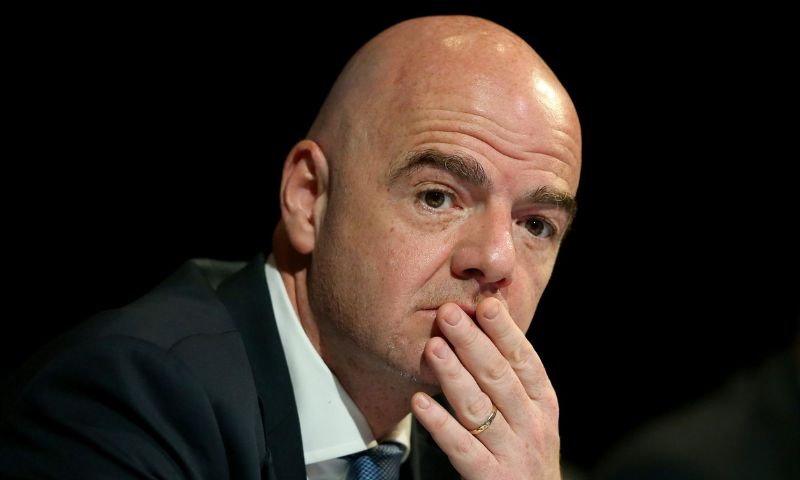
ISLAMABAD: Despite mounting criticism over transparency and governance, Gianni Infantino could secure another term as FIFA president, with his strong support base in Africa and South America, a fragmented opposition and the absence of a credible challenger strengthening his re-election prospects, according to observers.
The 56-year-old Swiss official has faced growing scrutiny following his proposal to introduce private investment into FIFA’s commercial operations, an initiative that was subsequently shelved.
Although the controversy has reportedly weakened his standing among several football associations, Infantino retains crucial support that could prove decisive in his bid for a fourth and final term.
Divided opposition gives Infantino an advantage
Infantino’s proposed FIFA Forward Enterprise (FFE) initiative, which emerged in July following the successful World Cup, envisaged establishing a commercial subsidiary to manage FIFA’s major events, including the World Cup.
The proposal sparked concerns over transparency and governance, prompting criticism from several football officials and raising questions about the organisation’s commercial decision-making.
However, two prominent critics of Infantino, UEFA president Aleksander Ceferin and reportedly CONCACAF chief Victor Montagliani, are seeking re-election to their respective positions rather than challenging him for FIFA’s presidency.
Victor Montagliani rules out challenging Gianni Infantino for Fifa presidency by committing to Concacaf re-election bid | The Guardian https://t.co/tsK6lQKFkm
— Matt Hughes (@MattHughesMedia) October 8, 2026
Their decisions have left Infantino’s opponents struggling to find a credible candidate capable of mounting a serious challenge.
Terrence Burns, a marketing strategist involved in two successful World Cup hosting bids, told AFP that Infantino remained in a strong position despite the controversy.
“He holds all the cards and always has,” Burns said, suggesting that a potential challenger at this stage might be motivated by political strategy or efforts to negotiate concessions rather than a realistic prospect of winning.
Former International Olympic Committee (IOC) marketing chief Michael Payne also expressed surprise that no serious rival had emerged.
“If he is re-elected, which is looking increasingly likely, it will redefine the term Houdini,” Payne said, comparing Infantino’s political resilience to the celebrated escape artist.
Read Also: UEFA Chief Ceferin Tells Infantino to Quit
Support in Africa and South America could prove crucial
Infantino’s continued backing among football associations in Africa and South America could be central to his re-election campaign, even as opposition grows in parts of Europe.
Without a unified challenger, dissatisfied associations may struggle to turn their criticism into a coordinated electoral campaign. This political fragmentation could allow Infantino to retain the support needed to extend his leadership.
Lise Klaveness, president of the Norwegian Football Federation and one of Infantino’s prominent critics, has impressed observers but ruled out contesting the presidency.
Even if she changed her mind, she would face considerable obstacles in becoming the first woman to run for the leadership of world football. Kirsty Coventry became the first woman elected president of the IOC last year, but observers say the political dynamics within FIFA are different.
A source close to football governance, speaking to AFP on condition of anonymity, suggested that FIFA’s internal environment would make a Klaveness candidacy particularly challenging.
BREAKING: The Union of Arab Football Associations has reaffirmed its support for FIFA President Gianni Infantino ahead of his upcoming re-election bid.
The UAFA praised Infantino’s decade of leadership, crediting him with helping develop the game and expand football’s global reach.
— Transfer News (@TransferNews) October 3, 2026
Legal challenges could complicate his bid
Despite his apparent electoral advantage, Infantino’s position is not entirely secure. Critics have pursued legal action in the United States and submitted formal complaints to FIFA committees over the proposed FFE initiative and related governance concerns.
Klaveness and the Norwegian federation have highlighted three issues, including concerns linked to Infantino’s relationship with US President Donald Trump.
The proposed FFE initiative was expected to involve a major investment from the venture capital firm of Josh Kushner, the brother of Trump’s son-in-law Jared Kushner.
UEFA has also launched legal proceedings in US courts seeking access to documents related to the FFE proposal, a case FIFA is strongly contesting.
Read Also: Who Are the Potential Candidates to Replace Gianni Infantino As FIFA President?
Burns described the legal dispute as a significant complication for Infantino, questioning why the initiative’s details remained contested if the proposal had merely suffered from procedural or communication problems.
He argued that concerns over transparency could continue to undermine confidence in FIFA’s leadership.
The Norwegian federation could also approach the Court of Arbitration for Sport (CAS) if it is dissatisfied with how FIFA handles its complaints. However, there is no guarantee that the complaints will receive a substantive review or lead to action against Infantino.
FIFA says Gianni Infantino will seek re-election in 2027 despite opposition over his failed plan to privatise World Cup commercial rights.
No rival candidate has emerged, with nominations requiring support from five FIFA member associations by November.
Source: Sky News https://t.co/nMnVp5qkV1
— Clash Report (@clashreport) September 6, 2026
Financial considerations may shape FIFA’s election
The lack of support from major football nations, including Spain, France and England, could pose a challenge to Infantino, according to Payne, who warned that divisions within FIFA could deepen.
He argued that a global sports organisation depends on unity and suggested the current dispute could take FIFA into unfamiliar territory.
Burns, however, believes many football associations may ultimately prefer political stability to a divisive leadership contest. Without compelling evidence of serious wrongdoing or a clear financial incentive to remove the incumbent, federations could be reluctant to challenge him.
Read Also: Platini Demands FIFA President Infantino Must Go
The combination of established political alliances, the absence of a strong rival and the uncertain outcome of legal challenges could therefore work in Infantino’s favour.
Burns believes the controversy could ultimately strengthen the FIFA president’s position, potentially leading to an even greater concentration of power and influence if he secures another term.
The FIFA presidential election is scheduled for March 2027, with prospective candidates required to declare their intention to run by November 18, 2026.