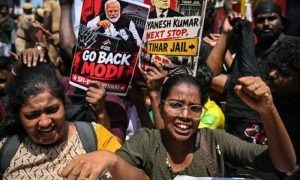
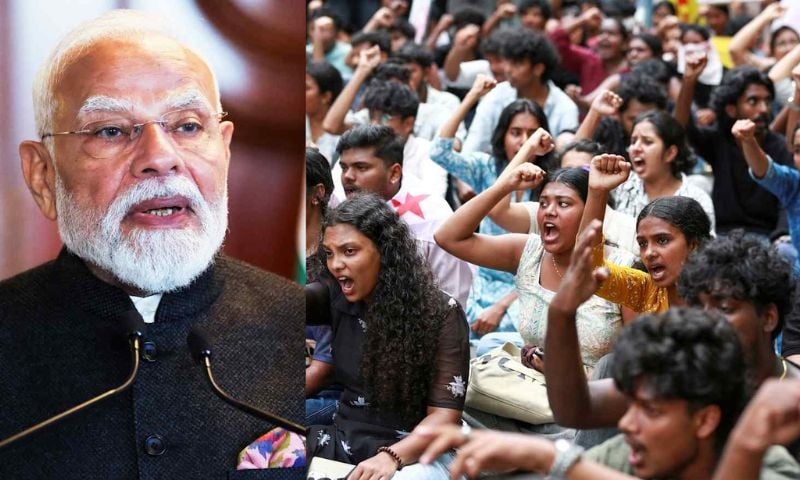
NEW DELHI: India’s anti-government Cockroach Movement has emerged as one of the biggest political challenges to Prime Minister Narendra Modi’s government, culminating in the resignation of Education Minister Dharmendra Pradhan after weeks of nationwide student protests over examination paper leaks.
The movement, led by the satirical Cockroach Janta Party (CJP), announced the suspension of protests after Pradhan stepped down, saying the decision met a key demand of demonstrators.
Student leaders described the resignation as a major victory but said they would continue pursuing accountability over repeated examination leaks and police action against protesters.
The protests, which began in New Delhi in early June, quickly spread to more than a dozen cities, drawing students from diverse social, religious and regional backgrounds.
Demonstrators accused authorities of failing to protect the integrity of competitive examinations used for university admissions and government recruitment.
Protest leaders also demanded compensation for families of students who died by suicide following exam paper leak controversies.
ALSO READ: The Emperor Has No Clothes: Arundhati Roy on How Indian Youth Exposed Modi
The movement gained further momentum after police dispersed demonstrators attempting to march towards Parliament and after educator Sonam Wangchuk ended a 26-day hunger strike following government assurances of reforms in the examination system.
Political analysts said the protests proved difficult for the government to counter because they united young people across caste, class and religious divides.
Commentators noted that the administration’s attempts to portray protest organisers as politically motivated failed to weaken public support for the movement.
The Cockroach Janta Party, founded by activist Abhijeet Dipke after a controversial remark comparing unemployed youth to “cockroaches”, rapidly transformed from an online campaign into a nationwide protest platform.
The movement also received backing from several public figures, including acclaimed author Arundhati Roy, who praised the role of young protesters in challenging the government.
Following Pradhan’s resignation, Prime Minister Modi acknowledged public concerns over examination paper leaks and pledged continued action against those responsible.
Although protest leaders have called off demonstrations for now, they insist that broader reforms of India’s examination system and accountability for officials involved in irregularities remain unresolved, leaving questions over whether the movement could evolve into a broader political force in the future.