TEHRAN: Tensions in the Gulf have sharply intensified after Iran’s Islamic Revolutionary Guard Corps (IRGC) warned that any military vessels approaching the Strait of Hormuz would be treated as a breach of the recently agreed two-week ceasefire with the United States.
In a strongly worded statement carried by Iranian state media on Sunday, the IRGC asserted that the strategically vital waterway remains under the “full control and smart management” of Iran’s naval forces.
While the passage remains open to civilian shipping under specific conditions, the Guards cautioned that any military incursion would be met with “harsh and decisive” action.
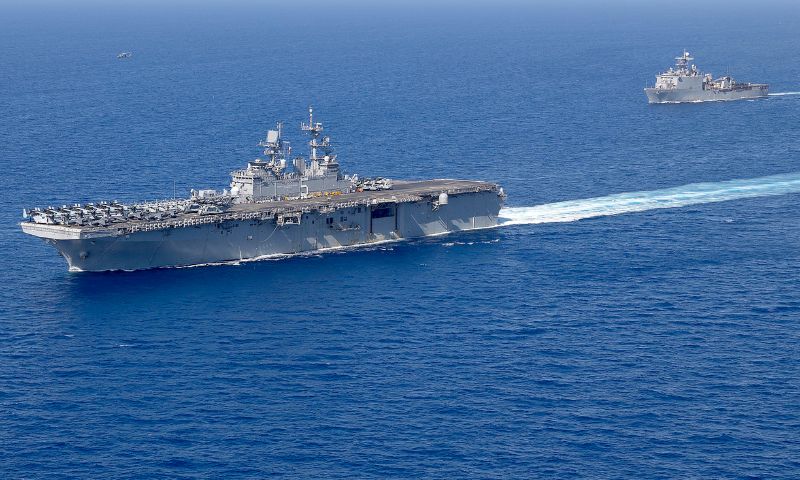
The warning follows a surprise announcement by US President Donald Trump, who declared that American naval forces would begin blockading vessels entering or leaving the strait.
According to the US Central Command (CENTCOM), the blockade will formally come into effect on Monday evening regional time, extending to Iranian ports and applying to vessels of all nationalities. However, ships travelling between non-Iranian ports will still be permitted to transit the waterway.
Washington claims the move is necessary to ensure maritime security, accusing Tehran of threatening commercial shipping and imposing what it described as “illegal tolls” on vessels transiting the route.
In response, Iran’s leadership struck a defiant tone. Parliament Speaker Mohammad Bagher Ghalibaf said Tehran would not yield to pressure, warning that any confrontation would be met in kind. “If they fight, we will fight,” he said, adding that Iran remains open to dialogue but will not bow to threats.
The IRGC reinforced this stance in a series of statements and social media posts, warning that adversaries risk being caught in a “deadly vortex” in the strait if they miscalculate. Accompanying footage released by the Guards showed vessels being tracked through targeting systems, underscoring the seriousness of the threat.
The Strait of Hormuz, a narrow passage linking the Gulf to the Arabian Sea, is one of the world’s most critical energy corridors. In normal conditions, roughly 20 per cent of global oil and liquefied natural gas supplies pass through it. However, the waterway has been effectively restricted since late February, when hostilities escalated following US and Israeli strikes on Iranian targets.
Although reopening the strait was reportedly a key condition of the ceasefire agreed earlier this week, the latest developments have cast doubt on the durability of the ceasefire. The disruption has already triggered a global energy crunch, pushing fuel prices higher and raising concerns over supply stability.
Analysts warn that any direct confrontation in the strait could have far-reaching economic and geopolitical consequences, potentially drawing in regional and global powers.
For now, both sides appear locked in a tense standoff, with the risk of escalation looming large over one of the world’s most vital maritime chokepoints.
After the Iran-US talks concluded without an agreement, the United States announced a sweeping naval blockade targeting Iranian ports and vessels, marking a sharp escalation in tensions after high-stakes negotiations between Washington and Tehran ended in Islamabad early Sunday.
US President Donald Trump said on Sunday that the US Navy would immediately begin enforcing restrictions in and around the strategically vital Strait of Hormuz, through which roughly one-fifth of the world’s oil supply typically passes.