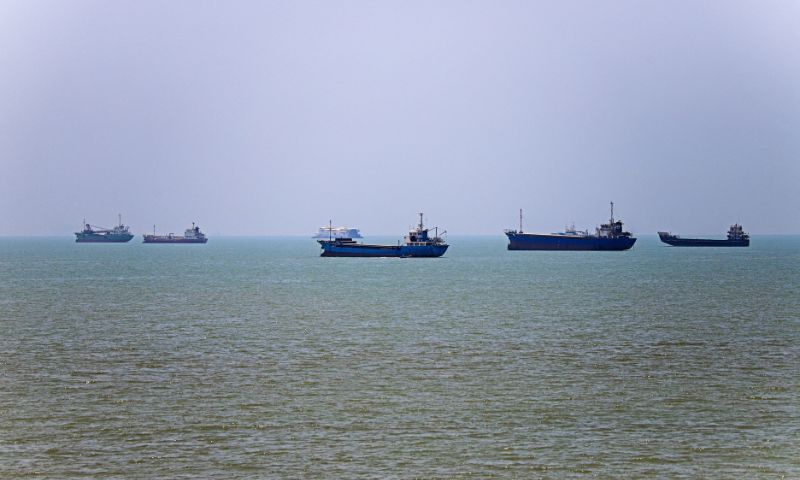
PARIS: Shipping traffic through the Strait of Hormuz has surged to its highest level in two months following a US-Iran agreement to reopen the key maritime route, according to maritime tracking data released on Friday.
A total of 25 commercial vessels transited the strait on Thursday, the highest daily figure since mid-April, data from tracking firm AXSMarine showed. This marks more than three times the average of just over seven daily crossings recorded since early March.
The increase in activity was also reflected onshore, where eyewitnesses reported queues of empty trucks stretching up to three kilometres outside the UAE’s Korfakkan port, just south of the strait, as at least four container ships unloaded cargo.
📢 Strait of Hormuz traffic sees its strongest daily rebound in two months against a backdrop of its largest AIS disruption.
🌍 Yesterday, we observed 25 verified commercial vessel crossings through the Strait of Hormuz.
📊 That is the highest single-day count since 18 April,… pic.twitter.com/JbnfzYBrnv
— AXSMarine (@AXSMarine) June 19, 2026
AXSMarine noted that the actual number of crossings may be higher, as some vessels reportedly disabled or manipulated their AIS tracking signals to avoid detection.
The rise in traffic follows an agreement between Iran and the United States this week to reopen the strategic waterway as part of efforts to end the conflict. However, it comes amid uncertainty after planned US-Iran talks in Switzerland were postponed.
Iran’s Persian Gulf Strait Authority on Friday issued new regulations governing maritime transit during the 60-day period covered by the war agreement.
In a post on X, the authority said all vessels intending to pass through the Strait of Hormuz must submit a transit request at least 48 hours in advance.
It also announced that it would waive “tariffs” and Iranian insurance charges for ships transiting the strait during the 60-day window.
Persian Gulf Strait Authority:
To prevent delays at the entrance to or exit from the Strait of Hormuz, it is necessary to submit the transit request with complete required information at least 48 hours before arriving in the strait area.
During the 60-day period, no fees will… https://t.co/ZurLYUorQB
— Iran’s Today (@Iran) June 19, 2026
Separately, International Maritime Organisation (IMO) Secretary-General Arsenio Dominguez said in April that the body was working on measures to ensure the safe passage of vessels in and out of the Gulf.
More than 500 commercial vessels and around 11,000 seafarers remain stranded in the Gulf, according to the International Maritime Organisation (IMO), which said a total of 20,000 seafarers in the region have been affected by the conflict.
The agreement reached this week to end the war also aimed to halt fighting in Lebanon. However, Israel’s military on Friday announced fresh strikes in the area.
Later, a US official said Israel and Iran-backed Hezbollah had agreed to a ceasefire.
The closure of the Strait of Hormuz during the conflict had previously pushed up global oil prices and disrupted shipments of energy supplies and key commodities, including fertilisers.