
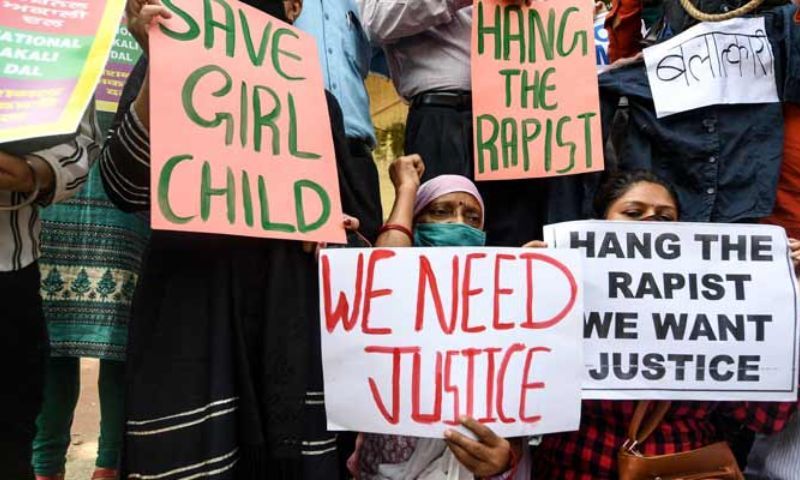
NEW DELHI, INDIA: Growing incidents of rape have triggered large protests at Indian universities, with students demanding justice, stronger action against sexual violence and greater accountability from authorities following a series of attacks in Delhi.
Hundreds of women students marched through Delhi on Wednesday, chanting “We want justice” and carrying posters condemning sexual violence and restrictions placed on women in the name of safety.
The protests followed several rape cases reported in Delhi in recent weeks, including the gang-rape of a 17-year-old girl in a public park near Delhi University by three men who posed as police officers.
A week earlier, another 17-year-old girl was gang-raped and killed in Delhi’s Swaroop Nagar area after going to meet friends. Police said that the girl was raped, stabbed and her body dumped in a field, where it was later found.
Cases involving an 11-year-old and a six-year-old girl were also reported during the same month, while a 16-year-old girl was raped last month by a bus driver and conductor after boarding a sleeper bus in Delhi.
The incidents have renewed concerns among female students about safety in public spaces and university areas, while protesters have also criticised measures that they say place restrictions on women rather than addressing perpetrators.
The protests have drawn comparisons with the 2012 Nirbhaya case, in which a young woman was gang-raped on a Delhi bus and later died from her injuries. The case prompted widespread protests and led to changes in India’s laws concerning sexual offences.
The Supreme Court said this week that the recent cases “starkly underlined a systematic failure” and drew “painful parallels” with the 2012 incident.
Students participating in the protests have called for improved street lighting, stronger policing and more effective mechanisms for reporting and investigating sexual harassment and assault.
Vaishnavi Dhruw, a 21-year-old history student at Delhi University, said many women in the capital continued to feel unsafe. “I don’t know a single woman who lives in this city and feels safe,” she said.
Dhruw said women should not be expected to restrict their movements because of the threat of sexual violence. “We are not marching for safety, we are here to protest for our freedom, for the most basic right to walk in our own streets,” she said.
The protests have also focused on restrictions introduced following the recent incidents. Women in Delhi were advised to avoid parks at night, while classes were temporarily suspended at a prominent women’s college. Some university hostels also impose curfews on female students.
Aranya Rathore, 25, a Delhi University student, criticised such measures. “Instead of going after criminals, you’re going to tell women to sit at home,” she said.
Female students said concerns about personal safety affect everyday decisions, including what they wear, when they travel and which educational institutions or jobs they choose.
Ananya Wig, a Delhi University graduate and founder of the gender-equality initiative Her Huq, said many women consider proximity to home when choosing educational and employment opportunities because of safety concerns.
READ ALSO: String of Rape Cases in Delhi Trigger Concerns Over Women’s Safety in India
“Not on the basis of their marks, not on the basis of their aspirations, but simply, ‘OK, the shorter the distance, the more likely it is that I will be safe,’” she said.
Students have also raised concerns about sexual harassment on university campuses and called for stronger accountability and reporting mechanisms.
Devyani Sarkar, a 24-year-old English master’s student, stated that women at Delhi University had faced assault and harassment, including allegations involving professors.
“Delhi University is one of the most prestigious universities in India right now but there are various cases of women being assaulted by professors,” she said.
Delhi University has not responded to the allegations cited by the protesters, according to the reports. The protests come amid wider demonstrations by young Indians over education reform, which have involved large numbers of Gen Z protesters.
Seventeen-year-old student Subhani said her generation was increasingly willing to speak out against social problems. “My generation is not afraid to stand up and protest. We know that society has to change,” she said.
The demonstrations have placed renewed focus on sexual violence in India and on demands by young women for greater freedom, security and accountability rather than restrictions on their movements.