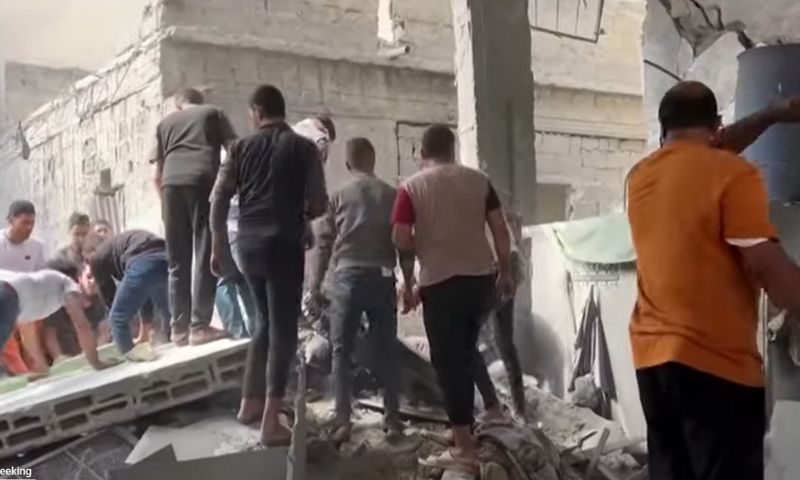
UNITED NATIONS: UN agencies have reported that hospitals in the devastated Gaza Strip are closing because they are out of fuel for generators and water and overburdened with civilians fleeing Israeli shelling.
Doctors, hospital administrators, and foreign relief agencies depict terrifying circumstances, such as physicians having to perform procedures with minimal or no anesthesia, by the light of cell phones, or using vinegar instead of antiseptic in certain situations.
In addition to the thousands of patients suffering from traumatic wounds from continuous aircraft bombing, Gaza’s hospitals are overrun by tens of thousands of Palestinians seeking refuge, making medical care for the injured much more difficult.
On Wednesday night, the main hospital in Gaza, located south of the enclave, warned that life-saving operations would stop due to fuel shortages. This came after UN Secretary-General Antonio Guterres called for an immediate humanitarian ceasefire.
The UN Chief told the Security Council on Tuesday that a truce was needed “to ease epic suffering, make the delivery of aid easier and safer, and facilitate the release of hostages.”
The UN Palestine Refugee Agency (UNRWA) said on Wednesday that in the last 24 hours, three more staff members had been killed due to the Israeli bombardment continuing across Gaza, bringing the total to 38 since the complete military siege started.
A close-range strike severely damaged one school in Rafah, in the far south, which was providing shelter to about 4,600 internally displaced people, according to UNRWA.
Since October 7th, the Ministry of Health, under Hamas’s control, has reported nearly 5,800 deaths in Gaza, 2,360 of which were children. Over 16,000 people have sustained injuries.
UNRWA said 1,900 people were injured, and 95 died in the West Bank.
ALSO READ: Israel Ground Forces Raid Hamas Sites in Gaza: Military
The major humanitarian organization in the enclave, UNRWA, issued a warning in Gaza, stating that it will have to suspend operations starting Wednesday night if fuel is not permitted.
Since October 11th, Gaza has been without electricity, and fuel shortages have made it difficult to provide essential services like water, bakeries, and ambulances.
According to media reports, eight trucks from the Egyptian Red Crescent made up the fourth humanitarian assistance convoy, which landed in the enclave late on Tuesday.
The UN Humanitarian Affairs Coordination Office (OCHA) claimed that Tuesday was also the most significant number of deaths recorded in Gaza during this round of conflicts in a single day.
As the situation worsens, UN Women has brought attention to the plight of women and girls in the Gaza Strip by adding its voice to the UN chief’s appeals for a humanitarian truce.
Sarah Hendriks, the deputy executive director of UN Women, highlighted in an interview with UN News how critical it is for women and girls in Gaza to have access to safe housing, security, and maternity care. She noted that around 5,500 women in Gaza will give birth in the upcoming month, and approximately 50,000 women are pregnant, according to UNFPA, the UN Population Fund.
According to a report released by WHO on Tuesday, Gaza’s healthcare access is getting harder and harder every hour. A third of the territory’s hospitals and nearly two-thirds of its primary care clinics have closed.
Hendriks also said that “the violence has produced close to 900 new female-headed households” and highlighted the struggle of widows to provide for their families. She warned about the constant threat of gender-based violence and how conditions in congested shelters and widespread displacement aggravate it.
Hendriks said, “We will continue to remain on the ground listening to the voices of women and girls, hearing their perspectives and translating those to the international community so that their needs can be prioritized even as the solutions to the overall conflict are being addressed.” —APP