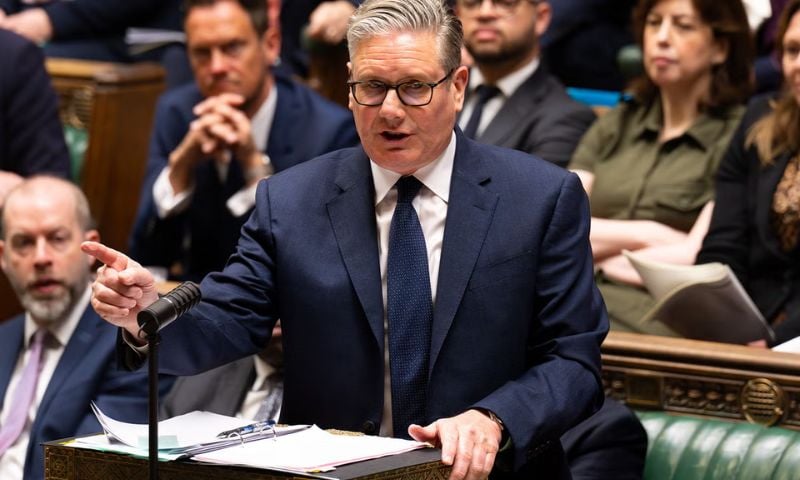



LONDON, United Kingdom: Prime Minister Keir Starmer has become the latest British leader facing mounting political pressure after heavy losses for the Labour Party in last week’s regional and local elections intensified questions about his leadership.
The elections, held across Scotland, Wales and 136 English local authorities, marked the biggest electoral test since Labour’s landslide victory in the 2024 general election.
Labour suffered major setbacks across England, where it defended more than 2,500 council seats but retained only 1,068 while losing nearly 1,500 seats. Meanwhile, Reform UK recorded the largest gains, adding more than 1,450 councillors, reports Anadolu.
In Wales, Labour lost a national election for the first time in more than a century, while in Scotland the Scottish National Party retained power for a fifth consecutive term.
Although Starmer has insisted he will continue governing, pressure within Labour has intensified. More than 80 lawmakers and several ministers reportedly urged him to resign or announce a departure timetable.
The crisis deepened after Wes Streeting resigned as health secretary, citing Labour’s electoral collapse and loss of confidence in Starmer’s leadership.
Streeting became the first Cabinet minister and the fifth minister overall to resign, following the departures of Jess Phillips, Miatta Fahnbulleh, Alex Davies-Jones and Zubir Ahmed.
Britain’s Era of Political Volatility
Since David Cameron resigned in 2016 following the Brexit referendum, Britain has had five prime ministers: Theresa May, Boris Johnson, Liz Truss, Rishi Sunak and Starmer.
That amounts to a new prime minister roughly every two years.
While Britain has experienced periods of rapid leadership turnover before, including the 19th century and the interwar era, analysts say the current instability is unusual compared to the relative political continuity seen between 1979 and 2016, when the country had only five leaders over nearly four decades.
Theresa May and Brexit Deadlock
Theresa May entered office in July 2016 after Cameron resigned following the Brexit referendum.
A supporter of Britain’s departure from the European Union, May formally triggered Article 50 in March 2017 to begin the withdrawal process.
Her government became consumed by efforts to negotiate and pass a Brexit agreement through Parliament. Repeated defeats of her proposed deal, coupled with growing unrest inside the Conservative Party, weakened her authority.
After Parliament rejected her Brexit agreement three times and the Conservatives suffered losses in the 2019 European elections, May resigned in July 2019.
Boris Johnson and the Partygate Scandal
Boris Johnson succeeded May, promising to “get Brexit done.”
Under his leadership, Britain formally left the European Union on January 31, 2020. However, his premiership quickly became dominated by the COVID-19 pandemic.
Johnson’s political standing later collapsed following revelations that government staff and Conservative Party officials held gatherings during pandemic lockdowns, in what became known as the “Partygate” scandal.
After surviving a confidence vote and facing mass resignations from ministers, Johnson resigned in 2022.
Liz Truss and Economic Turmoil
Liz Truss’s tenure became the shortest in British history.
Just weeks after taking office in September 2022, her government unveiled a controversial economic package involving major tax cuts and increased borrowing.
The plan triggered financial market turmoil, a collapse in confidence and pressure on the British pound.
Truss resigned after only 50 days in office.
Rishi Sunak and Conservative Decline
Rishi Sunak inherited a divided Conservative Party and worsening economic conditions.
He pledged to reduce inflation, stabilise the economy and tackle irregular migration through the Rwanda asylum policy.
Sunak maintained strong support for Ukraine following Russia’s invasion and backed Israel after the October 7 attacks, but his government struggled to reverse declining Conservative popularity.
The Conservatives suffered heavy losses in local elections before losing the 2024 general election to Labour.
Keir Starmer’s Mounting Pressure
After Labour’s sweeping victory in 2024, Starmer entered office promising stability after years of Conservative turmoil.
His government focused on resolving public-sector strikes, managing immigration pressures and addressing economic uncertainty.
On foreign policy, Starmer maintained support for Ukraine, called for a ceasefire in Gaza, and later formally recognised the State of Palestine.
Despite initially positive approval ratings, Starmer’s popularity has steadily declined.
A YouGov poll in late 2025 placed his net approval rating at minus 54 percent, while a recent Ipsos survey found that two-thirds of respondents believed he should resign before the next general election.
The latest election setbacks have intensified concerns that Britain’s cycle of political instability may continue, placing Starmer under growing pressure less than two years after his landslide victory.