For years, the Western imagination has viewed India through a lens of mysticism—a land of wandering sadhus and ancient wisdom. However, in his jarring new memoir, J’avais un rêve indien: Dans l’enfer de la prison de Gorakhpur (I Had an Indian Dream: In the Hell of Gorakhpur Prison), French filmmaker Valentin Henault strips away this romanticised veneer.
What begins as a quest to document India Syndrome evolves into a harrowing expose of internal colonialism, systemic caste violence, and the brutal reality of the Indian carceral system under the rising tide of Hindutva ideology.
Henault arrived in India in August 2023, initially seeking the absolute. That idealism vanished almost instantly upon witnessing the raw exploitation of the country’s most vulnerable.
He observed children scavenging sacred rivers for coins and elderly men performing animal-like labour, while affluent urbanites maintained a lifestyle supported by generational servitude.
Disillusioned by spiritual clichés, Henault shifted his focus to the plight of Dalits (also known as “untouchables”). Despite making up a significant portion of the population, Dalits, and particularly Dalit women, remain targets of routine violence.
Henault’s narrative identifies a layered domination: the rich over the poor, men over women, and, most pervasively, upper castes over lower castes. He argues that modern Indian progress serves only the elite, leaving the marginalised trapped in a cycle of dependency and humiliation.
The book’s emotional core is Seema Gautam, a fierce Dalit activist whose mother was murdered by upper-caste individuals over a land dispute. Through Seema, Henault was introduced to the Ambedkar People’s Movement.
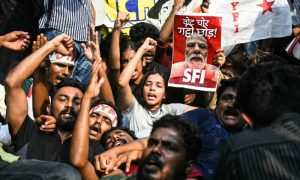
He accompanied her to remote villages where she delivered electrifying speeches, condemned “modern slavery,” and demanded land rights for the landless.
Henault’s documentation of these villages reveals a stark reality: goat-filled huts, a lack of electricity, and constant caste-based insults. Even educated Dalits were forced to endure public humiliation by upper-caste men.
More chilling were the files of atrocities Seema shared. It includes dossiers of rapes and murders of Dalit minors where police complicity, evidence tampering, and the intimidation of victims’ families were the standard operating procedure.
Henault’s journey took a dark turn in October 2023. During a peaceful land-rights march in Gorakhpur, Uttar Pradesh, police stormed his hotel and arrested him under the Foreigners Act.
Though he was filming a documentary, authorities accused him of espionage and fomenting unrest. Local media outlets quickly labelled him a “terrorist,” attempting to delegitimise the Dalit movement as a product of foreign interference.
The author spent approximately one month in Gorakhpur Central Jail, a facility designed for a fraction of the 3000+ inmates it held. Placed in the pavillon des fous (ward for the mentally unstable), Henault describes a sensory assault of filth, torture, and extreme sleep deprivation.
In prison, the outside world’s prejudices were magnified. The jail functioned not by the Indian Constitution, but by ancient discriminatory codes. Upper-caste inmates occupied the best positions, while Dalits were relegated to the corners near toilets.
Muslims, who represent roughly 14–15% of India’s population and face increasing institutionalised Islamophobia through policies like bulldozer justice, were entirely segregated.
Risking further punishment, Henault secretly recorded the testimonies of his fellow inmates, mostly poor, innocent undertrials jailed on fabricated charges like love jihad. He eventually secured bail and returned to France in May 2024, but the experience left him permanently changed.
J’avais un rêve indien serves as a scathing critique of Western cultural relativism. Henault concludes that to ignore the systemic violence of the caste system in favour of spiritual tourism is a betrayal of the millions living in a state of constant peril.
His memoir is a powerful, sombre testament to the resilience of the marginalised and a demand for the world to see India as it truly is, rather than a so-called mystical dream.