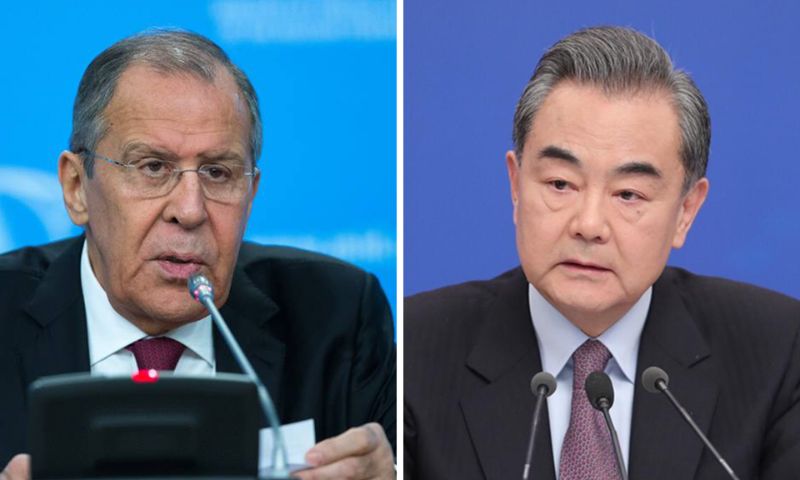
BEIJING: China is willing to continue working with Russia within the framework of the UN Security Council and make joint efforts to de-escalate the Middle East conflict, Chinese Foreign Minister Wang Yi told his Russian counterpart Sergei Lavrov in a phone call on Sunday.
Wang said that the situation in the Middle East continues to deteriorate, hostilities are still escalating, and the fundamental solution to ensuring navigation through the Strait of Hormuz lies in achieving an early ceasefire and bringing the war to an end, China’s state-run Xinhua news agency reported.
Chinese Foreign Minister Wang said that China has consistently advocated the resolution of international and regional hotspot issues through dialogue and negotiation.
China willing to cooperate with Russia to de-escalate Mideast situation, says FM https://t.co/owganWcmL0 pic.twitter.com/w9xIeANfdT
— China Xinhua News (@XHNews) April 5, 2026
The Chinese and Russian foreign ministers’ call came ahead of a UN Security Council vote next week on a Bahraini resolution to protect commercial shipping in and around the Strait of Hormuz.
As permanent members of the UN Security Council, China and Russia should “uphold fairness and justice on matters of principle, adopt an objective and balanced approach and seek to win greater understanding and support from the international community,” Wang told Lavrov, according to a statement from his ministry.
Russia stresses immediate ceasefire
A Russian Foreign Ministry statement said the ministers discussed ways to achieve a rapid ceasefire and “launch a political-diplomatic dialogue.”
“Satisfaction was expressed at the coincidence in Russia’s and China’s approaches on most issues on the global agenda, including the situation around Iran,” it said.
Lavrov said Russia is highly concerned about the continued escalation of tensions in the Middle East, according to Xinhua.
Regarding the ongoing conflict and the issue of the Strait of Hormuz, Lavrov said Russia maintains that military operations must be stopped immediately and efforts should return to the track of political and diplomatic settlement to address the root causes of the conflict, and the UN Security Council should play a constructive role in this regard, according to Xinhua.
Russia stands ready to maintain close communication and coordination with China and continue to make efforts and speak out in support of a ceasefire and the end of the war, Lavrov said.
China has repeatedly called for a ceasefire in the Gulf region and the Middle East, urging an end to the fighting that has run for more than a month and largely closed the Strait of Hormuz, a critical shipping artery for oil and gas.
China-Pakistan five-point peace plan
Meanwhile, Pakistan has intensified diplomatic efforts to de-escalate the conflict and offered to host the US-Iran talks.
On March 31, China and Pakistan agreed on a five-point framework to restore peace and stability in the Gulf and Middle East.
The plan was issued after high-level talks between Pakistan’s Deputy Prime Minister and Foreign Minister Ishaq Dar and China’s Foreign Minister Wang Yi in Beijing on Tuesday.
The two sides called for an immediate cessation of hostilities, the initiation of dialogue among all parties, protection of civilians and critical infrastructure, ensuring the security of key maritime routes, including the Strait of Hormuz, and upholding the principles of the United Nations Charter to achieve lasting peace in the region, according to a statement issued by Pakistan’s Foreign Ministry.
According to the Foreign Ministry statement, Chinese Foreign Minister Wang Yi and Pakistan’s Deputy Prime Minister and Foreign Minister Ishaq Dar met in Beijing on Tuesday to review the situation in the Gulf and Middle East Region.
Both Pakistan and China forward a five-point plan for restoring peace in the Gulf and the Middle East.
PR No.85/2026
Five-Point Initiative of China and Pakistan for Restoring Peace and Stability in the Gulf and Middle East Region (Beijing, March 31,2026) pic.twitter.com/JAkSsro17a
— Ministry of Foreign Affairs – Pakistan (@ForeignOfficePk) March 31, 2026
Immediate cessation of hostilities
China and Pakistan call for the immediate cessation of hostilities and utmost efforts to prevent the conflict from spreading. “Humanitarian assistance must be allowed to all war-affected areas.”
Start peace talks as soon as possible
Beijing and Islamabad urged the initiation of peace talks as soon as possible. China and Pakistan stressed that sovereignty, territorial integrity, national independence and security of Iran and the Gulf states should be safeguarded.
“Sovereignty, territorial integrity, national independence and security of Iran and the Gulf states should be safeguarded.”
Dar and Wang agreed that dialogue and diplomacy are the only viable options to resolve conflicts.
China and Pakistan support the relevant parties in initiating talks, with all parties committing to a peaceful resolution of disputes, and refraining from the use or the threat of use of force during peace talks, according to the statement.
Stop attacks on civilian and nonmilitary targets
China and Pakistan demanded that the principle of protecting civilians in military conflict should be observed.
“China and Pakistan call on parties to the conflict to immediately stop attacks on civilians and nonmilitary targets, and fully adhere to International Humanitarian Law (IHL), and stop attacking important infrastructure, including energy, desalination and power facilities, and peaceful nuclear infrastructure, such as nuclear power plants,” the Foreign Ministry statement added.
Security of shipping lanes
The Strait of Hormuz, together with its adjacent waters, is an important global shipping route for goods and energy.
China and Pakistan called on the parties to protect the security of ships and crew members stranded in the Strait of Hormuz, allow the early and safe passage of civilian and commercial ships, and restore normal passage through the Strait as soon as possible.
Primacy of UN Charter
China and Pakistan called for efforts to practice true multilateralism, to jointly strengthen the primacy of the United Nations, and to support the conclusion of an agreement for establishing a comprehensive peace framework and realising lasting peace based on the purposes and principles of the UN Charter and international law.