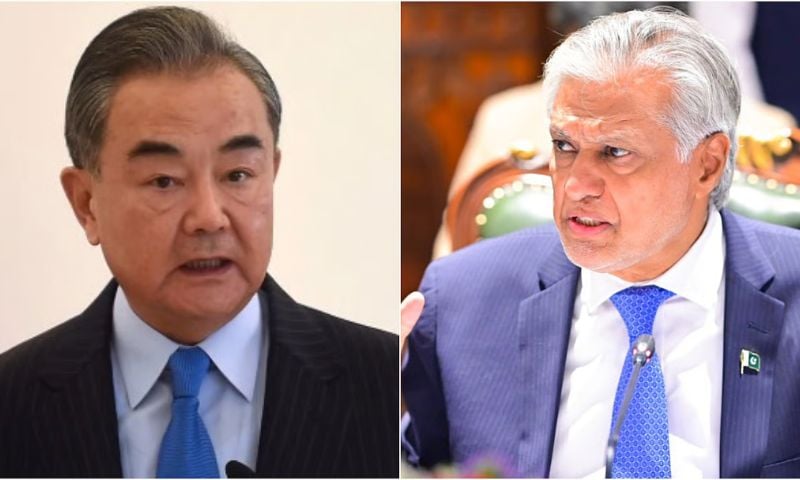
ISLAMABAD: Pakistan’s Deputy Prime Minister and Foreign Minister Ishaq Dar held a telephone conversation on Monday with Chinese Foreign Minister Wang Yi, during which Beijing reaffirmed its continued support for Islamabad’s “constructive” diplomatic efforts to resolve the US–Iran conflict.
The two leaders exchanged views on the recently concluded Islamabad Talks between the United States and Iran, Pakistan’s Foreign Ministry said.
Chinese Foreign Minister Wang Yi appreciated Pakistan’s “dedicated” efforts to promote peace and stability in the region.
Wang reaffirmed Beijing’s continued support for Pakistan’s “constructive” diplomatic role to end the conflict.
Dar reiterated Pakistan’s steadfast commitment to advancing dialogue and diplomacy as the preferred means to restore peace in the region.
Emphasising that dialogue and diplomacy remain the only viable path forward, both leaders discussed the Pakistan–China Five-Point Peace Initiative aimed at facilitating the peaceful resolution of issues.
They agreed to remain in close contact as Pakistan intensified diplomatic efforts to resume dialogue after the high-stakes Islamabad Talks over the weekend.
Deputy Prime Minister/Foreign Minister Senator Mohammad Ishaq Dar @MIshaqDar50 held a telephone conversation today with the Foreign Minister of the People’s Republic of China, Wang Yi.
The two leaders exchanged views on the recently concluded Islamabad Talks and the direct… pic.twitter.com/Hux8AkXzUs
— Ministry of Foreign Affairs – Pakistan (@ForeignOfficePk) April 13, 2026
Pakistan emerged as a key mediator in the US-Iran war after PM Sharif mediated a two-week ceasefire between Washington and Tehran on April 8.
Delegations from Washington and Tehran then arrived in Islamabad and held negotiations for over 20 hours at PM Sharif’s invitation over the last weekend. However, the negotiations could not result in a final agreement despite progress.
Meanwhile, Chinese Foreign Ministry spokesperson Lin Jian said that the US-Iran talks in Islamabad was a step towards de-escalation.
“China hopes the ceasefire will be kept, disputes will be resolved through political and diplomatic means rather than reigniting the flames of war, and conditions will be created for an early return of peace to the Gulf,” the spokesperson stated.
The U.S.-Iran negotiation in Islamabad was a step towards de-escalation. China hopes the ceasefire will be kept, disputes will be resolved through political and diplomatic means rather than reigniting the flames of war, and conditions will be created for an early return of peace… pic.twitter.com/VDU95i8jfW
— Lin Jian 林剑 (@SpoxCHN_LinJian) April 13, 2026
Pakistan continues ‘full efforts’ to end US-Iran conflict
Meanwhile, Pakistan’s Prime Minister Shehbaz Sharif said on Monday that Islamabad remains fully engaged in diplomatic efforts to resolve issues between the US and Iran.
“Today, the ceasefire still stands. As I am talking to you, matters that are not resolved, full efforts are underway to resolve them,” PM Sharif said in a televised address to the federal cabinet.
Calling the engagement a “historic moment”, PM Sharif said the Islamabad Talks offered an opportunity to transform rising tensions into lasting peace.
He added that Pakistan’s efforts had helped sustain the ceasefire, while work continued to bridge remaining differences.
PM Sharif also said Pakistan’s mediation came at a critical time when the global economy was under strain due to the conflict, allowing Islamabad to contribute positively to regional stability.
اسلام آباد: 13 اپریل 2026.
وزیرِ اعظم محمد شہباز شریف کی زیرِ صدارت وفاقی کابینہ کا خصوصی اجلاس آج اسلام آباد میں منعقد ہوا.
وزیرِ اعظم نے وفاقی کابینہ کے اجلاس میں خطے کی صورتحال اور پاکستان کی امن کیلئے کوششوں کے حوالے سے گفتگو کی.
وفاقی کابینہ نے اتفاقِ رائے سے قرارداد… pic.twitter.com/l5IWmtKa5g
— Prime Minister’s Office (@PakPMO) April 13, 2026
US-Iran talks in Islamabad
Pakistan-mediated talks between the US and Iran concluded in Islamabad on Sunday after more than 21 hours of intensive negotiations, with all sides signalling that diplomatic engagement would continue.
Following the talks, Pakistan urged both countries to maintain a “positive spirit” and uphold the ceasefire.
Pakistan’s Deputy Prime Minister and Foreign Minister Ishaq Dar reaffirmed Islamabad’s commitment to facilitating dialogue, stressing that diplomacy must continue despite the absence of a breakthrough.
“We hope that the two sides continue with the positive spirit to achieve durable peace and prosperity for the entire region and beyond,” Dar said, adding that adherence to the ceasefire remained critical.
He said Pakistan would remain actively engaged in supporting future negotiations between Washington and Tehran.
‘Final and best offer’
US Vice President JD Vance said the talks were substantive but fell short of an agreement.
“We’ve made very clear what our red lines are… and they have chosen not to accept our terms,” he told reporters in Islamabad.
Vance said Washington had presented what it described as a “final and best offer” and would await Iran’s response.
He reiterated that the US objective remained ensuring that Iran does not develop nuclear weapons or the capability to rapidly acquire them.
“We need to see an affirmative commitment… not just now, but for the long term,” he said.
Iran emphasises ‘good faith’
Iranian Parliament Speaker Mohammad Bagher Ghalibaf struck a cautiously constructive tone following the talks, saying Tehran had entered negotiations in good faith but remained sceptical due to past experiences.
“Before the negotiations, I emphasised that we have the necessary good faith and will, but… we have no trust in the opposing side,” he said in posts on X.
He said Iranian officials had presented forward-looking proposals.
Ghalibaf also expressed appreciation for Pakistan’s role in facilitating the engagement, thanking the country for its efforts.