Key Points
- Project targets storage of over 1 million tonnes of CO₂ annually while enhancing gas recovery
- Initiative integrates carbon capture, utilisation and storage (CCUS) into offshore production systems
ISLAMABAD: China has launched its first offshore carbon injection project in Hainan province, marking a major step in Carbon Capture, Utilisation and Storage (CCUS) technology within marine energy operations.
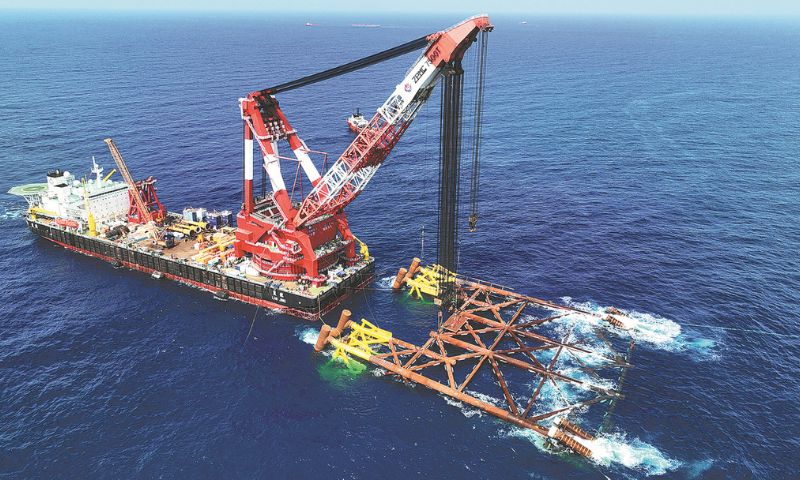
The project, led by China National Offshore Oil Corporation (CNOOC), has begun construction at the Dongfang 1-1 gas field in the Yinggehai Sea region. It marks the country’s first offshore system where carbon dioxide is directly reinjected into underground reservoirs linked to gas production.
Carbon injection, in simple terms, refers to the process of capturing carbon dioxide produced during energy extraction, compressing it into a dense form, and then storing it deep underground in geological formations such as depleted gas reservoirs.
In offshore settings, this also enables the use of gas in extracting additional natural gas trapped in the reservoir, improving overall recovery.
According to official project details, the system is designed to capture carbon dioxide generated during gas production, purify and compress it, and inject it back into subsea formations beneath the gas field. This dual function reduces emissions entering the atmosphere while enhancing the efficiency of natural gas extraction.
Once fully operational, the project is expected to store more than 1 million tonnes of carbon dioxide annually in offshore geological structures, making it one of the largest marine-based carbon storage initiatives currently under development in the region.
The initiative integrates carbon management directly into offshore production systems, reducing the need for separate onshore handling facilities and improving operational efficiency in high-carbon gas fields.
The project is part of a broader CCUS framework being developed by China to support both energy security and emissions reduction, particularly in sectors where decarbonisation is technically difficult.
Industry analysts describe the Hainan development as a key step in scaling CCUS from pilot applications to full industrial deployment in offshore environments, where engineering complexity and costs are significantly higher than onshore projects.
Aligned with China’s long-term climate strategy to peak emissions before 2030 and achieve carbon neutrality by 2060, the project reflects a growing focus on embedding emissions control technologies directly into upstream energy production.
With offshore operations now underway, the Hainan initiative signals a broader shift in China’s energy sector toward integrating carbon management as a standard component of oil and gas development.